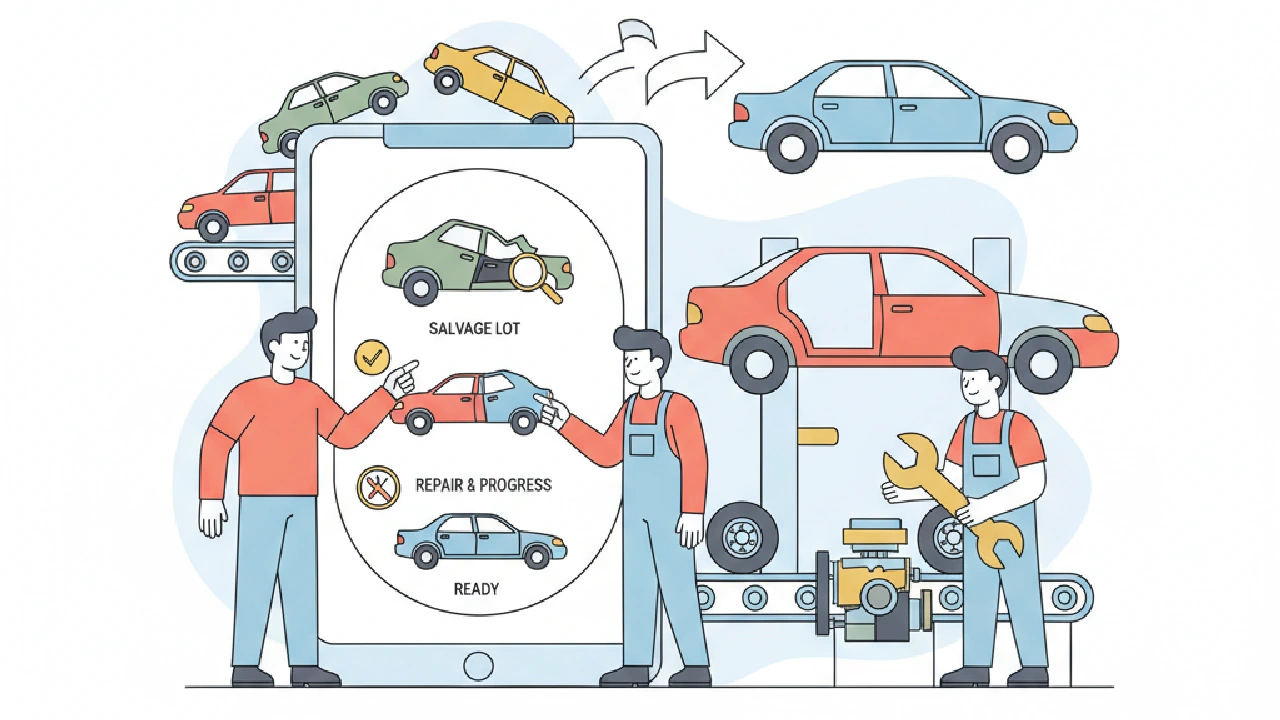
To make real money flipping salvage vehicles, you need a system. It's not about luck; it's about precision. That means knowing exactly what you're bidding on, what it'll cost to fix, and what you can sell it for. A robust watchlist is your central hub for this, keeping you organized from auction day to final sale.
A solid watchlist does more than just show you upcoming auctions. It helps you manage potential buys, track repair status, and stay on top of your inventory. Think of it as your battle plan for every vehicle.
Mastering Your Watchlist: From Bid to Buy
Your watchlist isn't just a list of interesting cars. It's where your profit starts. Every vehicle on it needs a clear purpose and a detailed plan. If you're not tracking key metrics here, you're leaving money on the table.
Max Bid Strategy
This is non-negotiable: never bid without your max bid calculated. Your max bid isn't a guess; it's a formula. Start with your target ARV – what you realistically expect to sell the car for. Subtract your repair estimate, buyer fees (Copart/IAAI fees are complex, factor them in precisely), transport costs, and your desired profit margin. What's left is your absolute max bid. The AutoFlip Pro intelligent max bid calculator helps you dial this in by providing market value estimates based on comparable listings and allowing you to input repair costs and target profit margins.
For example, you spot a 2018 Honda Civic with light front-end damage. Similar clean-title Civics are selling for $15,000 (ARV). You estimate $2,500 in parts and labor. Buyer fees might be $700, transport $300. You want a $3,000 profit. Your max bid is: $15,000 (ARV) - $2,500 (repairs) - $700 (fees) - $300 (transport) - $3,000 (profit) = $8,500. Don't go a dollar over.
Title Traps and Risk Management
Not all salvage titles are created equal. Some are straightforward, like a theft recovery with minimal damage. Others, like flood titles or vehicles with structural damage, are profit killers or hard sells. AutoFlip Pro's risk level calculation flags these immediately by analyzing factors like title type and sales history. Only bid on titles you understand and can confidently re-title in your state. A clear title conversion path is crucial. If there's any doubt, pass. The risk isn't worth the potential headache or financial loss.
Tracking Repair Progress: Stay on Schedule
Once you win a lot, the clock starts ticking. Every day a car sits, it's costing you money. Your Auctions Watchlist, especially when upgraded to the Pro plan with its Portfolio pipeline, should evolve beyond just bidding – it becomes your repair management tool.
Estimating and Sourcing Parts
Accurate repair estimates start with a detailed damage assessment. AutoFlip Pro retrieves and organizes listing images, helping you in this assessment. Don't just guess. Factor in parts cost (new vs. used, OEM vs. aftermarket) and labor. Keep a running tally within your watchlist entry. Start sourcing parts immediately after purchase – don't wait for the car to arrive. Back-ordered parts can delay your flip for weeks, eating into your profit. Utilize AutoFlip Pro's Parts Inventory (Pro plan) and Vendors List (Pro plan) to manage part numbers, vendor details, and estimated delivery dates.
Repair Timeline and Milestones
Break down the repair process into clear milestones: In Transport, Delivered, First Inspection, In Repair, Final Inspection, Listed, Sold, Holding. These align with AutoFlip Pro's 8-stage flip pipeline in the Portfolio feature. Update these statuses. This gives you a quick visual on where each vehicle stands and helps you identify bottlenecks. If a car is stuck at "Waiting Parts" (a repair task status in AutoFlip Pro) for too long, you know to chase down that vendor.
Post-Repair: From Ready to Sell
The repair is done. Now it is time to move it. Just like your acquisition and repair phases, your selling process needs structure. Clear out the clutter and get that vehicle listed on your preferred platforms.
Listing and Sales Tracking
After a thorough final inspection, your vehicle is ready for sale. Update its status in your AutoFlip Pro Portfolio to "Listed." This helps you keep a clear view of what's actively for sale versus what's still in repair or transport. Good photos and a detailed description are essential. Highlight the repairs made and any unique features. Once sold, mark the vehicle as "Sold" in your Portfolio to complete the flip workflow. This provides valuable data for future analyses and helps refine your profit projections.
Before You Bid… Check This:
- Your Max Bid: Is it calculated precisely, factoring in ALL costs and your target profit? If not, recalculate.
- Title Type & Sales History: Have you checked for red flags like multiple "Sold" entries or problematic titles? Review AutoFlip Pro's risk score for a quick assessment.
- Parts Availability & Cost: Have you estimated repair costs accurately and identified potential parts sourcing challenges?
- Transport Logistics: Do you have a clear plan for moving the vehicle after purchase, and are transport costs factored into your max bid?
- Storage Costs: Are you accounting for any daily storage fees at the auction yard or your facility while awaiting repair?
Key Takeaways
- Always calculate your maximum bid using a precise formula, factoring in ARV, repair costs, fees, transport, and target profit. Don't overbid.
- Thoroughly assess title types and sales history to avoid high-risk vehicles that can lead to financial losses.
- Streamline your repair process by breaking it into manageable stages and proactively sourcing parts.
- Use a dedicated system like AutoFlip Pro's Portfolio to track vehicles from bid to sale, ensuring no steps are missed and maximizing your profit potential.
- Don't overlook the details: transport, storage, and administrative costs erode profits if not accounted for.
FAQ
What is the most crucial step before bidding on a salvage car?
The most crucial step is to perform a comprehensive analysis of the vehicle, including estimating its clean market value, repair costs, and potential profit margin. This allows you to calculate an accurate maximum bid. AutoFlip Pro helps by calculating your max bid based on these factors, so you never have to guess.
How can I avoid buying a salvage car with hidden problems?
Hidden problems often surface through a vehicle's history or title. Always check the sales history for multiple "Sold" entries and carefully review the title type. Salvage Title History Red Flags can indicate underlying issues. AutoFlip Pro assists with this by providing a risk level calculation that considers these factors, helping you identify problematic lots before you bid.
What's the best way to manage repairs for multiple salvage vehicles?
Managing repairs efficiently for multiple vehicles requires a structured approach. Break down the repair process into distinct stages and track the progress of each vehicle individually. AutoFlip Pro's Pro plan includes a Portfolio feature with an 8-stage flip pipeline and repair task tracking, allowing you to monitor vehicles from "In Transport" to "Sold" and keep parts organized across your inventory.
Can I share my vehicle analysis with a partner or mechanic?
Yes, AutoFlip Pro allows you to share your detailed vehicle analysis. On the analysis detail page, you can generate a read-only link that displays vehicle and lot details, market values, risk score, and your calculated max bid. This makes collaboration easy and transparent.
How does AutoFlip Pro help with inventory management for parts?
The Pro plan includes a Parts Inventory feature that lets you track reusable parts across your vehicles. This helps you manage available, reserved, and unavailable parts, preventing unnecessary purchases and ensuring you have the right components when needed for repairs. You can also link parts to specific vehicles in your Portfolio.