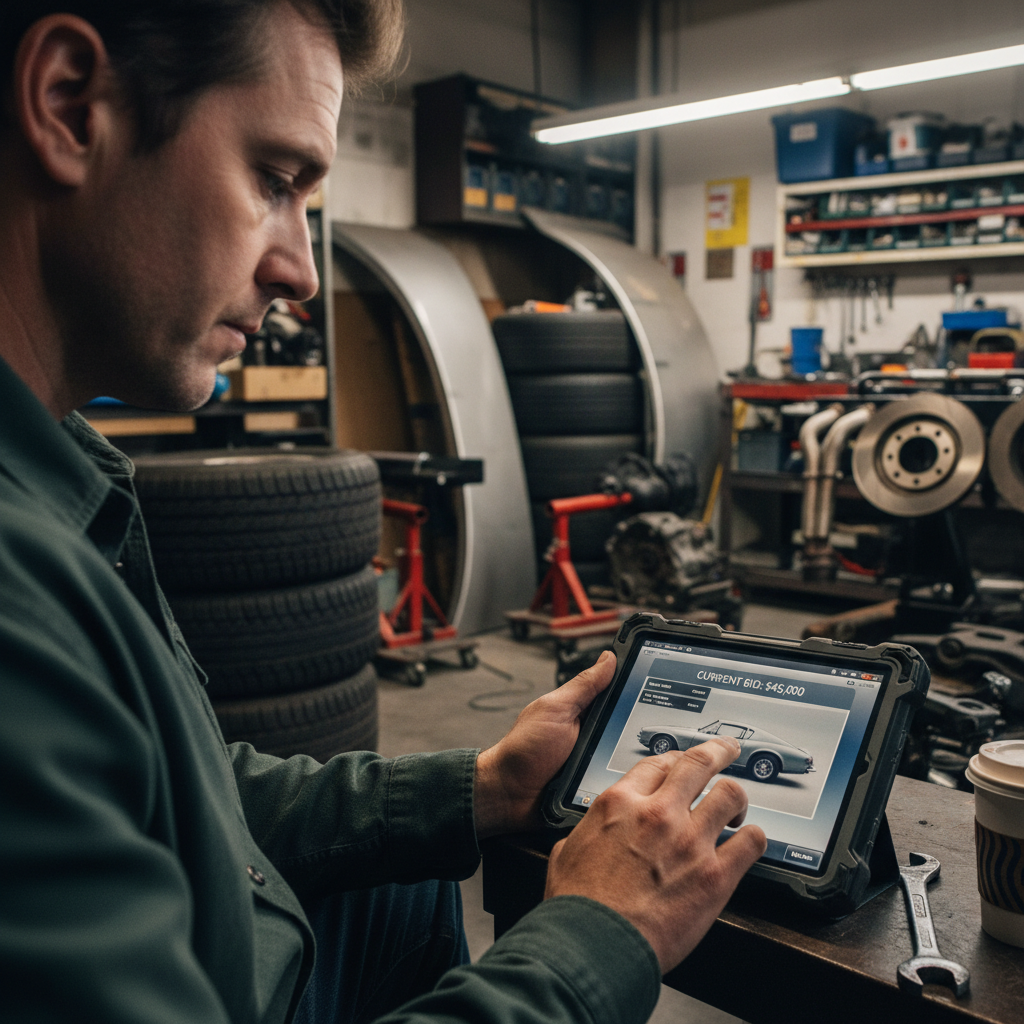
You’re staring at an auction listing. It’s a late-model sedan with some heavy front-end damage, but the mileage is low and the interior looks spotless. The current bid is laughably cheap, and your mind starts racing. “I could fix that for a few grand and easily double my money.”
Hold on. Before you get swept up in the adrenaline of the auction, you need to ground yourself in reality. That reality is built on one thing: accurate salvage car comps. Misjudge the value or underestimate the costs, and that "great deal" quickly becomes a very expensive lawn ornament that drains your bank account. Getting the numbers right isn’t just part of the process; it’s the only thing that separates professional flippers from hobbyists who consistently lose money.
This is your pre-auction checklist for getting the math right. We’re not talking about wishful thinking. We’re focused on a repeatable system for finding reliable comparable sales, calculating your maximum bid down to the dollar, and spotting the hidden risks that rookies miss.
What Are "Comps" and Where Do You Find Them?
In real estate, "comps" are recent sales of similar houses in the same neighborhood. In car flipping, the principle is identical. You’re looking for what a clean-title version of the exact car you’re bidding on would sell for in your local market. This number is often called the Clean Market Value (CMV) or After Repair Value (ARV). It’s the bedrock of your entire calculation.
Finding accurate comps is a mix of art and science. Here’s where professionals look:
- Public Listing Sites: Facebook Marketplace, Craigslist, and OfferUp are treasure troves of local market data. Search for the same year, make, model, and trim. Pay close attention to mileage and condition. Ignore pristine, low-mileage dealer listings and focus on private-party sales that are similar to what yours will be.
- Retail Sales Data: Sites like Kelley Blue Book (KBB) or Edmunds can provide a general baseline, but always take their "private party" values with a grain of salt. They are often inflated and don’t reflect the nuances of a local market.
- Auction Sales History: This is the gold standard but can be hard to access. Many platforms lock this data behind subscriptions. It tells you what dealers are *actually* paying for similar cars, which is often a more realistic indicator of value than public asking prices.
Manually gathering this data from multiple sites is tedious and prone to error. To streamline this, analysis platforms can do the heavy lifting. For instance, AutoFlip Pro’s analysis process automatically estimates the Clean Market Value by pulling comparable listings in your area, defined by the zipcode in your settings. This gives you a data-backed starting point instead of a wild guess.
Deconstructing the Max Bid Formula: Every Dollar Counts
Once you have a reliable Clean Market Value, you can work backward to find your maximum bid. The formula looks daunting, but each piece is a critical defense for your profit margin.
Max Bid = CMV - Title Discount - Repair Costs - Transport - Auction Fees - Target Profit - Risk Adjustment
Title Discount
A salvage or rebuilt title will always be worth less than a clean one. The discount varies by state and vehicle type but typically ranges from 20% to 40% off the Clean Market Value. For a car with a $20,000 CMV, a 30% title discount instantly chops $6,000 off its final retail value.
Repair Costs
This is the biggest variable and the easiest place to lose your shirt. Get detailed estimates for parts and labor. Call your body shop guy. Check prices on parts online. If the car doesn’t start, assume the worst. A "Runs & Drives" verification from the auction is a good sign, but it’s no guarantee. Always add a 15-20% buffer for unexpected issues—a cracked sensor, a hidden wiring problem, or a bent frame section the initial photos didn’t show.
Transport and Fees
Don’t forget the cost of getting the car from the auction yard to your shop. Then there are the auction fees themselves, which can add hundreds or even thousands to your purchase price. A detailed guide on understanding car auction fees can help you anticipate these costs accurately. They are a percentage of the sale price, so a higher bid means higher fees.
Target Profit & Risk Adjustment
Decide your non-negotiable profit before you even look at the bid button. Whether it’s $2,000 or 25% of the vehicle’s value, set it and stick to it. The risk adjustment is a buffer for non-repair issues. Does the car have a flood title? A history of being sold and resold? These factors increase risk and should reduce what you’re willing to pay. A robust platform automatically handles this; for example, AutoFlip Pro’s Max Bid Calculator integrates your pre-set profit margin and a risk adjustment factor directly into its calculations, ensuring you don't have to remember it in the heat of the moment.
Title Status and Sales History: The Silent Profit Killers
Not all salvage is created equal. A simple side-swipe that triggered an airbag is a world away from a car that was submerged in a hurricane. This is where you have to become a detective, and the vehicle’s history is your primary evidence. Newbies get excited about the car; pros get obsessed with its past.
The two biggest red flags are title type and sales history:
- Problematic Titles: Beyond a standard "Salvage" title, look out for "Junk/Parts Only," "Flood," or "Theft/Recovery." These titles come with significant warnings. A "Junk" title can often never be legally put back on the road. A "Flood" title scares away most buyers, even if the car looks perfect.
- Suspicious Sales History: A vehicle appearing at auction multiple times in a short period is a massive red flag. It often means another buyer purchased it, discovered a major hidden issue (like a bent frame or a catastrophic engine failure), and dumped it back at the auction to cut their losses. You could be buying someone else’s expensive mistake.
Manually checking for these issues on every car is a chore. This is where an automated risk assessment becomes invaluable. The Risk Level Calculation in AutoFlip Pro is designed specifically to catch these silent killers. It automatically penalizes a vehicle’s score for things like flood titles or, more importantly, a sales history showing multiple "Sold" entries, alerting you to a potential problem before you invest a single dollar.
Before You Bid on That Salvage Car, Check This:
- Your Numbers Are Set: Have you determined the Clean Market Value from local comps? Have you calculated your absolute maximum bid using the full formula? Don’t start bidding until you have this number.
- Repairs Are Estimated (with a buffer): Do you have a realistic parts and labor estimate? Did you add at least 15% for unexpected problems?
- Title and History Are Vetted: Did you confirm the title type and check for any warnings? Have you analyzed the sales history for red flags like multiple previous sales?
- Profit Is Locked In: Is your target profit already subtracted from your max bid? Your profit should be guaranteed before the auction even starts.
- Emotion Is In Check: Are you prepared to walk away if the bidding exceeds your max bid by even one dollar? The easiest way to lose money in this business is to get into a bidding war. Stick to the math.
Whether you’re just starting or looking to scale, a rigorous, repeatable process is your best asset. If you find yourself juggling spreadsheets and browser tabs, it might be time to centralize your workflow. You can run a free Copart lot analysis with AutoFlip Pro to see how an automated system pulls all this data—market value, risk factors, and max bid—into a single, clear dashboard.
Key takeaways
- Start with Local Comps: Never bid without first establishing the Clean Market Value (CMV) based on comparable private-party sales in your specific area. National averages are misleading.
- Your Max Bid Is Non-Negotiable: Calculate your maximum bid by subtracting all costs—repairs, transport, fees, title discounts, and target profit—from the CMV. Stick to this number no matter what.
- History Is More Important Than Damage: The vehicle’s title status and sales history often hide more risk than visible cosmetic damage. A car sold multiple times recently is a major red flag that other flippers have already rejected.
- Budget for the Unexpected: Always add a 15-20% contingency to your repair estimate. Hidden problems are a rule, not an exception, in the salvage business. This is a core part of learning how to flip cars profitably.
FAQ
What makes a good "comp" for a salvage car?
A good comp is a vehicle of the same year, make, model, and trim with similar mileage, sold by a private party in your local market. The goal is to find the value of a clean-title equivalent to accurately set your ARV, which is the starting point for all your profit calculations.
Why is a "Runs & Drives" status at auction unreliable?
“Runs & Drives” only guarantees the vehicle started and could be put into gear at the auction yard. It does not mean the engine is healthy, the transmission is sound, or that it can be safely driven on the road. It’s a positive sign, but it’s not a substitute for a thorough inspection or a higher repair buffer for a car you can't inspect yourself, a key lesson in any car auction beginners guide.
How does location affect my max bid?
Location impacts your bid in two major ways: the Clean Market Value and transport costs. Vehicle values vary significantly by region (e.g., a 4x4 truck is worth more in Colorado than in Florida). Secondly, the distance from the auction yard to your shop determines your transport cost, which must be subtracted to find your true max bid.
How can I track multiple salvage vehicles I'm interested in?
Efficiently tracking multiple vehicles requires organization. Instead of scattered notes or spreadsheets, using a dedicated tool is key. AutoFlip Pro offers an Auctions Watchlist where you can save every analysis you run. It centralizes vehicle details, auction dates, and risk levels, allowing you to manage your potential bids from one screen without losing track of critical information.
What's the single biggest mistake new flippers make with comps?
The biggest mistake is using a national, clean-title retail value (like from a dealer’s website) as their starting point. This number is almost always inflated and doesn’t account for the salvage title discount or local market conditions, leading them to drastically over-estimate the ARV and overpay at auction.