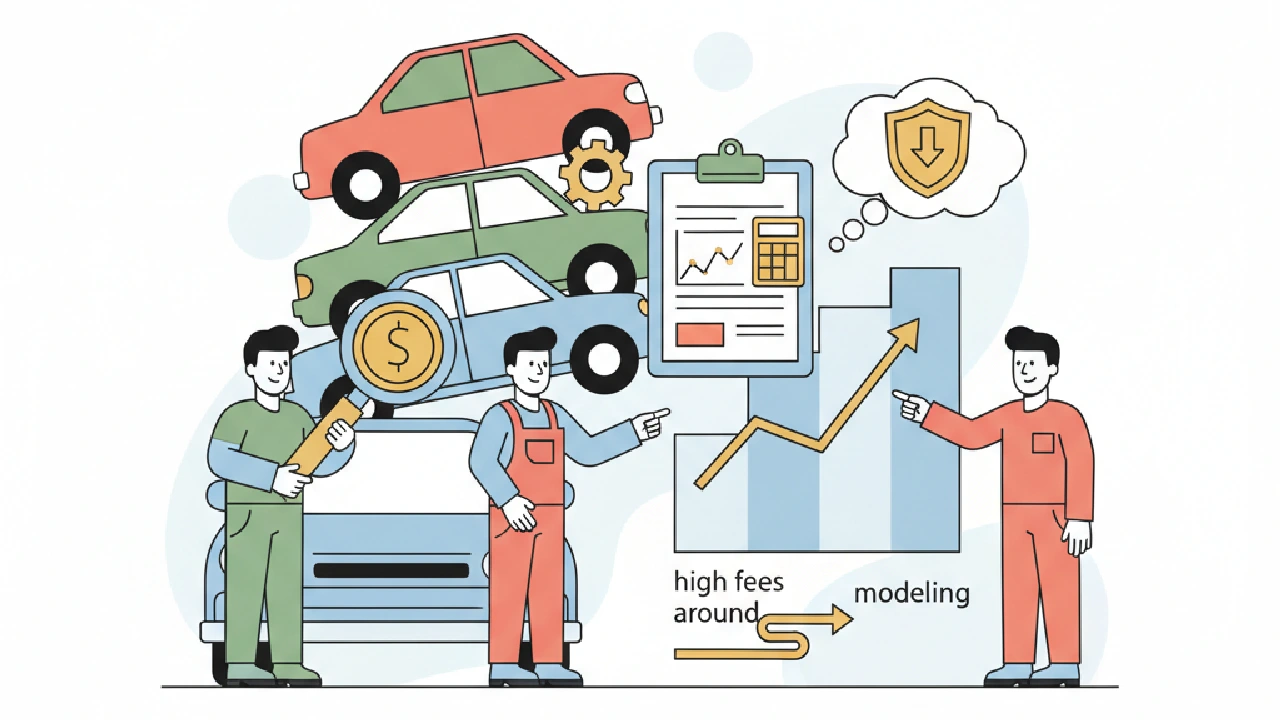
why are copart fees so high is the first question you ask when the invoice arrives and the winning bid looks tiny next to the final bill. Copart’s model layers fees on top of the winning bid. That stacked, tiered pricing often adds 20–30% to the purchase price. If you don’t model those layers up front, you’ll overpay or lose money on thin-margin cars.
Core idea — fees are a stack, not a single line item
Think of Copart fees like a sandwich: bidding fee, title/administration fees, storage, relist penalties, broker costs, and transport. Each line can look small alone; together they chew into your spread. The platform’s pricing is intentionally layered, which is why small cars get hit harder — the same fixed or minimum fees are a larger share of a low bid. If you want a pre-bid checklist for spotting those leak points, see our guide to analyze a Copart or IAAI lot before you bid.
1) Max-bid math you can actually use
Don’t guess. Use a simple template every time you evaluate a lot:
- ARV (after-repair value) — a conservative number you can realistically sell at in your comp radius.
- Repairs — a realistic shop estimate, not optimistic DIY guesses. See our salvage auction repair estimate for pre-bid repair math.
- Fees — budget for 20–30% of the purchase price to cover the layered Copart fees unless the listing shows lower specific fees.
- Broker — if you need one, use $250–$300.
- Transport — use $300–$600 until you have a firm quote.
- Other costs — inspection $25 per visit; storage $50–$100/day after the free window; relist/renege exposure $600 or 10% of the vehicle value.
- Target profit — your minimum spread to bother doing the flip.
Put that into a one-line formula (order only):
Max bid = ARV - Repairs - (Fees 20–30% of bid) - Broker ($250–$300) - Transport ($300–$600) - Target profit
Don’t try to squeeze numbers tighter than those ranges until you have a transport quote and a shop estimate. The 20–30% fee assumption is your buffer for the Copart stack. For a worked example on setting your limit, see how to set your Copart max bid without overpaying.
2) Title risk and spread — know what you can't fix cheaply
Titles kill deals faster than dents. Some lots have salvage titles, some have clean titles with title brands, and some list title-related fees on top of bids. If title paperwork is messy, factor that into repairs or a clean-title conversion cost. Copart charges title-related fees on top of the bidding fee. If you can’t flip the title quickly in your state, increase your buy-side discount.
Spread matters more than absolute price. A $4k car with a thin spread is far riskier than an $8k car with the same dollar profit. For low-dollar cars, the fixed pieces (broker, inspection, minimum bidding fees) eat a bigger share of your margin.
3) Repairs vs. opportunity cost — pick fights you can win
Salvage auctions lure you with low bids, but repairs are not just parts and labor — they’re the time, rework, title work, and unexpected shop finds. Use a conservative repair estimate. If a car needs more than cosmetic or simple mechanical work, demand a larger gap between ARV and bid.
Don’t over-index on an assumed parts bargain. If your comps are thin in your comp radius, price pressure will reduce your ARV. That’s where the fee stack becomes decisive: when fees add 20–30% of the purchase price, the margin for repair surprises disappears fast. For a full pre-bid approach, see our piece on how to analyze a salvage auction lot like a pro before you bid.
4) Operational speed: booking transport and avoiding storage
Copart’s storage is punitive for missed windows. Storage can hit $50–$100/day after the free pickup window — not a rounding error if you’re dealing with cars under $5k. Book transport before you pay when you can; quotes will usually fall in the $300–$600 range. If you need a broker to bid, include their $250–$300 fee in the decision.
If you can pick up same-day or within the free window, you remove a big line-item risk. If not, treat storage as a live daily drain that compounds your holding cost and can flip a winner into a loser quickly.
Mini-case: the $4k car you thought was a steal
Scenario: you win a car at a $4k bid. Copart’s layered fees often add 20–30% of the purchase price. Also account for broker ($250–$300), transport ($300–$600), inspection ($25), and potential storage at $50–$100/day. Relist/renege exposure can be $600 or 10% of the vehicle value.
What this means in practice: do not assume the invoice will be the bid plus a small admin fee. Model the 20–30% fee layer, add the broker and transport ranges, and assume at least one-day storage risk if you can’t lock pickup. If your repair estimate is uncertain, walk away or lower your max bid aggressively.
Practical bidding rules I use on auction day
- Never bid to your ARV. Always bid to your ARV minus the full fee stack and a conservative repair buffer.
- Use the 20–30% rule for Copart fee layers until you can see lot-specific fees on the listing.
- If you’ll need a broker, add $250–$300 to your model right away; treat it as non-negotiable.
- Get a transport quote before payment. Use $300–$600 if you can’t get a firm quote before bidding.
- If title work looks messy or the listing shows extra title fees, knock down your max bid further or skip the lot.
Where a salvage flip tool helps
Before you bid, remove guesswork by checking VIN/lot analysis, a max-bid calculation, and a risk score so the fee stack becomes a predictable number, not a surprise. AutoFlip Pro pulls VIN or lot details, estimates market value and repair costs, runs a risk level that highlights sales-history/title red flags, and calculates a max bid that includes fees and transport — so you can see whether the 20–30% Copart stack kills the spread. Try a free lot analysis to analyze a Copart lot free before you bid.
Key takeaways
- Assume Copart’s fee stack will add 20–30% to your purchase price unless the lot shows specific lower fees.
- Include broker ($250–$300) and transport ($300–$600) in your max-bid math before you bid.
- Storage ($50–$100/day) and relist exposure ($600 or 10% of value) can kill margins fast — book transport and plan pickups.
FAQ
Are Copart fees a fixed percent?
No. They are tiered and layered. The common planning rule is to budget for a 20–30% fee stack on top of the winning bid for many salvage buys.
Do I always need a broker?
If you’re unlicensed or remote, you often do. When you do, factor a broker fee in the $250–$300 range into your decision.
How should I handle missed pickup or storage risk?
Treat storage as a real daily cost. Industry notes show storage can be $50–$100/day after free pickup. Lock transport first and plan pickup to avoid that daily drain.
What’s the riskiest hidden fee?
Relist/renege penalties are brutal compared with margins. The research shows relist exposure at $600 or 10% of vehicle value. Don’t bid unless you can pay and pick up within the posted windows.
Can I factor out fees by flipping quickly?
Speed helps, but you still pay the invoice fees. Quick flips avoid additional storage and holding costs, but the Copart fee stack and broker/transport bills are immediate and must be in your model.
Actionable checklist — what to do before you click "place bid"
- Run comps and set a conservative ARV for your comp radius.
- Get a shop repair estimate or use conservative repair assumptions.
- Model fees as 20–30% of the purchase price, then add broker ($250–$300) and transport ($300–$600).
- Check title notes and listed title fees. If messy, lower your bid or walk.
- Book transport before payment; confirm pickup window to avoid $50–$100/day storage.
- Only bid if your max-bid formula still leaves your target profit after all the above. For a step-by-step pre-bid checklist, consult the first salvage flip checklist.
Keep this sheet handy on auction day. Copart’s fees are not a mystery once you treat them as predictable line items and refuse to let them be surprises.