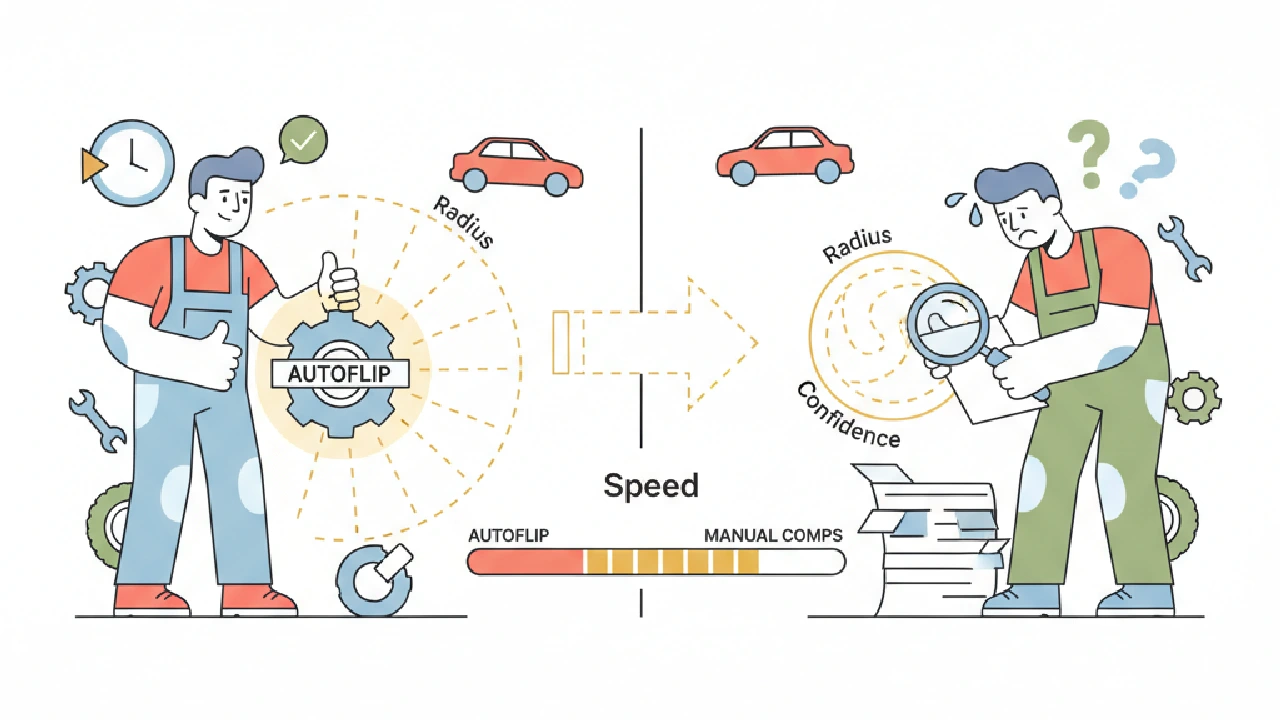
Knowing whether to trust an automated comp tool or dig through auction results yourself is the difference between a winning bid and a money pit. This isn't about "AI vs. human." It's about when to use which tool for what job. Automated systems like AutoFlip Pro are fast for first-pass filtering. Manual comp research gives you final valuation confidence, especially on edge cases. Combine both for the best results.
The Core Trade-off: Speed vs. Precision
The practical tradeoff is simple: an automated system is faster for first-pass filtering, while manual comps are still better for final valuation and edge cases. Automated systems can scan thousands of listings quickly, flagging candidates and red flags. They reduce the repetitive search work. This keeps rules consistent across high volumes.
Manual comps, however, give you full control. You judge condition, location, and market nuance. This is critical when comps are thin, rural, unique, or stale. The main risk with automation is missing subjective condition differences or unusual market context. Automated systems optimize for rule-based filtering, not human judgment. The main risk with manual comps is the time they take. They can be inconsistent between analysts and are more exposed to fatigue and missed data points.
Automated Strengths: Fast Filtering and Scale
Automated comp tools excel at initial screening. They can sort through a massive volume of auction inventory. This saves hours of browsing. For example, if you're looking for a specific year range of a Honda Civic with light front-end damage, an automated system can highlight all matches across multiple auctions instantly. It handles the initial heavy lifting, letting you focus on the most promising vehicles.
Automation also ensures consistency. Every listing gets evaluated against the same criteria. This reduces human error and bias in the early stages. For a high-volume flipper, this consistency is key to maintaining a predictable deal flow and avoiding emotional bids. AutoFlip Pro's market value estimation based on comparable listings provides this crucial consistency, offering a Clean Market Value and a Market Value Confidence rating.
Manual Strengths: Nuance, Condition, and Local Market
While automation handles the initial filter, manual comp research is non-negotiable for the final bid. Automated systems struggle with the subjective. They can't see the difference between "minor dent" and "needs full quarter panel replacement" as accurately as a human. They don't account for specific trim levels, options, or subtle repair costs that significantly impact After Repair Value (ARV).
Consider a 2018 Toyota Camry XSE. An automated system might pull comps for all 2018 Camrys. But if your target car is a low-mileage XSE with a premium package and the comps are mostly LE models with higher mileage, your ARV will be off. Manual review lets you adjust for these details. You can filter by exact trim, verify options from photos, and even spot regional preferences for certain colors or features. This level of detail directly impacts your max bid.
The Hybrid Workflow: Automation for Coverage, Manual for Pricing
For resale and flip work, the most effective workflow is a hybrid: use automated tools to find and rank listings, then manually verify recent, condition-matched comps before making an offer. An automated tool can quickly identify 50 potential vehicles from a a 5,000-vehicle auction. From those 50, you then dive deep.
For example, if an automated system flags a 2020 Ford F-150 with rear-end damage, your manual process kicks in. You'll pull specific comps for that F-150 trim and powertrain with similar damage from a 100-mile radius over the last 90 days. You'll analyze sold prices, factor in specific repair estimates for the damage shown, and compare that to your target ARV. AutoFlip Pro helps streamline this by automatically fetching vehicle data, calculating risk levels, and determining optimal maximum bid prices based on market values, repair costs, transport expenses, and your target profit margins. You can analyze a Copart lot free before you bid to see how it works.
Manual comps still matter most for the final decision because they let you adjust for repair cost, transport, seller risk, and local demand—factors automation typically only approximates.
Mini-Case: The Honda Civic Hatchback
Let
Key takeaways
- Automated tools provide unparalleled speed and consistency for initial filtering, helping you efficiently sort through large volumes of auction listings and identify promising candidates.
- Manual comparable research remains crucial for nuanced valuation, allowing you to account for subjective condition differences, specific trim levels, options, and local market preferences that significantly impact After Repair Value.
- Combining both approaches—using automation for broad coverage and initial ranking, then applying manual diligence for final pricing—creates the most effective workflow for profitable salvage title flipping.
- Accurately accounting for all costs, including repair, transport, and auction fees, is essential for determining a viable maximum bid, a process where an intelligent max bid calculator can be invaluable.
- Always verify critical factors like sales history and title type, as these can drastically alter a vehicle's risk profile and profitability.
FAQ
How does AutoFlip Pro estimate market value?
AutoFlip Pro uses a sophisticated algorithm to estimate the clean market value of a vehicle. It considers specifications like year, make, model, and trim, then cross-references this data with current market listings and comparable sales in your specified local area. This provides a data-driven estimate, complemented by a Market Value Confidence rating (High, Medium, Low) to help you gauge the reliability of the estimate.
Can AutoFlip Pro help me identify risky vehicles?
Yes, AutoFlip Pro is designed to calculate a comprehensive risk level for each vehicle. It scores potential purchases on a 0-100 scale, evaluating factors such as sales history (multiple "Sold" entries are a major red flag), verified insurance sellers (a positive indicator), and title type (e.g., Junk/Parts Only, Flood, or Salvage titles carry warnings and score deductions). This helps you quickly identify high-risk vehicles before investing further time.
What factors does AutoFlip Pro consider when calculating a maximum bid?
AutoFlip Pro's intelligent max bid calculator takes into account several critical factors to help you determine your optimal maximum bid. These include the estimated Clean Market Value, a Title Discount (if applicable), estimated Repair Costs, Transport Costs (based on your default destination), Auction Fees, your Target Profit Margin, and a Risk Adjustment derived from the vehicle's risk score. It helps ensure all potential expenses are factored into your bid strategy.
Is there a way to try AutoFlip Pro's analysis features without signing up?
Yes, AutoFlip Pro offers a free public lot analyzer at /try. Anyone can use it to get a full analysis, risk score, and maximum bid calculation for a Copart or IAAI lot without needing an account. This allows you to experience the platform's core analysis capabilities firsthand before committing to a subscription.
How does AutoFlip Pro help manage the post-auction process for Pro users?
For Pro plan subscribers, AutoFlip Pro provides a comprehensive 8-stage flip pipeline within the Portfolio feature. This helps you track vehicles from "In Transport" to "Sold," manage repair tasks (To Do, In Progress, Waiting Parts, Done), and even track parts orders (Not Ordered, Ordered, Shipped, Delivered). Additionally, the Parts Inventory and Vendors List features help you organize reusable parts and supplier contacts, streamlining your entire flipping operation.