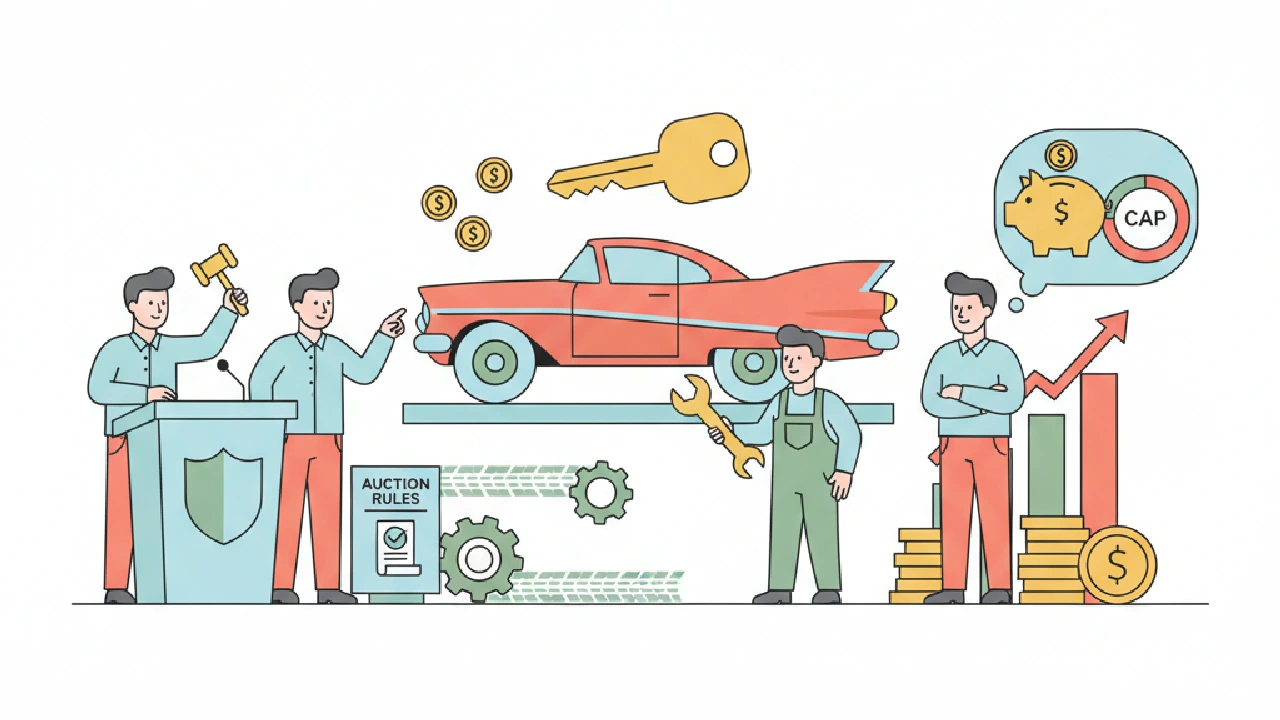
If you're in the car flipping business, you flip at auctions. This guide is a practical pre-auction briefing: short, no fluff. We cover max-bid math, title risk, buyer fees, repairs, licensing and taxes, and how much capital you actually need on hand. Read it like a checklist. Do the math before the hammer drops.
Core idea — buy low, fix right, obey the rules
The car flipping business is simple in concept: buy undervalued inventory, add minimal reconditioning, sell quickly. The hard part is the details. Auctions add predictable fees and delays. Titles add legal risk. Repairs eat margins. You win by running the numbers before you bid, and by knowing state-by-state rules on flipping cars and dealer/license thresholds.
1) Max-bid math — how to set a firm ceiling
Set your max bid before you click. Use a top-down formula and stick to it. Don’t chase. The formula is: target resale price (your ARV) minus desired profit minus all known costs (buyer fees, transport/inspection/reconditioning, repairs, sales fees, taxes).
You set your own ARV. The costs below are the ones you must subtract right now. Use these auction numbers as constants when you run your own ARV (and consult salvage car comps to set ARV).
- Buyer fees: Copart/IAAI buyer fees are usually hundreds of dollars per car (often roughly $200–$1,000+ before gate, virtual-bid, storage, and broker charges). Always confirm the lot fee calculator before you bid.
- Transport, inspection and reconditioning: plan for $300–$600 per car.
- Common repair work (brakes, tires, suspension): average repairs run $400–$700.
Concrete mini-case: add those line items together to get a reliable cushion. Example additive costs you must subtract from ARV: buyer fees $550 + transport/inspection/reconditioning $500 + repairs $600 = $1,650. Subtract that from your target resale price. The remainder is the maximum you can pay for the vehicle if you want that profit.
Don’t forget soft costs: listing fees, photos, small parts, and holding interest if you floor-plan. If you can’t cover those without stretching your margin, pass.
2) Title risk, holding periods, and licensing
Titles can kill a flip. Know the rules before you bid. Most states require a short holding period before resale — often 3–7 days. Some states require title transfer within 10 days. Failing to follow those rules costs you fines or worse. Treat title timing as a project constraint.
Watch for these traps:
- “Clean” auctions with unexpected salvage notations. If the vehicle’s history looks murky, walk.
- Title-by-mail delays. Some auctions and states use mailed titles or slow electronic transfers. That delay holds up your sale and your cash flow.
- Dealer vs. hobby thresholds. If you flip more than your state’s threshold of vehicles in a year, you may need a dealer license. Licensing changes your compliance and tax duties.
If you expect volume, consider a dealer license and bond. It simplifies repeat sales and tax handling. For a state-by-state walkthrough on brokerage and licensing options, see our how to become a Copart broker (state-by-state guide).
3) Fees, repairs, and the repair-first rule
Auction fees look small until you pile on transport and reconditioning. Those hidden costs now average $300–$600 per car. Repairs have also crept up. Common fixes average $400–$700. That changes what’s a good buy.
Fix the money-making items first: low-labor cosmetics, tires, fluids, and brakes move cars fast. Avoid cars with undefined electrical gremlins, major collision/frame damage, or engine failure you can’t prove how to fix. Labor shortages and parts inflation make long jobs expensive.
Practical rule: if a car needs more time in the shop than a week of regular labor, re-evaluate your numbers. Your working capital and turnover cost are tied to how long cars sit.
4) Taxes, bookkeeping and business structure
Taxes are not optional. Decide early how you will report flips. Set up simple bookkeeping now. Track purchase price, fees, repairs, transport, and sale price for every car. That data saves you headaches and reduces audit risk.
Sales tax and income tax vary by state and by whether you hold a dealer license. If you sell without a dealer license, you may still be required to collect or remit sales tax depending on local rules. If you worry about audit exposure, pick a formal structure (LLC or S-corp) and keep clean records. Talk to an accountant — but keep the books simple and timely.
Two bookkeeping items that matter more than entity type:
- Separate bank account for business cash flow. Never mix personal and flipping funds.
- Daily inventory list with VIN, lot number, buy price, fees, repair spend, and target resale price.
5) Capital planning — how much runway you need
Capital is not just the purchase price. It’s the buyer fee, transport/reconditioning, repairs, holding time, and taxes. Use the additive-cost example above to stress-test your bankroll.
Think in cycles. One car ties up cash until it sells. If your average additive costs are $300–$600 for transport/reconditioning and $400–$700 for repairs, that’s the cash you must have on hand even before the purchase price. If you flip multiple cars at once, multiply the buffer by your active-unit count.
Don’t rely on immediate resale. Titles and paperwork can slow you 3–7 days or longer. Plan for worst-case sight-holds or paperwork delays when you schedule payments to sellers and transporters.
Operations tips that keep margins intact
- Pre-check comps in a tight radius. Use auction MMR and regional comps, not national listing pages.
- Inspect the car yourself or hire a spotter — learn how to analyze a Copart or IAAI lot before you bid. Cosmetic photos lie. Mechanical problems hide behind clean exteriors.
- Bid with a calculator. If you go mental on the bid, you will pay retail prices in an auction mindset.
- Walk from emotional bids. If you find yourself arguing the car is “different,” stop. You are defending a number, not a dream.
Mini-check math recap (use these numbers as constants)
Use the listed auction constants for quick checks before you bid:
- Buyer fees: often $200–$1,000+ per vehicle (buyer fee alone; verify on the auction lot calculator).
- Transport/inspection/reconditioning: $300–$600 per car.
- Common repairs: $400–$700.
Example cost stack to subtract from your target resale price: buyer fees $550 + transport/reconditioning $500 + repairs $600 = $1,650. Subtract that from the ARV to get your max bid. That simple stack keeps you honest when the room gets hot.
Where a salvage flip tool helps
When you need a quick, objective second opinion, tools that run a VIN or lot analysis, calculate a max bid from market comps, and surface a risk score save time and catch title or sales-history red flags before you bid. Use those outputs only to check your numbers — they replace spreadsheet guesswork, not your judgment.
- Example outcome: a max bid calculator forces you to subtract fees, transport, repair estimates, and a profit margin before you bid.
- Example outcome: a risk score flags multiple prior “sold” entries or insurance-seller listings that would change your willingness to buy.
Try an analyzer to run a lot through those checks — for example, analyze a Copart lot free before you bid.
Key takeaways
- Do the max-bid math before you bid. Use realistic buyer fees (often $200–$1,000+) and add transport $300–$600 and repairs $400–$700 into the calculation — then verify fees on the lot calculator.
- Titles and holding periods matter. Many states require a 3–7 day hold and some demand title transfer within 10 days.
- Start simple with bookkeeping: separate bank account, VIN-level tracking, and receipts for every spend.
- Plan capital for add-on costs, not just the hammer price. Hidden costs compress margins faster than you think.
FAQ
Do I need a dealer license to flip cars?
It depends on volume and state rules. If you consistently sell above your state’s threshold, a dealer license makes compliance easier. If you stay below that threshold, track your sales carefully and be prepared to apply for a license if you scale up.
How should I handle sales tax when flipping cars?
Sales tax treatment varies by state and by whether you have a dealer license. Keep detailed records of purchase and sale transactions. Consult a tax pro for your state rules. Accurate receipts and timely filings reduce audit risk.
What’s the single biggest margin killer at auctions?
Unexpected repair time and transport/reconditioning costs. Those are the items that push a flip from profitable to a loss. Use the $300–$600 and $400–$700 ranges as your sanity check before you bid.
How much cash should I keep per car?
Plan for the additive costs first: buyer fees (often $200–$1,000+), transport/reconditioning $300–$600, and repairs $400–$700. Those are the immediate cash needs before you factor purchase price or taxes.
Which valuation tool should I trust for ARV?
Use auction-focused pricing tools and regional comps. Industry operators lean on MMR and regional auction comps for the most reliable, auction-to-resale margins. Cross-check with consumer guides to confirm retail expectations.
Actionable checklist — what to do before auction day
- Run the max-bid math for each vehicle: ARV minus (buyer fee + transport $300–$600 + repairs $400–$700 + desired profit) (see our step-by-step salvage flip process for order of operations).
- Confirm title type and expected transfer timeline in the lot details. If it’s unclear, skip the lot.
- Have cash or pre-approved transport scheduled. Transport and reconditioning now average $300–$600; don’t assume it’s free.
- Use a separate business bank account and log VIN, lot number, all costs, and target resale price immediately after purchase.
- If you plan volume, start paperwork for a dealer license and get an accountant lined up to set tax treatment correctly.
That’s the briefing. Bring the calculator. Bring patience. Don’t let an auction room mood overwrite your numbers.