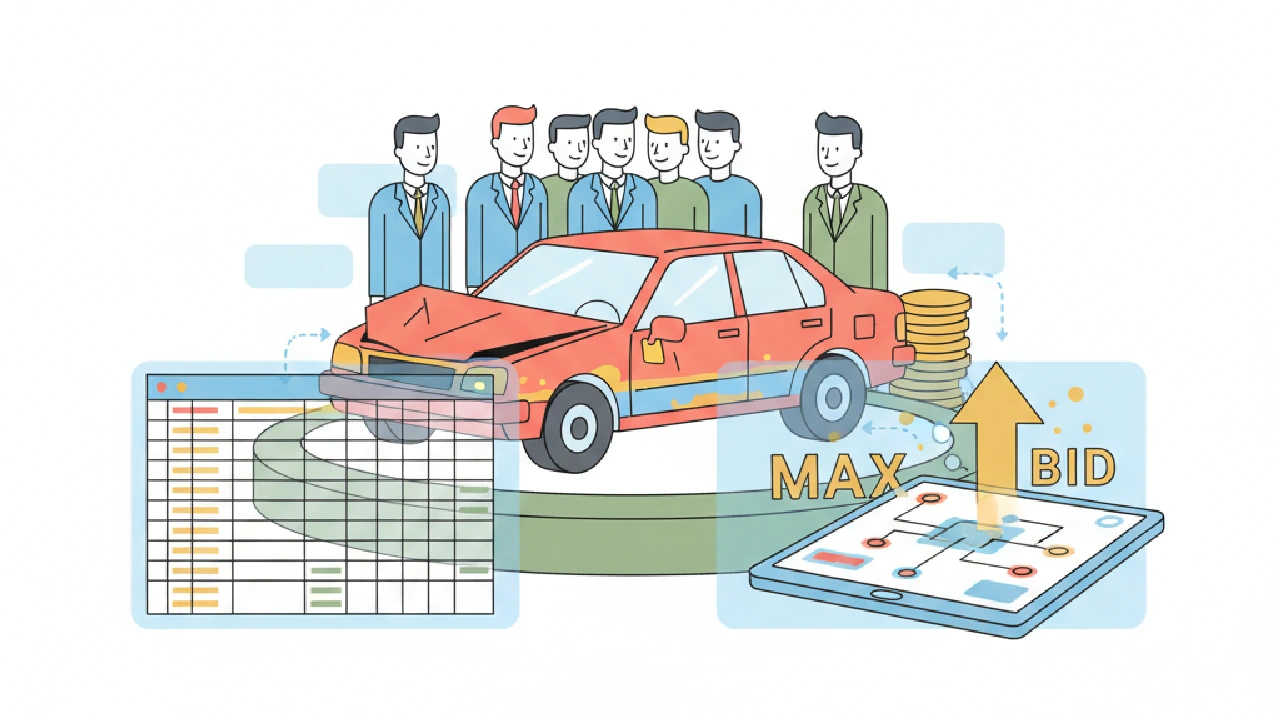
Auction day is coming, and we're not leaving money on the table. Forget those pretty pictures on Copart or IAAI. We're talking raw numbers, max bid math, and sniffing out the traps before they bite us. Whether you use some fancy AI or a battle-tested spreadsheet, the game is about accurate profit estimates.
A true salvage flip profit calculator needs to do more than just subtract buy from sell. That's a fast track to losing your shirt. We need to compute our maximum allowable offer by working backward from our expected resale value. Then, we subtract all-in costs: auction fees, transport, repairs, reconditioning, title/registration, holding time, and selling costs.
The Cold Hard Truth About Max Bid
Your max bid isn't just whatever you feel like paying. It's a hard number derived from your exit strategy. The formula is simple:
Max bid = Expected resale value − All other costs − Target profit.
If you don't know your "all other costs" inside and out, you're bidding blind. This isn't real estate where a 70% rule might give you a rough guide. Salvage cars are a different beast. Parts and labor can swing wildly. Bid competition can get insane. You need a more conservative cushion here.
Expected Resale Value: Don't Guess, Verify
This is your starting point. Don't pull numbers out of thin air. Look at retail comps in your local market. Not wholesale asks, not dealer pricing guides. What's that exact year, make, model, and trim selling for to a private party, fully reconditioned, right now? That's your "After Repaired Value" (ARV). Get it wrong, and your whole calculation is toast.
For example, if a clean 2018 Honda Civic EX with 80k miles sells for $15,000 all day in your area, that's your ARV. Don't convince yourself it's worth $17,000 because you saw one listed high. Stick to reality.
Edge Case: High-Demand Niche Vehicles. While generally you stick to market comps, certain vehicles like classic cars, rare sports cars, or highly modified trucks might command a premium. For these, deep dives into enthusiast forums, completed eBay auctions, and specialist dealer listings are crucial. Don't just look at boilerplate Kelly Blue Book values; they often miss the true market for these unique assets. Still, apply a healthy dose of skepticism and always aim for multiple data points.
Uncovering All the Costs: No Stone Unturned
This is where most beginners hemorrhage money. They only factor in the hammer price and maybe a quick repair estimate. Big mistake. Every dollar counts against your profit. Your salvage flip profit calculator needs to capture everything.
Auction Fees: The Silent Killers
Copart and IAAI have complex fee structures. Buyer fees, gate fees, internet bid fees, relist fees – it adds up fast. Get familiar with their fee schedules for your specific buyer type and state. It can easily be hundreds, sometimes even over a thousand bucks, on top of the hammer price. A calculator that only does buy vs. sell price is useless here; it's just a fee calculator with a different name.
Operator Angle: Understanding Licensure and Fees. Your buyer type dramatically impacts fees. Licensed dealers typically get lower fees than public buyers. If you're frequently buying, getting a dealer's license, even a limited one, could save you thousands annually. Also, always check for premium membership levels offered by the auction platforms. While they come with an upfront cost, they often reduce per-auction fees significantly, especially if you're buying multiple vehicles per month. Factor that membership cost into your overall business overhead, not just individual car costs.
Repair Estimates: Dig Deep, Multiply by Two
This is often the biggest variable. You need a solid estimate, broken down into parts, labor, paint/body, mechanical, and a hefty contingency. Frame damage, airbags, suspension components – these are profit eaters. Get quotes, or better better yet, have your trusted mechanic or body shop look at the photos/video before you bid. Then, add a 20-30% fudge factor for the inevitable surprises.
Let's say that 2018 Civic has front-end damage. Initial estimate from your guy is $3,000. Parts are $1,500, labor $1,000, paint $500. Add 25% contingency: $750. Total repair estimate: $3,750.
New Example: Water Damage (Flood Cars). These are notoriously tricky. While visual damage might seem minimal, corrosion can affect electrical systems, modules, sensors, and even internal engine components over time. A "fix" might just be a temporary solution, leading to callbacks and reputation damage. For flood cars, your "repair estimate" needs to heavily weigh the risk of hidden electrical issues. Often, these are best avoided by beginners unless you have a specialist who can rigorously inspect every wire harness and module. If you do consider one, factor in a contingency of 50-75% for electrical overhauls, or simply a much lower ARV due to ongoing risk, which heavily limits your max bid.
Operator Angle: The Importance of a Reliable Network. Your repair estimates are only as good as your mechanics and body shops. Cultivate strong relationships with trusted professionals who understand your business model. They should be able to provide quick, accurate, and competitive quotes based on auction photos and descriptions. A good shop will also point out potential hidden damage that might not be obvious to the untrained eye, like subtle frame kinks or compromised suspension points from a seemingly minor fender bender. This network is invaluable for minimizing surprises.
Parts Sourcing: New, Used, Aftermarket, or OEM?
The cost breakdown for repairs isn't just about the labor; it's heavily influenced by your parts strategy. Each option has its pros and cons:
- New OEM (Original Equipment Manufacturer): Highest quality, perfect fit, but most expensive. Often necessary for critical safety components like airbags or certain structural elements.
- New Aftermarket: Cheaper alternatives. Quality can vary wildly. Some aftermarket parts are excellent, others are poor copies. Research brands diligently.
- Used OEM (Salvage Yard Parts): Excellent value. Sourcing from a donor vehicle can save a fortune, especially for body panels, lights, or interior components. Be wary of hidden damage on used parts. Always inspect them thoroughly before purchase.
- Remanufactured: Common for engines, transmissions, and certain electronic modules. Offers a balance of cost and reliability, often with a warranty.
Your salvage flip profit calculator should allow for multiple parts scenarios. For instance, a cracked bumper cover might be an aftermarket piece, while a damaged headlight might require a used OEM assembly to ensure proper alignment and function. Failing to account for this nuanced approach to parts sourcing leads to either overestimating costs (missing good deals) or underestimating (eating into profit).
Transport, Storage, and Holding: Time is Money
How much to tow it from the auction yard to your shop? If you're waiting on parts, how many days will it sit, and what's that costing you in storage? Title and registration fees are also non-negotiable costs. If the car sits for two weeks waiting for a specific taillight from Japan, that's two weeks of potential storage fees and lost selling time.
New Example: Long-Distance Sourcing. Sometimes, the best deals are not local. You might find a gem hundreds of miles away. While the initial "deal" looks great, the transport costs can be astronomical. A cross-country tow could be $1,000 or more. You also need to factor in potential delays at pickup locations, especially if the vehicle is coming from a CAT (catastrophe) lot during hurricane season. These delays mean more storage fees at the auction yard, extending your holding time and impacting your cash flow. Always get firm transport quotes before bidding on out-of-state vehicles.
Edge Case: Specialized Transport Needs. Not all vehicles can be towed easily. A non-running luxury car might need a flatbed and specialized winching. A classic car might require enclosed transport. These specialized services cost more. Factor this in if you're dealing with high-value or unusual vehicles. Also, consider "inoperable fees" from auction houses if the vehicle doesn't start or drive, often incurring additional charges for loading.
Title Acquisition and Fees: The Paper Trail
Getting a salvage title processed and then converted to a rebuilt or clear title (depending on your state's regulations and the vehicle's damage history) is a critical step. Each state has different requirements, fees, and timelines. Some states are quick; others can take months. This directly impacts your holding costs and when you can legally sell the vehicle. Research your state's DMV/DOI procedures thoroughly for rebuilt title inspections and branding. Sometimes this even involves an anti-theft inspection. If a car comes with a "parts only" title or has issues with lien releases, it might never be street legal, making it only suitable for parting out – drastically altering its ARV and your max bid.
Exit Costs: The Final Bite
You're not just dropping it off at the buyer's house. You need to wash it, detail it inside and out (reconditioning). If you're selling on a platform, there are listing fees, final value fees, or commissions. Don't forget these. They can easily shave another few hundred dollars off your top line.
Operator Angle: Reconditioning vs. Detail. Reconditioning goes beyond a basic wash. It involves addressing minor cosmetic flaws that significantly impact perceived value. Think paintless dent removal (PDR) for hail damage, headlight restoration, interior stain removal, or even slight touch-ups to minor paint chips. While these aren't strictly "repairs," they enhance your ARV and justify a higher selling price, often with a much better ROI than major mechanical work. Your calculator should differentiate between basic cleaning and more involved reconditioning expenses.
New Example: Marketing and Advertising Spend. Unless you have a direct buyer, you'll spend money to market your vehicle. This includes professional photos, social media boosts, listing fees on platforms like Facebook Marketplace, Craigslist, or specific auto sales sites. If you're using a consignment dealer, their commission will be a major exit cost. Even just displaying the car somewhere visible might incur a small fee. Don't overlook these "soft" costs; they are essential for moving inventory efficiently.
Mini-Case: The 2018 Honda Civic EX Revisited
Let's put it all together with our example. We're aiming for a $2,000 profit on this specific flip. Max bid = Expected resale value − All other costs − Target profit.
Expected Resale Value (ARV): $15,000
All Other Costs:
- Auction Fees: (Let's assume you're a basic buyer, and it's common to see $700-$1,000) $900
- Transport to Shop: $200 (local tow)
- Repair Estimate (Front-End Damage): $3,750 (as calculated above)
- Parts Sourcing Contingency (beyond initial estimate): $250 (e.g., small clips, unforeseen bracket)
- Storage/Holding (e.g., 5 days at $25/day + 1 week waiting for title branding): $300 ($125 for storage, $175 for lost opportunity if capital is tied up)
- Title & Registration Fees: $150 (varies by state, assuming standard rebuilt title fees and minor processing)
- Reconditioning/Detail: $150
- Selling Costs (Listing fees, basic ad spend): $100
- Subtotal of All Other Costs: $5,800
Target Profit: $2,000
Max Bid Calculation:
$15,000 (ARV) − $5,800 (All Other Costs) − $2,000 (Target Profit) = $7,200 Max Bid
If the Civic goes for $8,000 at auction, you've already blown your budget and will make less than your target profit, or even lose money unless you can drastically cut repair costs or sell for more. This is why the max bid calculation is non-negotiable. It keeps you disciplined and out of emotional bidding wars.
AI vs. Spreadsheet: The Tools of the Trade
Both AI-powered tools and meticulously crafted spreadsheets serve the same fundamental purpose: accurately calculating your max bid. The choice often comes down to personal preference, budget, and the scale of your operation.
The Spreadsheet Advantage (Manual Control)
A well-built spreadsheet (Excel, Google Sheets) offers unparalleled transparency and customization. You build the formulas, you input the variables, and you see exactly how each cost impacts your bottom line. This forces you to understand every single line item.
- Customization: Tailor it exactly to your state's fees, your local repair shop rates, and your specific reconditioning standards.
- Transparency: No "black box" algorithms. You see every calculation step.
- Cost-Effective: Free if you already have spreadsheet software.
- Learning Curve: Requires a solid understanding of formulas and data entry.
Operator Angle: Template Creation. Develop a master spreadsheet template with pre-filled formulas for common scenarios. Then, copy and adjust it for each specific auction car. Include dropdowns for common auction fees based on vehicle price tiers, and conditional formatting to highlight deals that fall within your profit margins or those that require a closer look. Over time, your spreadsheet becomes a powerful data collection tool, allowing you to track actual vs. estimated costs and refine future bids.
The AI Advantage (Automation & Data-Driven Insights)
AI tools, particularly those built for the auto industry, go beyond simple calculations. They leverage vast datasets of past auction sales, repair costs, and retail prices to offer predictive analytics.
- Speed & Efficiency: Quickly process multiple vehicles, flag potential high-profit or high-risk units.
- Predictive Analytics: Some AI can estimate repair costs based on damage images, predict resale values with greater accuracy by analyzing millions of comparable listings, and even forecast auction competition.
- Identify Trends: Spot market trends, identify undervalued makes/models, or warn of declining demand for certain vehicle types.
- Data Integration: Many integrate directly with auction platforms, pulling data automatically.
Edge Case: AI Limitations. While powerful, AI isn't infallible. It relies on historical data, and truly unique or highly customized vehicles might throw off its predictions. Also, AI might struggle with nuanced damage assessments that a seasoned human eye would catch (e.g., subtle frame damage not clearly visible in photos). It's a tool to augment your decision-making, not replace your judgment entirely. Always cross-reference AI suggestions with your own research and experience.
New Example: Advanced AI Features. Modern AI tools might offer features like "damage recognition" where you upload photos, and the AI estimates repair categories and associated costs instantly. Others provide "market saturation analysis" for a given make/model in your area, helping you understand how quickly you can expect to sell the repaired vehicle. Some even offer "historical bid analysis" for similar vehicles at the same auction, helping you gauge potential competition and avoid overpaying.
The Hybrid Approach: Best of Both Worlds
Many successful salvage flippers use a hybrid approach. They might use AI tools to quickly screen hundreds of auction listings, identifying the most promising candidates. Then, for those top prospects, they dive into their detailed spreadsheets, manually inputting and verifying all the costs, getting physical quotes, and adding their expert judgment. This combines the speed and breadth of AI with the precision and control of a custom spreadsheet.
To help balance speed and precision, an intelligent platform like AutoFlip Pro offers a Max Bid Calculator that accounts for market value, repair costs, transport, auction fees, and your target profit margins. It also provides a Risk Level Calculation, which is crucial for identifying hidden red flags like problematic sales history or title types before you commit.
Ultimately, whether you choose a sophisticated AI or a robust spreadsheet, the core principle remains: know your numbers. Every single cost, every potential fee, every minute of holding time needs to be accounted for. The difference between a profitable flip and a financial headache often comes down to this ruthless attention to detail in your max bid calculation. Don't get caught out. Bid smart, and you'll flip for profit.
Key takeaways
- Your maximum bid is a non-negotiable figure determined by working backward from the expected resale value and meticulously subtracting all potential costs and your target profit.
- Overlooking any cost—be it obscure auction fees, unforeseen repair complications, transport, storage, or even title processing—will directly erode your profit margins. Account for everything.
- Accurate market value estimation for the reconditioned vehicle (ARV) is the foundation of a successful bid. Rely on local retail comparables, not inflated listings or wholesale guides.
- Both AI-powered tools and custom spreadsheets can help calculate max bids. AI offers speed and data-driven insights for screening, while spreadsheets provide granular control and transparency for detailed analysis. A hybrid approach often yields the best results.
- Prioritize understanding your state's title regulations and cultivate a network of trusted mechanics and body shops. These relationships are crucial for accurate repair estimates and avoiding costly surprises.
FAQ
How do I calculate max bid for a salvage car?
To calculate your max bid for a salvage car, start with the vehicle's expected resale value (ARV) after repairs and reconditioning. From this, subtract all your estimated costs including auction fees, repair costs for parts and labor, transport, storage, title processing fees, reconditioning, selling costs, and your desired profit margin. The remaining figure is your absolute maximum bid. Tools like a salvage max bid calculator can automate this process.
What costs are most commonly overlooked by new salvage car flippers?
New salvage car flippers often overlook or underestimate auction fees (which can be complex and substantial), repair contingencies (for unexpected issues), storage fees, and the often-lengthy and costly process of title acquisition and branding. Transport costs, especially for non-running vehicles or long distances, are another frequent source of miscalculation. Ignoring these can significantly reduce or eliminate your profit. You can learn more about specific pitfalls related to transport in this article: Transport Cost Salvage Flip Mistakes That Shrink Your Max Bid.
Can I rely solely on AI for max bid calculations?
While AI tools offer speed and powerful data-driven insights by analyzing vast datasets, they should augment, not replace, your judgment. AI may struggle with highly unique vehicles or nuanced damage assessments. It's best to use AI for initial screening and predictive analytics, then apply your own granular research, expert quotes, and experience to refine the max bid, often using a detailed spreadsheet for transparency.
How does title type affect my max bid?
The title type significantly impacts both the vehicle's resale value and the repair/inspection process. A flood, junk, or parts-only title typically commands a much lower resale value (ARV) compared to a clean title, even after repairs. Some title brands may require extensive and costly inspections to become street legal, directly reducing your maximum allowable bid. Always factor in the title discount impact on your max bid.
What's the biggest factor in determining repair costs for a salvage vehicle?
The largest factor in determining repair costs is the type and extent of damage, which dictates both parts and labor. Frame damage, airbag deployment, damage to critical mechanical components (engine, transmission), and electrical issues in flood vehicles often lead to the highest repair bills. Sourcing parts effectively (new vs. used vs. aftermarket) and having a reliable network of mechanics and body shops are crucial for managing these costs.