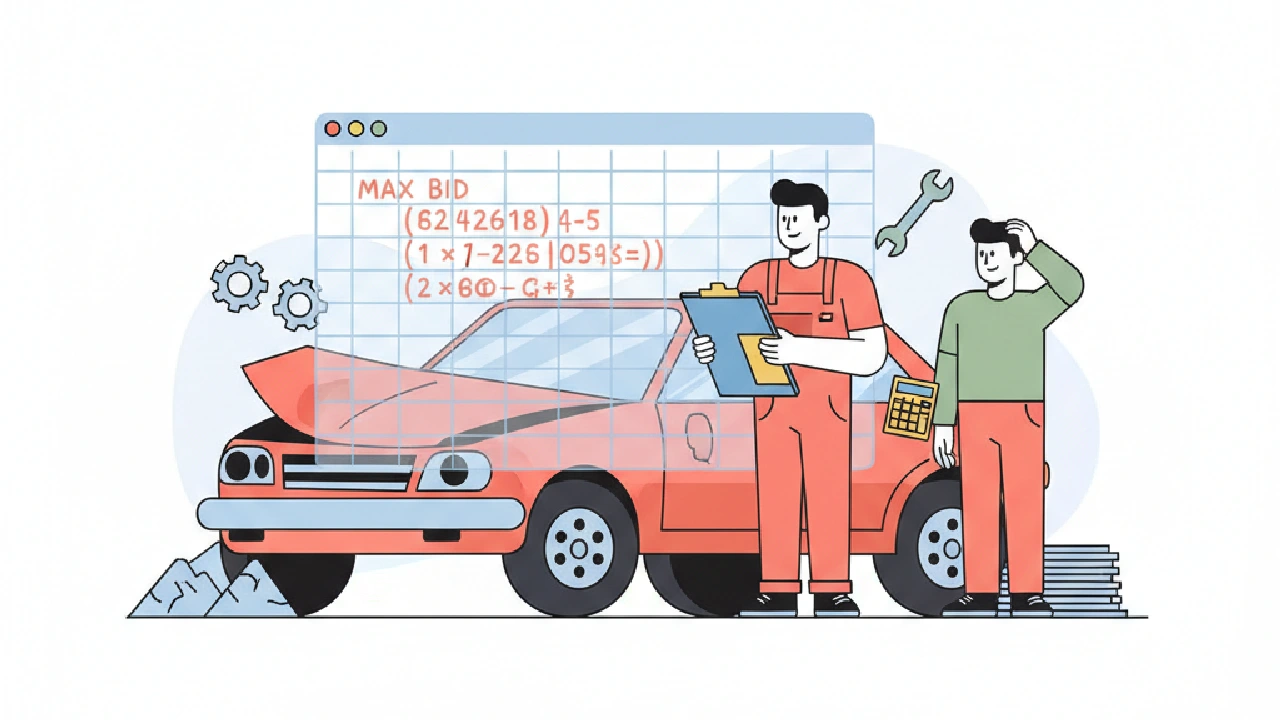
Short version: the phrase title discount max bid matters because your spreadsheet's max bid is only as good as the resale number you used. If you base your max on clean-title comps and forget title discounts, inspections, fees, and labor ranges, you will get surprised—often after you win the unit.
Core idea — what actually breaks in a spreadsheet
Spreadsheets lie when inputs don't match reality. You set a max bid from a clean-title comp or a retail number. The auction returns a salvage or rebuilt title. Your resale number drops—often by a large percentage. The system will still accept your max bid, and you can win at a price that looks fine on paper until you factor the title discount, transfer rules, and real repair costs. For practical examples of spreadsheet failure modes, see salvage flip spreadsheet: why spreadsheets break after 10 active lots.
1) Max bid mechanics — what the system does and what you think it does
Fact: max bid is a ceiling, not the price you pay. The auction platform bids incrementally for you and you typically pay the current winning price, not your max. For example, if your max is $5,000 and the lot closes at $3,000, you pay $3,000.
Why this matters: many flippers set an aggressive max because they assume they won’t actually pay it. That’s true until somebody else sets a higher ceiling or a tie of identical maxes goes to the other bidder. Then your spreadsheet’s assumed safety margin disappears.
Practical takeaway: never mix optimistic comps with aggressive maxes and call it conservative. Before you set a max, analyze a Copart or IAAI lot before you bid so platform specifics and listing details don’t surprise your backsolve.
2) Title discount is not a fixed fee — it’s a multiplier on your resale value
Spreadsheets often model damage and repairs but ignore title status. Title status changes the exit value, not the work needed to fix the car. Industry ranges show that a salvage title typically values a vehicle at 40–60% of clean-title value. A rebuilt title usually lands at 60–80% of clean-title value.
That means if you grabbed clean comps for ARV and then treat salvage or rebuilt cars the same, your spreadsheet will overstate resale by the salvage/rebuilt gap. The spread is large enough to flip a profitable buy into a loss.
Do this instead: always force a title-discount multiplier on your ARV line. Treat clean-title comps and salvage/rebuilt comps separately. If you don’t have salvage comps, apply the 40–60% or 60–80% guardrails to your clean comp before you backsolve your max bid. If you need the conceptual differences explained, see Rebuild vs Salvage Title: What Actually Changes Resale.
3) Fees, title transfer, and repair ranges that break the backsolve
People forget small fees and big labor ranges. Buyer fees are still in the ballpark of $50–$90 per vehicle. Title transfer and state processing fees can be $25–$50. Labor for salvage-to-rebuilt conversions commonly falls in a wide band; plan for $3,000–$8,000 depending on damage type and parts availability (see salvage auction repair estimate: Pre-bid repair math).
These items break the spreadsheet in two ways. First, they are sometimes entered as single-line items when they should be ranges with probability weight. Second, title-related delays (inspections or paperwork) raise holding costs and shrink your workable margin, but spreadsheets rarely model that time risk.
Opinion: if your model uses point estimates for buyer fees or labor, you’re lying to yourself. Convert those lines to ranges and run the backsolve on the low-end resale and high-end repair scenarios. If you want help modeling platform fees into your math, our write-up on why Copart fees are so high (and how to model around them) is a useful reference.
4) A concrete mini-case — how the mechanics and title discount collide
Use the auction mechanics that exist in the platforms. Say you set a max bid of $5,000. The lot closes at $3,000 and you pay $3,000. That’s the auction reality example everyone knows: max is a ceiling, not the final price.
Now layer title and repair reality on top. Assume the vehicle is salvage or rebuilt. The resale you used in the spreadsheet is a clean-title number. If the car is actually salvage, resale should be treated in the 40–60% band of that clean number. If it needs a salvage-to-rebuilt conversion, plan labor in the $3,000–$8,000 range and buyer/title fees of $50–$90 plus title transfer charges of $25–$50.
How the spreadsheet fails: you might have set your max = clean ARV - repairs - fees - margin. But your 'clean ARV' is wrong if the car arrives with a salvage or rebuilt title. The real ARV is 40–60% or 60–80% of your clean ARV. That change turns your backsolve into nonsense.
5) How to fix your max bid workflow — the backsolve with title discount
Change your order of operations. Stop starting from a clean comp and working down. Start from the actual exit scenario and backsolve.
Step 1 — decide exit scenario: salvage sale, rebuilt sale, or parts-only.
Step 2 — apply the title-discount multiplier to your clean comp (use the 40–60% or 60–80% bands). Work with ranges, not one number.
Step 3 — subtract realistic repair ranges. Use $3,000–$8,000 for labor planning where applicable. Treat parts and labor separately and flag long-lead items for luxury/EV models.
Step 4 — add buyer fees ($50–$90) and title transfer ($25–$50). Include inspection or holding costs as a qualitative flag if your state requires rebuilt inspections.
Step 5 — set your max bid using the backsolve formula many platforms use: Max Bid = Resale Value - Repair Costs - Fees - Margin. Use the discounted resale value, and use upper-bound repairs and fees to be conservative.
If you prefer automation, AutoFlip Pro's Max Bid Calculator applies title discounts, repair costs, transport, auction fees, and your profit margin to produce a defensible max bid and can run scenario ranges so you don't rely on single-point estimates.
Where a salvage flip tool helps
A quick, practical fit: AutoFlip Pro’s Max Bid Calculator takes the title-discount multiplier, transport, auction fees, repair estimates, and profit margin and runs the backsolve for you so you can see conservative and optimistic max bids. Pair that with the platform’s Risk Level Calculation to surface sales-history red flags before you pull the trigger.
- Use it to test worst-case resale (salvage 40–60%) against high-end repair scenarios.
- Run multiple scenarios quickly instead of editing spreadsheets for every lot.
Analyze a Copart lot free before you bid.
Key takeaways
- Always run the max bid backsolve from a discounted resale, not a clean comp.
- Treat buyer fees and title transfer as ranges, not flat line items ($50–$90; $25–$50).
- Model labor as a broad range and plan for the high end ($3,000–$8,000).
- Remember: your max bid is a ceiling. You usually pay the auction's final price, not the max — but valuation errors still kill margins.
FAQ
How does the platform use my max bid?
The platform uses your max bid as a ceiling and bids incrementally for you. You typically pay the final winning price, which can be lower than your max. That means a high max doesn't mean you overpaid unless you actually reach your ceiling or another bidder beats you.
If I win below my max, did I still make a mistake?
Maybe. Winning below your max can mask a valuation mistake. If your spreadsheet used a clean-title ARV but the car is salvage or rebuilt, the lower winning price might still be above the true discounted resale once repairs and fees are factored in.
Can membership tiers or buyer fee credits fix this problem?
Memberships can reduce buyer fees, and that helps. But fee reductions don't solve a bad ARV or underestimated repair job. Use membership discounts as a secondary optimization, not your primary defense against title discounts.
What is one quick rule I can apply before I hit submit on a max bid?
Run the backsolve using the appropriate title-discount band (40–60% for salvage; 60–80% for rebuilt). Use high-end repair and fee estimates. If the resulting max is lower than your spreadsheet's number, update the max and walk away from impulse raises.
Actionable checklist
- Confirm title status on the listing; assume salvage unless there’s a clear clean-title comp.
- Apply the 40–60% or 60–80% discount to clean ARV before backsolving.
- Use $3,000–$8,000 as your labor band where applicable; enter as a high/low field.
- Enter buyer fees as $50–$90 and title transfer as $25–$50; model worst-case totals.
- Set max bid = discounted resale - repairs - fees - margin. Use the high-end repair number for conservatism.
Keep your spreadsheets honest. Use ranges. Force the discount into the ARV line and treat your max bid as defensive, not aspirational. That is how operators stop losing money to title surprises.