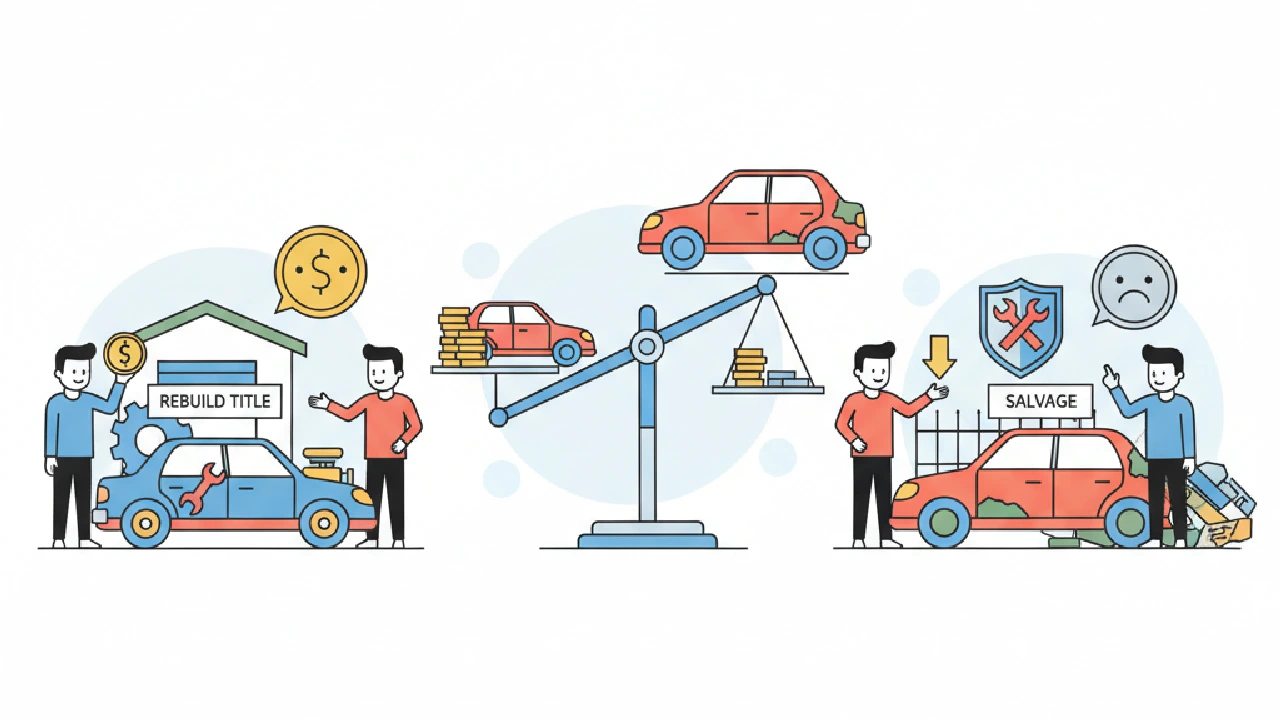
Short version up front: rebuild vs salvage title matters because one is a non-road-legal brand and the other is a permanent brand after repair. Say the words out loud at the gate and your bidder knows what to expect: market shrink, inspection questions, and permanent buyer skepticism. This piece is a straight operator briefing for Copart/IAAI day—no fluff—covering title risk, max-bid math, spread, repairs that actually move the needle, and how to avoid title traps.
The core idea — what the brands mean for resale
A salvage title means the car was declared a total loss and is not road-legal. A rebuilt title means that same car was repaired, passed a state salvage inspection, and is now legal to drive, but carries a permanent brand. That permanent branding is the single biggest resale lever (title brands that kill your flip spread) — it shrinks your buyer pool and changes the offers you get at retail or wholesale.
Do not treat "rebuilt" as clean. The title history never goes away. Rebuilt vehicles are roadworthy on paper, but the market still prices them down. Industry guidance for rebuilds is that they typically sell for 20–40% less than clean-title equivalents. Keep that range in your head when you're calculating max bids. Also watch broader market shifts that change those percentages (see salvage auction market changes for flipper math).
1) Max-bid math you can run in your head
Run this sequence every time before you click "place bid." Use percentages, not wishful thinking.
- Start with your clean-market ARV expressed as 100% — pick the right comp radius for the car (same year, trim, and within the local market you sell into). See salvage car comps to bid like a pro for how to set the right radius and comp set.
- Apply the rebuilt discount: plan for 20–40% lower than clean for a rebuilt title. For a salvage-only buy (not yet inspected/rebuilt), expect deeper discount and extra uncertainty.
- Subtract hard costs: buyer fees, transport, title transfer, documentation, plus the repair bill you estimate based on photos and notes. Don't guess—itemize parts and labor out of the gate. If you need help modeling auction fees into your max-bid, see guidance on why Copart fees are so high.
- Your max bid equals adjusted ARV minus those costs and your target profit margin.
Two practical notes: first, if the auction listing shows "salvage" only, you cannot assume it will become a rebuilt for that 20–40% gap without factoring state inspection risk and hidden damage. Second, buyer fees and transport vary by yard and lane; treat them as fixed costs you always deduct before entering a bid.
Tip: if you want a shortcut instead of doing every percent in your head, AutoFlip Pro's Max Bid Calculator can calculate Adjusted Market Value, transport, auction fees, target profit, and output a suggested max bid once you enter the VIN or lot number. That removes a lot of lane math and helps prevent the common mistake of assuming near-clean dollars.
2) Title risk and inspection traps
Title branding is state-controlled. That means inspection requirements and wording differ by state, but the mechanics are the same: an insurer totals the car when repair cost exceeds a threshold. That threshold can be described as a percent range—insurers set total-loss rules when repair costs exceed 75–100% of pre-loss value.
Key operating points:
- Salvage title = not road-legal. It’s sold as-is, often “parts only” if it’s structurally compromised. Expect a small buyer pool and bids aimed at parting or cheap rebuild projects.
- Rebuilt title = passed inspection, legal to register. But it will never revert to clean. That permanent visible history is what retail buyers see on reports and what dealers price off of.
- Inspection does not equal perfect fix. The state check confirms roadworthiness and safety items at the time of inspection. It does not certify repair quality, correct hidden structural fixes, or assure no intermittent electrical gremlins.
Don't ignore title paperwork in the lot photos. If the listing or VIN history hints at multiple prior brands or a salvage-to-rebuilt flip, factor in extra title-clarity work and reduced buyer trust. If you want a checklist to evaluate a lot at the gate, review how to analyze a salvage auction lot before you bid.
3) Repairs that move the resale needle — and the ones that don't
Spend your time and money on visible and structural fixes that buyers notice first. Mechanical freshness helps, but cosmetics and clear service items matter less than frame, airbag, and flood history.
- High-impact repairs: structural/frame, airbag replacement, flood remediation with documentation. These are the items that will scare retail buyers if done poorly or hidden.
- Lower-impact repairs: minor dents, scuffs, trim pieces, and simple interior refreshes. These add up, but they do not close a title gap.
- Electrical/ECU issues: buyers hate intermittent electrical problems. If you can't confirm sensors, modules, and immobilizer status, price deeper or walk away.
Document everything. The rebuilt title only proves the car passed inspection. What sells the car at retail is a clear paper trail: parts receipts, alignment data, airbag receipts, and post-repair photos. If you can produce that to a buyer, you cut bid resistance.
Mini-case: running the percent math (no dollar guessing)
Do this in the lane when you have limited time. Use percentages you already know.
- Assume clean-market ARV = 100 units (this is your reference).
- Rebuilt market expectation = 100 units minus the typical rebuilt hit. Use the provided industry range: plan for 20–40% less. That means expected market value = 60–80 units.
- Now subtract your fixed costs and profit margin as a percent of that expected market value. If your fees and transport equal X% and your repairs equal Y% of the expected market value, your max bid = (expected market value) - X% - Y% - target profit%.
Why this is useful: you don't need precise dollar values in the lane. If the rebuilt market is only 60–80% of clean, any bid that assumes the car will sell at 90–100% clean is a bad bid. Conversely, if you can control repair costs to keep Y% low, you widen your viable bid range.
4) Comps, radius, and buyer pool — the non-title levers
Title is the headline. Comps, geography, and buyer pool are the rest. A rebuilt import with rare trim can beat the typical 20–40% discount if you sell into a narrow niche. A common commuter with a rebuilt brand will stick to the bottom of that range or below.
- Comp radius: narrow the comp set to the buyers you actually sell to. For dealer-to-dealer flips use a wider geographic comp. For retail, keep it local and match trim/options.
- Buyer pool: wholesale buyers at auction price off reconditioning and resale risk. Private retail buyers may pay closer to the high end of the rebuilt range if you present documentation and warranty-like reassurance.
- Marketing: a clean, photographed parts list and receipts moves margin. Don't hide the rebuilt brand—explain it and show repair detail.
Practical warnings — things that wreck your profit
- Bad bids: assuming a rebuilt will fetch near-clean dollars. That is the most common mistake.
- Title traps: vehicles with multiple salvage events, or flood + frame notes. Those cars will struggle even after inspection.
- Repair surprises: rusted hidden mounts, prior poor repairs, and ECM mismatches. These spike labor and kill margins.
Quick test at the lane: if you can't see clear repair receipts or the listing shows structural or flood keywords, mentally move the expected market value toward the worse end of the 20–40% hit or decide to pass.
Feature bridge: When you need to reduce gate-time risk, combine a quick VIN/lot lookup and a risk score with market comps. AutoFlip Pro's Risk Level Calculation flags sales-history red flags (multiple "sold" events, insurance-seller signals) so you don't buy a repeatedly cycled title; its market value estimation pulls local comparables so your ARV and comp radius are grounded in the local market. If you want to run a live lot through those checks before you bid, you can analyze a Copart lot free before you bid.
Key takeaways
- Treat salvage as non-drivable inventory and rebuilt as permanently branded inventory—both change buyer pool and price.
- Use the 20–40% rebuilt discount range when setting max bids; never assume clean dollars for a rebuilt title.
- Run percent-based max-bid math in the lane: ARV as 100, apply rebuilt discount, subtract fixed costs and repair percent, then set your profit floor.
- Document repairs and keep receipts—title inspection proves roadworthiness, receipts prove quality and sell cars faster.
FAQ
Does a rebuilt title ever become clean?
No. A rebuilt title is a permanent brand. The vehicle history stays visible on title records and vehicle reports even after it passes state inspection.
Why do rebuilt cars sell for less?
Because the brand reduces buyer confidence and shrinks the market. Industry guidance is that rebuilt vehicles typically sell for 20–40% less than clean-title equivalents—so price accordingly.
Should I buy a salvage car to rebuild myself?
Only if you have a tightly controlled repair plan, documented parts and labor, and a realistic percent-based budget. If you cannot guarantee repair quality and receipts, the title-brand risk will eat your margin.
What inspections matter after I buy?
State salvage inspection for rebuilt issuance is mandatory for road legality. After that, buyers want documented structural, airbag, and flood remediation work. Independent structural or frame alignment documentation is a strong selling point.
How do I present a rebuilt vehicle to retail buyers?
Be transparent. Lead with documentation: inspection pass, parts invoices, photos before/after, and any post-repair checks (alignment, diagnostic reports). That reduces skepticism and improves your chance of hitting the high end of the rebuilt range.