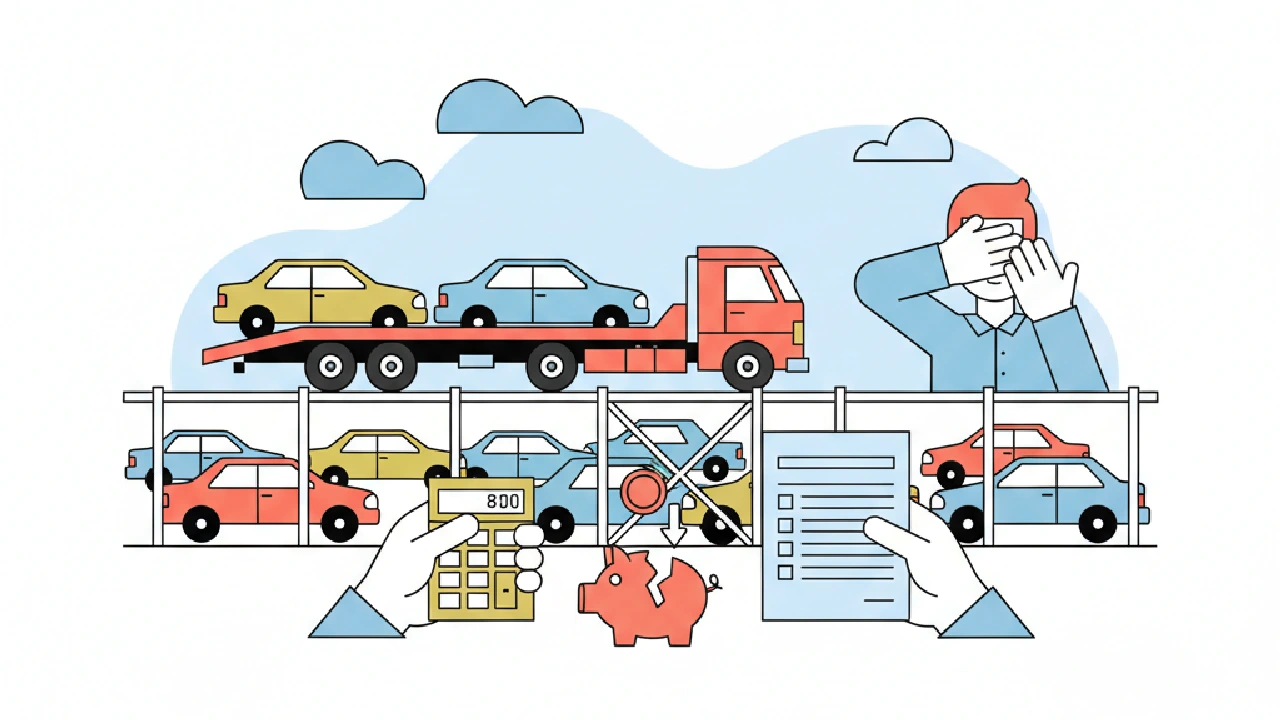
Short version: miscount the transport line and your max bid dies. The primary keyword is transport cost salvage flip — you must build max bids around real transport numbers, not guesses.
Core idea
You set a maximum bid to protect margin. If your transport math is wrong, that "max" is fake: a projected profit can become break-even or a loss. Treat transport as a line item you verify before you raise a paddle. No assumptions. If you need a pre-bid checklist, see our guide on how to analyze a salvage auction lot before you bid.
1) The transport line is not just a mile rate
People treat transport as a single per-mile number. That’s lazy and dangerous. Real transport cost for a salvage flip often includes winch fees, dispatch fees, load-difficulty surcharges, oversized-vehicle premiums, and site-access penalties. Those push a flat per-mile estimate way up.
Use explicit ranges you can quote: transport costs for a salvage flip typically range from $150–$350 for local non-running moves in the US, or £150–£800 (approx. $2.50–$4.00/mile) within the UK. Those are not optional contingencies — they are part of acquisition cost.
I’ve lost deals where a bidder assumed a flatbed at $1.50/mile — then a winch and remote yard added another $200. Don’t be that bidder. Confirm run-and-drive status to avoid surprise winch charges (see what 'run and drive' means on Copart).
Tip: enter your transport quotes into AutoFlip Pro's Max Bid Calculator so transport, repair estimates, auction fees, title discounts, and risk adjustments are subtracted correctly when the tool computes your max bid.
2) Line items you must verify before bidding
- Base flatbed or open-carrier rate (per-mile is fine if backed by a written quote)
- Winch or non-running vehicle fee (use $150–$350 if it applies)
- Dispatch or minimum trip fee (industry dispatch fees can add $75 per trip)
- Oversize/overset surcharges (+10–30% is common; watch the vehicle type)
- Remote ZIP or access penalty — remote sites push transport into the higher band of £600–£800 in extreme UK cases
- Storage or yard fees if you can't pick up immediately (storage commonly runs $10–$30/day)
Do not estimate these. Get a quote or a realistic band. Call two carriers, write their quotes into your bid sheet, and use those numbers when you set your limit. If you're buying through Copart, review the Copart storage fee timeline that eats margin to model holding costs accurately.
3) Title risk and inspection fees that alter your math
Title problems and post-purchase inspections are common traps. A listing might show a clean-title alert where you expect salvage paperwork — that creates registration delays and extra admin costs. Factor title risk into your max bid as an explicit line item — not as a vague "contingency." Use a salvage title history red flags: auction checklist to price title-related delays.
Storage can also balloon while you sort title or wait for an inspection. Industry numbers list storage at $10–$30/day. A week in storage becomes a real dent. If the car sits and you haven’t budgeted for those days, your margin disappears.
4) The "All-In" rule you should use
Work with a clear all-in target. Put every expected cost on the table: hammer price, buyer/platform fees, transport, repairs, title/registration, taxes, storage, and reconditioning. Then compare that total to your expected retail.
Industry guidance says your total cost should not exceed 60–70% of the expected retail price. Use that as a gate. If your all-in number breaches that band, don’t bid. It’s a blunt tool, but it keeps you out of money-losing deals.
5) Mini-case: concrete math you can copy
Buyer brief. Follow this exact sheet before you bid.
- Expected retail after repair (ARV): set by comps in a tight radius. Pick the comp radius you actually sell into. Keep it tight. Use salvage car comps to set ARV and avoid over-optimistic pricing.
- Hammer price: the price you expect to win at auction.
- Buyer/platform fees: plug the auction fee (estimate on the auction site).
- Transport: use explicit bands. For a local non-running move, use $150–$350. Add dispatch $75 if you can’t self-collect.
- Repairs: write your shop estimate, parts plus labor. Check common repair surprises in our salvage repair cost surprises briefing.
- Storage and title contingencies: budget $10–$30/day for storage and an explicit contingency if title risk exists.
Example with numbers you can reuse (copy the method):
Set ARV by comps in your selling radius. If your ARV is X, your target all-in ceiling is X times 60–70%. Say ARV = X. Calculate 60% of X and treat that as your hard ceiling. Add the exact transport quote (use a number between $150–$350 for local non-running moves). Include buyer fees and the repair estimate. The remaining amount is your max hammer bid.
Why I like this approach: it forces transport to be a known subtraction before you enter the auction. If transport swings from $150 to $350, you will see how much wiggle room you lose and stop overbidding early.
Practical checks to avoid common errors
- Never assume the car is running. If it’s not, add the non-running band of $150–$350.
- Ask about winch/yard access on the listing notes. If unknown, price the worst in your band.
- Get at least one transport quote for long runs. For long moves, per-mile rates vary — don’t guess the trip cost.
- Log dispatch fees (they exist). Industry sources cite dispatch fees around $75 per trip.
- Block storage days in your schedule — use $10–$30/day to model delays.
Title traps I call out
Trap 1: ambiguous title status on the listing. If the listing language is fuzzy, assume added admin time and storage.
Trap 2: out-of-state salvage rules. Different states (or countries) require inspections or transfers that cost time and money. Budget for that time and use storage/day to model the delay.
Trap 3: lot holds after payment. Some lots hold cars until funds clear or titles arrive. If that’s the case, you’re paying storage while you wait. Model it.
Transport hacks that save real dollars
- Self-collect inside 50 miles when possible. If you own a tow setup, this beats quotes for short runs.
- Consolidate pickups. Run 2–3 cars in one carrier when timing allows. This spreads the dispatch fee and trip cost.
- Build a list of 2 local haulers and one regional. Compare quotes quickly. One fast quote beats guesswork.
- Use live shipping dashboards when available to get door-to-door estimates before bidding.
Where a salvage flip tool helps
Plugging transport quotes into a max-bid calculator prevents guesswork from becoming losses. AutoFlip Pro's Max Bid Calculator uses clean market value, title discount, transport cost, auction fees, profit margin, repair cost, and risk adjustment to produce a recommended max bid that reflects true acquisition cost.
- Use it to compare how a $150 vs $350 transport quote changes your max bid in real time.
- Enter a realistic transport line, repair estimate, and buyer fees so the calculator subtracts them correctly from adjusted market value.
Analyze a lot free before you bid.
Key takeaways
- Verify the transport line before you set your max bid. Treat it as a mandatory quote, not a guess.
- Include winch fees, dispatch fees, storage, and title delays in your all-in math.
- Use the industry gate: total costs should not exceed 60–70% of ARV to stay profitable.
- For local non-running moves, budget $150–$350; dispatch fees can add $75.
Actionable checklist
- Before you bid: pull comps and set ARV and your 60–70% ceiling.
- Call 2 haulers. Get flat quotes. If non-running, use a $150–$350 band.
- Enter buyer fees, repair estimate, transport, storage ($10–$30/day), and title contingency into your bid sheet.
- If all-in exceeds 60–70% of ARV, walk. Close the laptop and wait for the next car.
FAQ
How do I handle transport for non-running cars?
Price the winch band explicitly. Industry guidance lists non-running local moves at $150–$350. Get a quote that includes winch or assume the upper band if uncertain.
Can I skip getting a transport quote and estimate instead?
No. Don’t guess. Dispatch and access fees change the number. Industry dispatch fees can add about $75 per trip. If you must estimate, use conservative bands from above.
How much storage should I budget while waiting for title or inspection?
Model storage at $10–$30/day. If title issues are possible, add several days to your model and treat the cost as a real line item.
What if the transport quote is much higher than expected at auction time?
Re-calc your max bid immediately. If transport pushes you past your 60–70% gate, do not chase the car. Chasing losses is a fast way to destroy cashflow.
Any quick bidding discipline to avoid panic buys?
Yes. Have a pre-filled bid sheet and a hard stop rule: if the all-in total is above your ceiling, stop. Never make ad-hoc increases to cover transport surprises.
Final note: transport cost is a small line on paper but a margin killer in reality. Treat it like the legal title — verify, budget, and be ready to walk. Bring the quotes to auction day and let math, not hope, decide your bids.