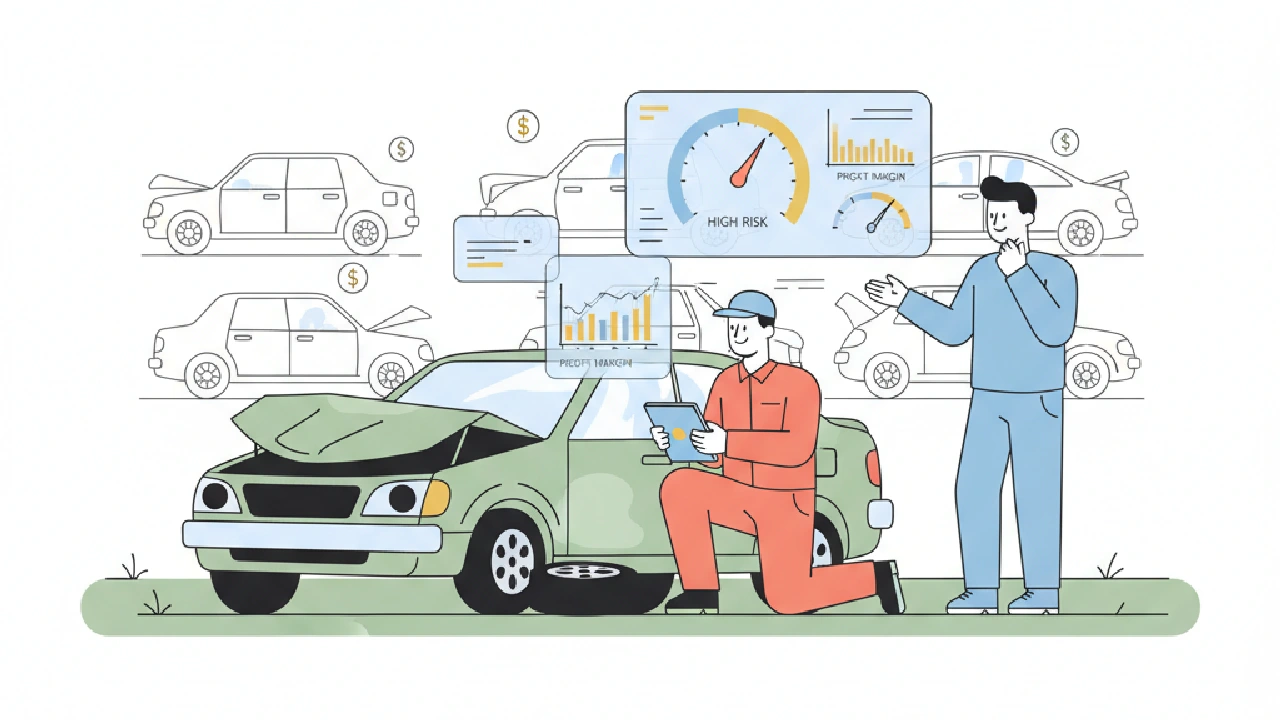
Flipping salvage cars from Copart and IAAI is a numbers game. You need to know your all-in cost before the gavel drops. The key to consistent profit isn’t just finding cheap cars; it’s accurately assessing risk. That’s where the AutoFlip Pro risk score comes in.
An AutoFlip Pro risk score is a composite number that tells you how much uncertainty you’re buying into. It’s not just about what you see; it’s about what you don’t see and what that unknown will cost you. This score helps you quickly decide if a lot is a go, a maybe, or a hard pass. We’re talking about title status, start codes, keys, visible damage, missing information, and the crucial spread between estimated retail and your max bid.
Understanding the Risk Score Scale
Think of the AutoFlip Pro risk score as a 0–100 scale, with lower numbers signaling lower risk and higher numbers screaming "danger ahead." AutoFlip Pro provides a risk score calculation to help you quickly identify potential issues before you bid.
- Low Risk (score ≥ 70): These are your sweet spots. Clear title, runs and drives, keys present, and damage that’s visible and bounded. Crucially, the asking price leaves plenty of room for transport, fees, and repairs, ensuring a healthy margin. These vehicles are often trade-ins or minor collision vehicles where the insurance company deemed them total losses due to specific clauses (e.g., cosmetic damage exceeding a certain percentage of value) rather than catastrophic failure. You might find a late-model car with a dented fender and bumper that’s easily repairable, offering a quick turnaround and strong profit.
- Medium Risk (score 40–69): Proceed with caution. You’re looking at one or more unknowns here: a stationary vehicle, missing keys, airbag deployment, unconfirmed frame or suspension issues, or poor photo coverage. These aren’t automatic no-bids, but they require deeper due diligence and a bigger repair budget buffer. For example, a car that "starts but doesn't run" could have a simple fix or a major engine issue.
- High Risk (score < 40): These are often money pits unless you’re an experienced rebuilder with deep resources for parts and labor. High-risk vehicles typically have major structural damage, flood damage, or multiple "sold" entries in their sales history, indicating repeated attempts to offload a problematic vehicle. Proceed only with extreme caution and a very conservative max bid.
Key Factors Influencing Your Risk Score
Several factors weigh into the overall risk assessment. Understanding these will help you interpret the score and make informed decisions.
Sales History (A-Level Factor)
A vehicle
Key Factors Influencing Your Risk Score
Several factors weigh into the overall risk assessment. Understanding these will help you interpret the score and make informed decisions.
Sales History (A-Level Factor)
A vehicle's sales history is perhaps the most critical indicator of potential trouble. The AutoFlip Pro risk score heavily penalizes vehicles with multiple "Sold" entries, especially if they reappear as "Active." This often suggests a recurring issue that previous buyers couldn't resolve profitably. A single "Sold" entry is neutral, indicating a normal closed auction, while an "Active" entry alone just means it's currently up for auction.
Ignoring sales history is a common mistake that leads to significant losses. Always check if a car has been passed around multiple times. This is such a critical factor that AutoFlip Pro applies a significant penalty for vehicles with a problematic sales history. For more detail, check out AutoFlip Pro Sales History: Spotting Relists and Title Traps.
Seller Type (A-Level Factor)
An insurance company selling a vehicle typically means it was deemed a total loss due to an accident, flood, or theft. These sellers are generally more transparent and trustworthy. AutoFlip Pro awards points for a verified insurance seller, reflecting a lower risk profile compared to private sellers or salvage yards, which might have less standardized disclosure practices.
Runs & Drives (B-Level Factor)
Does the car start and move under its own power? This is a fundamental question. A vehicle that "runs and drives" indicates a functional powertrain and significantly reduces the risk of costly engine or transmission repairs. Conversely, a vehicle that "does not run and drive" introduces a major unknown, potentially hiding severe mechanical issues.
Engine Starts (B-Level Factor)
Similar to "runs and drives," knowing if the engine starts is crucial. An engine that starts suggests the electrical system and basic engine components are operational. If it "does not start," you're looking at potential problems ranging from a dead battery to a seized engine, each with vastly different repair costs.
Title Type (C-Level Factor)
The title type profoundly impacts a vehicle's market value and your ability to register and sell it. While less critical than sales history or mechanical status, it's still important. AutoFlip Pro adjusts the risk score for various title types:
- Clean Title: The best-case scenario, indicating no prior major damage or salvage history.
- Junk/Parts Only: These titles often prevent legal road use and are typically for dismantling. AutoFlip Pro applies a significant penalty here.
- Flood Title: Indicates water damage, which can lead to long-term electrical and mechanical issues.
- Theft/Recovery: Often means the vehicle was stolen and recovered, potentially with missing parts or damage from the theft.
- Salvage Title: A neutral factor in the AutoFlip Pro score, as salvage titles are expected in this market. However, a salvage title still means the vehicle was deemed a total loss by an insurance company.
Understanding title types is essential for Salvage Title Flipping: Your Briefing for Auction Day.
How AutoFlip Pro Calculates Your Max Bid
Beyond just a risk score, AutoFlip Pro helps you translate that risk into a tangible number: your maximum bid. It uses a comprehensive formula that considers market value, repair costs, transport, fees, and your desired profit margin. This ensures you never overpay for a risky vehicle.
First, AutoFlip Pro estimates the Clean Market Value based on comparable listings in your area, giving you confidence in the vehicle's potential resale price. Then, it factors in a Title Discount based on the title type. It also accounts for estimated Repair Costs (if available), Transport Costs (based on your default destination), and Auction Fees.
Finally, your desired Target Profit Margin is subtracted, along with a Risk Adjustment derived from the overall risk score. The result is a precise maximum bid you can confidently place, knowing all variables have been accounted for. For a deeper dive, see Autoflip Max Bid Calculator: Title, Transport, and Your Bottom Line.
You can analyze any Copart or IAAI lot for free and get a full risk score and max bid estimate at autoflip.pro/try.
Key Takeaways
- AutoFlip Pro's risk score (0-100) quickly identifies potential issues in salvage vehicles, categorizing them as Low, Medium, or High risk.
- Critical factors like sales history, seller type, and mechanical status (runs/drives, engine starts) heavily influence the score.
- Problematic sales history (multiple "Sold" entries) is a major red flag, indicating potential unresolved issues.
- The risk score directly feeds into AutoFlip Pro's intelligent max bid calculator, helping you set a profitable bid limit by factoring in market value, repair, transport, fees, and target profit.
- Always set your default zipcode and destination in AutoFlip Pro settings for the most accurate market valuations and transport cost estimates.
FAQ
How does AutoFlip Pro determine if a vehicle has "Sales History"?
AutoFlip Pro automatically pulls sales history from auction platforms like Copart and IAAI. It looks for past auction entries for the specific VIN or lot number. Multiple "Sold" entries, especially if followed by a current "Active" status, are identified as high-risk indicators, suggesting the vehicle has been repeatedly re-listed due to unresolved problems. This historical data is crucial for risk assessment.
Can I adjust the risk factors or my target profit margin in AutoFlip Pro?
While the core risk factor weightings are set by AutoFlip Pro's algorithm, you can customize your overall bidding strategy in your settings. You can define your Target Profit Margin, which directly impacts the max bid calculation. Additionally, by using the platform's repair cost estimator, you can input more precise repair figures, further refining the max bid based on your assessment.
What if a vehicle has an "Unknown" status on its auction date?
An "Unknown" status typically means there's no scheduled auction date available from the platform yet. While this doesn't directly impact the risk score (it's a status, not a condition), it does add a layer of uncertainty regarding when you might acquire the vehicle. AutoFlip Pro prioritizes known dates, moving "Unknown" status vehicles to the bottom of your watchlist until more information becomes available. You can manually edit auction dates in your Auctions Watchlist.
Does AutoFlip Pro help me track my vehicles after I win them?
Yes, for Pro plan users, AutoFlip Pro offers a comprehensive Portfolio feature. This 8-stage flip pipeline allows you to track vehicles from "In Transport" all the way to "Sold." It also includes detailed repair tracking, parts inventory management, and a vendor list, giving you a full overview of your post-auction operations. This is key for profitable Salvage Flip Pipeline: From Bid to Sold management.
Is there a way to quickly check a car's risk without signing up for AutoFlip Pro?
Absolutely! Anyone can use the free public lot analyzer at autoflip.pro/try. Simply enter a VIN or lot number from Copart or IAAI, and you'll receive a full analysis, risk score, and max bid estimate for that specific vehicle. It's a great way to experience AutoFlip Pro's capabilities before committing to a plan.