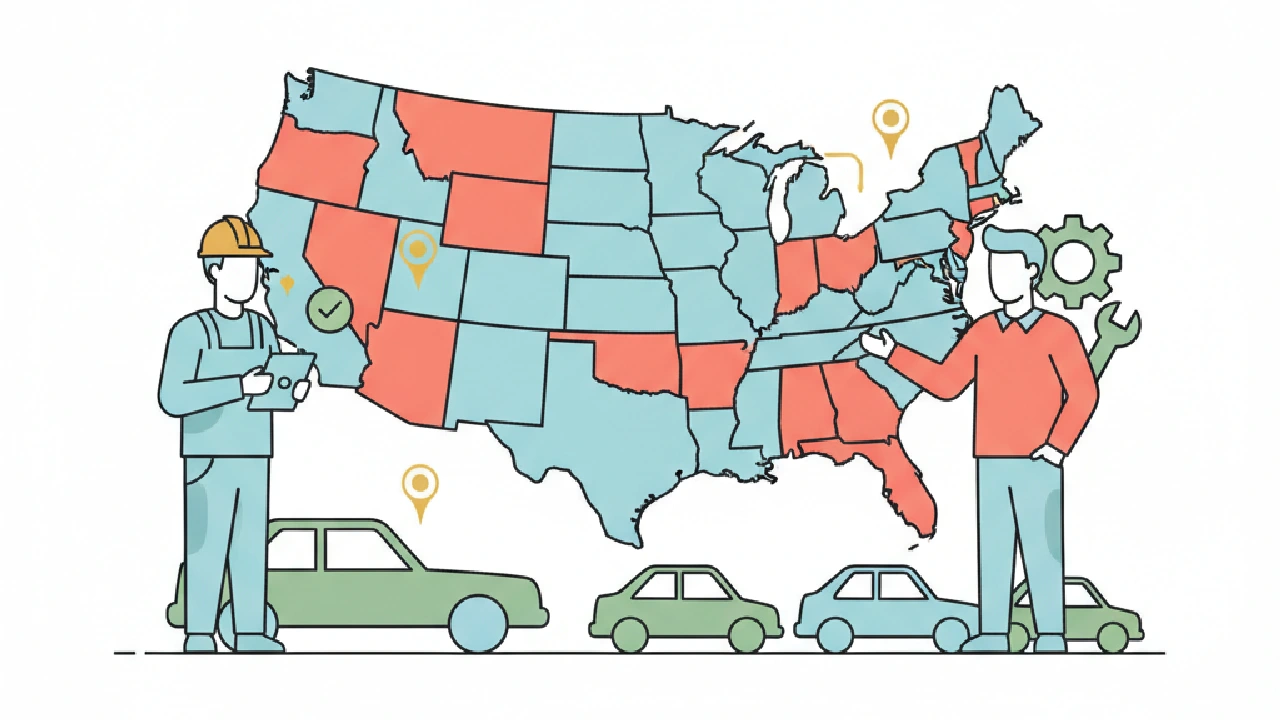
Copart's State Licensing Overview lists 15 states where a private individual can bid on both titled and salvage cars, and 25 states where both go through a broker. That split is the core of Copart license requirements by state, and it follows the state where the car sits, not the state where you live. Check it before you spend an evening on photos, history and repair math for a lot you cannot win.
Your membership tier does not change the answer. A Basic or Premier account gets you into the auto auction; the lot's state decides whether your bid counts. Below is the full private buyer table as Copart showed it on November 3, 2026, plus how many cars you can resell before your own state wants a dealer license.
How Copart Decides Who Can Bid on a Lot
The first column of Copart's State Licensing Overview is labeled "Vehicle Location," and every rule in the row follows it. Copart's own guide to buying without a dealer license puts it plainly: "The laws of the state where the vehicle is located govern who can bid on and win vehicles in auctions, not where the buyer is located."
The Copart New Member Guide says the documents you upload "depend on the laws of the state where the automobile is located." So a buyer in Ohio looking at a Pennsylvania lot reads the Pennsylvania row.
Without a license, you register as an Individual. Copart says an Individual "will only be able to purchase vehicles listed in the 'No License Required' category," and can also use a broker, "who can purchase any vehicle on your behalf." Its FAQ adds that "only a government-issued ID, such as a driver's license or passport, is required to bid on these No License Required vehicles."
Copart also says "All Basic and Premier Members may bid on No License Required inventory," so paying for Premier does not open restricted lots. The step by step for opening an account is in our pillar guide on how to buy from Copart without a dealer license. Read the lot's yard state first, then the table, then the lot page.
Copart License Requirements by State: The Private Buyer Table
This is the Private Individuals section of Copart's overview, copied cell for cell from the live page on November 3, 2026. Copart calls the listing "a general guideline of what type of items each Member may be able to purchase" and says "it is by no means a comprehensive or complete listing of eligibility rules." It adds: "Our websites will determine bid eligibility in real time based upon the licenses and documents you have on file."
| Vehicle location | Private individuals: titled items | Private individuals: salvage |
|---|---|---|
| Alabama | BROKER | BROKER |
| Alaska | BROKER | BROKER |
| Arizona | YES | YES |
| Arkansas | YES | YES |
| California | BROKER | BROKER |
| Colorado | BROKER | YES* |
| Connecticut | BROKER | BROKER |
| Delaware | BROKER | BROKER |
| Florida | BROKER | BROKER |
| Georgia | BROKER | YES |
| Hawaii | BROKER | YES |
| Idaho | YES | YES |
| Illinois | BROKER | BROKER |
| Indiana | BROKER | BROKER |
| Iowa | YES | YES |
| Kansas | BROKER | YES |
| Kentucky | BROKER | BROKER |
| Louisiana | YES | YES |
| Maine | BROKER | BROKER |
| Maryland | BROKER | BROKER |
| Massachusetts | BROKER | BROKER |
| Michigan | YES | BROKER |
| Minnesota | YES | YES |
| Mississippi | YES | YES |
| Missouri | YES | BROKER |
| Montana | YES | YES |
| Nebraska | YES | YES |
| Nevada | BROKER | BROKER |
| New Hampshire | BROKER | BROKER |
| New Jersey | BROKER | BROKER |
| New Mexico | BROKER | BROKER |
| New York | BROKER | BROKER |
| North Carolina | YES | YES |
| North Dakota | BROKER | BROKER |
| Ohio | BROKER | YES |
| Oklahoma | YES | YES |
| Oregon | YES | YES |
| Pennsylvania | YES | YES |
| Rhode Island | BROKER | BROKER |
| South Carolina | BROKER | BROKER |
| South Dakota | BROKER | BROKER |
| Tennessee | BROKER | BROKER |
| Texas | BROKER | YES |
| Utah | YES | BROKER |
| Vermont | YES | YES |
| Virginia | BROKER | BROKER |
| Washington | BROKER | YES |
| West Virginia | BROKER | BROKER |
| Wisconsin | BROKER | BROKER |
| Wyoming | YES | YES |
Copart's footnote for the starred Colorado salvage cell reads: "Only Title Document of Public Bill of Sale Parts, Reconstructed Permit to Sell, Permit to Sell, Parts Only w/ NoTitle, or CO-Public -Salvage Title." A second footnote on the page says "NC Public eligible for Clean Title Documents, some restrictions may apply." The page shows no date and no row for Washington, DC; it also has a boats, jet skis and snowmobiles column and Canadian provinces, which are left out here.
Treat the table as a filter, not a promise. If the lot page will not let you bid, the lot page wins.
What the Table Means for Your Next Bid
Read the private buyer columns as four groups. Each one changes which lots are worth your research time.
Titled and salvage both YES (15 states): Arizona, Arkansas, Idaho, Iowa, Louisiana, Minnesota, Mississippi, Montana, Nebraska, North Carolina, Oklahoma, Oregon, Pennsylvania, Vermont and Wyoming.
Titled YES, salvage BROKER (3 states): Michigan, Missouri and Utah.
Titled BROKER, salvage YES (7 states): Colorado, Georgia, Hawaii, Kansas, Ohio, Texas and Washington. Colorado's salvage YES is limited to the title documents in the footnote.
Both BROKER (25 states): Alabama, Alaska, California, Connecticut, Delaware, Florida, Illinois, Indiana, Kentucky, Maine, Maryland, Massachusetts, Nevada, New Hampshire, New Jersey, New Mexico, New York, North Dakota, Rhode Island, South Carolina, South Dakota, Tennessee, Virginia, West Virginia and Wisconsin.
Michigan is the one to watch if you buy close to home. Copart shows titled YES but salvage BROKER there, and the Michigan SOS dealer page says "Only a Salvage Vehicle Agent may buy salvage or scrap titled vehicles at an auction." A salvage lot in a Michigan yard is not a public lot, whatever the photos look like.
Texas works the other way: Copart's Texas licensing page says private individuals "may purchase salvage titled items on their own but will need to go through a Broker for all clean titled vehicles." In a BROKER cell, Copart still lets an Individual buy lots listed in the No License Required category. Start from Copart's No License Required search when you want only lots you can win today.
When the Car You Want Sits in a Broker State
Copart's Brokers and Alliance Gateways page describes brokers as "third-party licensed professionals who help you buy Copart vehicles in restricted states that require a business license." The same page says: "Don't see a broker in your state? Explore our 'No License Required' category today."
Copart's licensing help page says that for a private citizen in a state that requires a specific license, Copart "can help you locate a trusted Broker." Ask the broker which states and title types they can buy before you bid through them.
A license from home does not always fix it either. Copart's FAQ says businesses with licenses on file "may still be referred to a broker if the state in which they are planning to buy a vehicle requires dealer or dismantler license to bid on vehicles." Whether the broker's cut still leaves a flip is covered in our broker vs public bidding cost comparison.
If you are thinking about the other side of that desk, read how becoming a Copart broker works by state; this post stays on the buyer side. Either way, price the buyer fees on the Copart fee calculator before you send a broker a max bid.
How IAA Compares for Public Buyers
IAA's How to Register page says "Individual Buyers can bid at auctions that are open to the public (varies by state) and on vehicles that can be sold to the public." If your state does not permit public buying, IAA says you will be prompted to find a broker or upgrade to a business account. On each lot, check the "Who Can Bid" list in Bid Information on the vehicle page.
IAA also says "GSA inventory is open to all public buyers in all states." Its Public Buyer State by State Eligibility article says "Buyers in the state of Texas have a limit of purchasing 5 salvage vehicles per calendar year" and "Buyers in Tennessee have a purchase limit of 5 vehicles over 365 days." Our Copart vs IAAI guide for first time flippers puts the two side by side.
Hypothetical Mini Case: Six Salvage Cars in Texas
This is a made up example with round numbers, not market data. Say you live in Houston and plan to buy six salvage cars this year from Texas yards, one every two months.
Copart access: the overview lists Texas salvage as YES for private individuals, so each lot can look biddable on day one.
State buying limit: the TxDMV salvage dealer page says you do not need a salvage dealer license if you "buy five or fewer salvage or nonrepairable motor vehicles in a calendar year." Car number six crosses that line.
IAA limit: IAA caps Texas public buyers at 5 salvage vehicles per calendar year, so switching auctions does not get you to six.
Resale side: selling all six is a separate count, covered in the next section.
Copart's YES told you what the auction allows. It did not tell you what Texas allows. Plan your year at five, or get licensed before the sixth car.
How Many Cars Can You Resell a Year Before Your State Calls You a Dealer?
Winning a public lot is legal in the states above. Selling it is governed by your own state's dealer law, and there is no national number. Here is what five states actually say.
Texas: the TxDMV Motor Vehicle Dealer Manual says you do not need a dealer license if you are "selling or offering to sell fewer than five vehicles in the same calendar year, provided the vehicles are owned and registered in that person's name." If they are not, you "would need a license to sell even one vehicle."
Florida: Florida Statutes section 320.27 presumes you are in the business if you buy, sell or deal in "three or more motor vehicles" in any 12 month period, or offer or display three or more for sale. FLHSMV uses the same three or more test for its dealer license.
Michigan: the Michigan SOS defines a dealer as someone who, within a 12 month period, deals in "5 or more vehicles of a type required to be titled."
Arizona: A.R.S. 28-4301 defines a used motor vehicle dealer by "seven or more used motor vehicles in a continuous twelve month period."
California: the California DMV dealer definition sets no number. A dealer is anyone who "is engaged wholly or in part, in the business of selling, buying, or taking in trade vehicles for the purpose of resale," and DMV says acting as a dealer without a license is unlawful (license required). Selling cars "purchased and used as personal vehicles" does not make you a dealer.
Notice the clocks differ. Texas counts a calendar year, while Florida, Michigan and Arizona count 12 months back from any sale. On a rolling count, a car sold last November still counts this October.
The practical move is a simple log: date bought, date sold, and whose name was on the title at sale. In Texas the exemption only works if the car is titled and registered in your name, so title it before you list it, never sell on the seller's open paperwork. For the wider legal picture, read whether flipping cars is illegal in your state and our car flipping business guide.
Before You Bid in Another State, Check This:
The yard state on the lot page, and that state's private buyer cells in Copart's overview.
The title type on the lot matches a YES cell, or the lot carries the No License Required tag.
The lot page lets your account bid. If it does not, the table does not matter.
Your home state will title what you bring back. Our rebuilt title inspection by state guide covers the inspection side.
You know how you will pay and move the car after you win; see what happens after you win at Copart or IAAI.
This car keeps you under your state's buying and resale counts for the year.
For the lot side of that list, AutoFlip Pro pulls a Copart or IAAI lot's prior auction sale history, VIN decode, NHTSA recalls and risk score, then works out a max bid with fees, transport, repairs and a title discount. You can analyze a Copart lot free before you bid, with no account and a shareable link saved for 7 days. Set the number against our Copart max bid strategy before the auction opens.
Key Takeaways
Read the yard state's row in Copart's State Licensing Overview before you research any lot.
Treat the table as a guideline and let the lot page's bid eligibility make the final call.
Use the No License Required search when the car sits in a BROKER state and you want to bid yourself.
Count salvage buys as well as resales in Texas, where five a calendar year is the line without a license.
Log every car you sell and check your own state's dealer count before the next purchase.
FAQ
Which states let the public bid at Copart without a license?
Copart's overview lists 15 states as YES for private individuals on both titled and salvage items, including Arizona, North Carolina and Pennsylvania. Others are YES for only one title type, so check the table and the lot page.
Do I follow my state's rules or the car's state?
For bidding, the car's state. Copart's overview is organized by vehicle location, and required documents "depend on the laws of the state where the automobile is located." For reselling, your own state's dealer law applies.
Can I buy a salvage car in a state that says BROKER?
Only through a broker, unless that lot is tagged No License Required. Copart says Individuals can buy No License Required lots with a government ID.
Does a dealer license from my state open every Copart lot?
No. Copart says licensed businesses "may still be referred to a broker" where the state requires a dealer or dismantler license to bid.
Is IAA easier than Copart for public buyers?
IAA restricts by state and by lot, with a "Who Can Bid" list on every vehicle page. GSA inventory is open to public buyers in all states, while IAA limits Texas public buyers to 5 salvage vehicles per calendar year and Tennessee public buyers to 5 vehicles over 365 days.