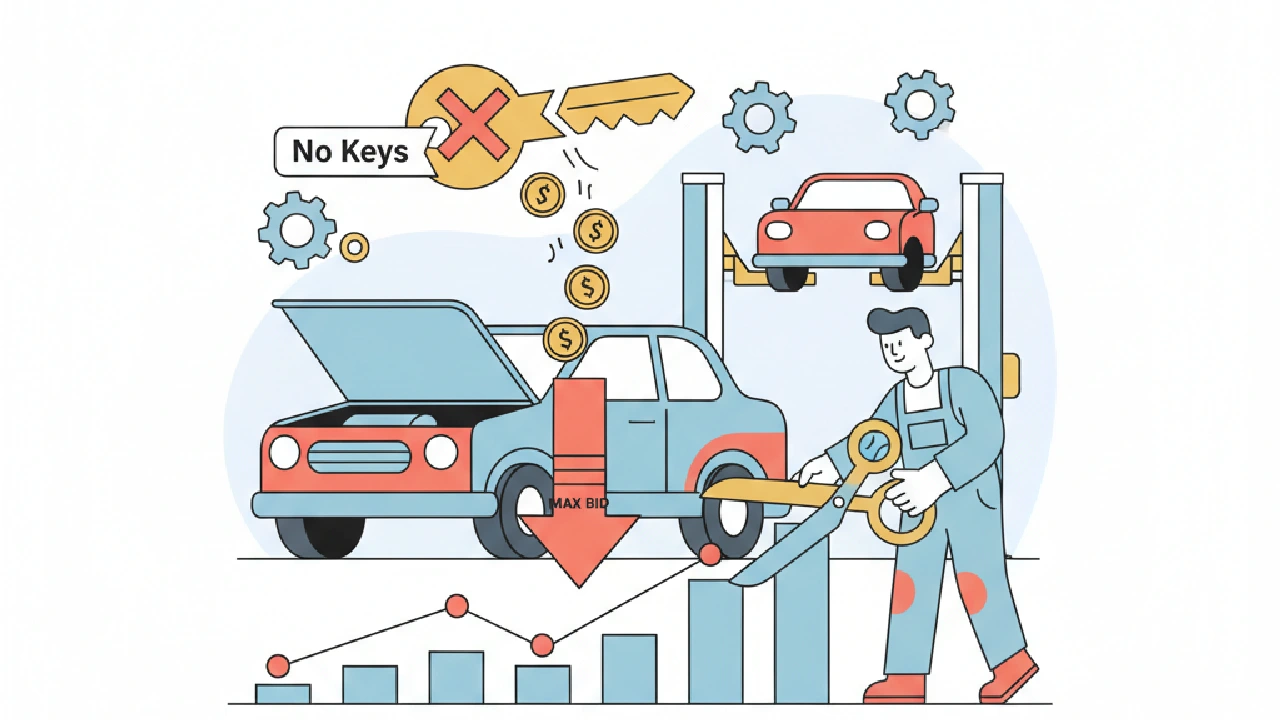
Copart tells you whether it has the keys. Its Common Terms page says the Keys designation shows whether Copart is in possession of the keys to the vehicle. When that field says no, you are buying a car you cannot start, lock or program until someone cuts and pairs a new key, and that cost belongs in the max bid before you bid.
This is only about the copart no keys deduction, not about whether the car runs. A car can run and drive in the listing video and still have no key for you.
What the listing does and does not tell you
The Keys field is a yes or no about possession. It does not say which kind of key the car takes, and the kind of key is what sets the price. A plain transponder key and a push to start proximity fob are different jobs with different bills.
Running condition is a separate question. For that, see what run and drive means on Copart and how IAAI stationary compares with run and drive.
Copart's glossary also says nothing about who pays for a replacement or what one costs. That number is yours to get. Confirm the Keys field on the lot page, then identify the key type from the year and the trim before you trust any bid.
What a replacement key actually costs
The figures below are published prices from a locksmith marketplace guide, not guesses, and they are quoted as the whole job. CarKeyNation's key programming cost guide, updated October 2, 2026, lists what a mobile automotive locksmith charges and what a dealer charges for the same work.
- A transponder key with remote runs $180 to $280 from a mobile specialist, and $280 to $475 at a dealer.
- A flip or switchblade key runs $220 to $320 mobile, and $330 to $475 at a dealer.
- A smart proximity fob on a Toyota, Honda or Hyundai runs $280 to $450 mobile, and $450 to $700 at a dealer.
- A Ford or GM smart proximity fob runs $300 to $475 mobile, and $475 to $750 at a dealer.
- A BMW, Mercedes or Audi smart proximity fob runs $450 to $850 mobile, and $700 to $1,300 at a dealer.
The same guide prices an all keys lost job as a surcharge on top of those, adding $80 to $250 with a mobile specialist and $200 to $500 at a dealer, plus a tow in the dealer case. Its smart key page, read the same day, puts a Range Rover or Jaguar Land Rover proximity key at $650 to $1,200 mobile and $950 to $1,800 at a dealer.
One limit on these numbers. They assume a working car that a locksmith can reach and pair. A dead battery, a missing module or a car at a yard that will not let a technician plug in can push the job outside these bands, and only a quote on that VIN will tell you.
Use the row that matches the car in front of you. A $200 transponder budget on a push to start BMW is how bidders blow the repair line.
Why a Copart lot is usually the expensive version
Every row above assumes at least one working key still exists. CarKeyNation says that when none does, the trade calls it all keys lost, and the car has to accept a key from nothing. On some makes that means pulling a security code first.
On others it means authenticating through a gateway. That is the surcharge.
A no keys Copart car is that situation by default. You did not lose a spare. There is no key at all, and you may not be able to have the work done until the car is in your hands.
The manufacturer does not make this easier from a distance. Toyota's owner support page, updated October 2, 2025, says a replacement key starts with the parts department at your local dealer, and that the dealer needs your photo identification plus proof of ownership, including the 17 digit VIN. Toyota also says it offers no service to locate a lost key remotely.
So budget the all keys lost figure, not the spare key figure. If you cannot get a VIN specific quote before the auction, use the top of the published range for that brand and key type.
How to take it out of the max bid
Put the key on its own line in your repair number. Do not bury it in a round guess, because it is one of the few repair costs you can price before you own the car.
Here is a hypothetical, and the bid math is made up even though the key prices above are not. Say your max bid on a 2019 push to start Toyota comes out at $7,800 before the key. The published mobile range for a Toyota or Lexus smart key is $280 to $420, and the all keys lost surcharge adds $80 to $250.
Taking the top of both, because you have no key and no quote, gives $670.
Subtract it. Your max bid falls from $7,800 to $7,130. If a dealer is your only option, the same page puts that Toyota smart key at $450 to $700 before the dealer surcharge of $200 to $500, so the line can clear $1,000 and the max bid should drop by that much instead.
Then stop. The key deduction fixes the key. It does not pay for finding out the car has a dead immobilizer or a missing fuse box once you get it.
If the listing gives you no way to confirm the car powers up, that is a separate reason to cut the bid or pass, and it belongs on its own line.
Write the key line into the max bid using the top of the sourced range, then get a VIN specific quote and adjust.
Before You Bid a No Keys Copart Lot, Check This:
- The Keys field on the lot, not just the photos
- The key type for that year and trim, transponder, flip or proximity
- The published range for that brand, mobile and dealer
- The all keys lost surcharge, since you have no working key
- Whether the yard will let anyone program a key before pickup
- A VIN specific quote if you can get one in time
- The deduction taken off your max bid as its own line
Keeping the key line with the rest of the bid
The key is one line. The rest of the number still has to be built, and the title and the fees move it more than a fob does on most cars. Our guide to building a Copart max bid puts every line in order, and the repair costs that surprise flippers covers the ones you cannot see in photos.
If you want that key line sitting inside a full max bid instead of a note on your phone, you can run a free Copart or IAAI lot analysis and add the key cost to the repair figure. AutoFlip Pro, the auto auction analysis tool, imports the lot and builds the max bid from the market price, title, fees, transport and repairs, so a missing key shows up as a smaller number rather than a surprise after you win.
Paid plans start with a 7 day free trial and a credit card is required. Starter is $29.99 a month with a capped number of vehicle analyses per billing period, and that cap may vary, plus the risk score, max bid calculator, watchlist, Copart and IAAI import and shareable analysis links. Pro is $59.99 a month with unlimited Copart and IAAI lot scans.
Key takeaways
- Read the Keys field. It only tells you whether Copart has the key, not what a replacement costs.
- Price the key type, not a flat number. A proximity fob costs several times a basic transponder.
- Budget the all keys lost figure, because a no keys car has nothing to clone from.
- Use the top of the published range when you cannot get a quote on that VIN.
- Subtract it as its own line, and do not let it stand in for other unknown mechanical costs.
FAQ
Does no keys on Copart mean the car does not run?
No. The Keys field only says whether Copart has the key. A car can show as running in the listing and still have no key for the buyer.
Judge the running condition from the listing details, and judge the key separately.
How much should I subtract for a missing key?
Match the key type. CarKeyNation's October 2026 guide puts a mobile transponder key at $180 to $280 and a mainstream smart proximity fob at $280 to $475, with an all keys lost surcharge of $80 to $250 on top. Use the row for your brand, and the top of the range without a VIN quote.
Can I just have a dealer make a key from the VIN?
Not remotely, at least at Toyota. Its owner support page says you go to your local dealer's parts department with photo identification and proof of ownership, including the VIN, and that Toyota cannot locate a lost key for you. Plan on the work happening after you have the car and the paperwork.
Is a locksmith always cheaper than the dealer?
On the published numbers, yes. The same guide shows dealers at $280 to $475 for a transponder key against $180 to $280 mobile, and dealer smart key prices run well above the mobile range. Call both with the VIN, because a given car can need a tool only the dealer has.
Should the key cost change my max bid or just my repair estimate?
Both, because the repair estimate feeds the max bid. Put it on its own line so you can see it, then let it reduce the number you are willing to bid. A max bid that ignores a known key cost is over by exactly that amount.