Updated October 2026
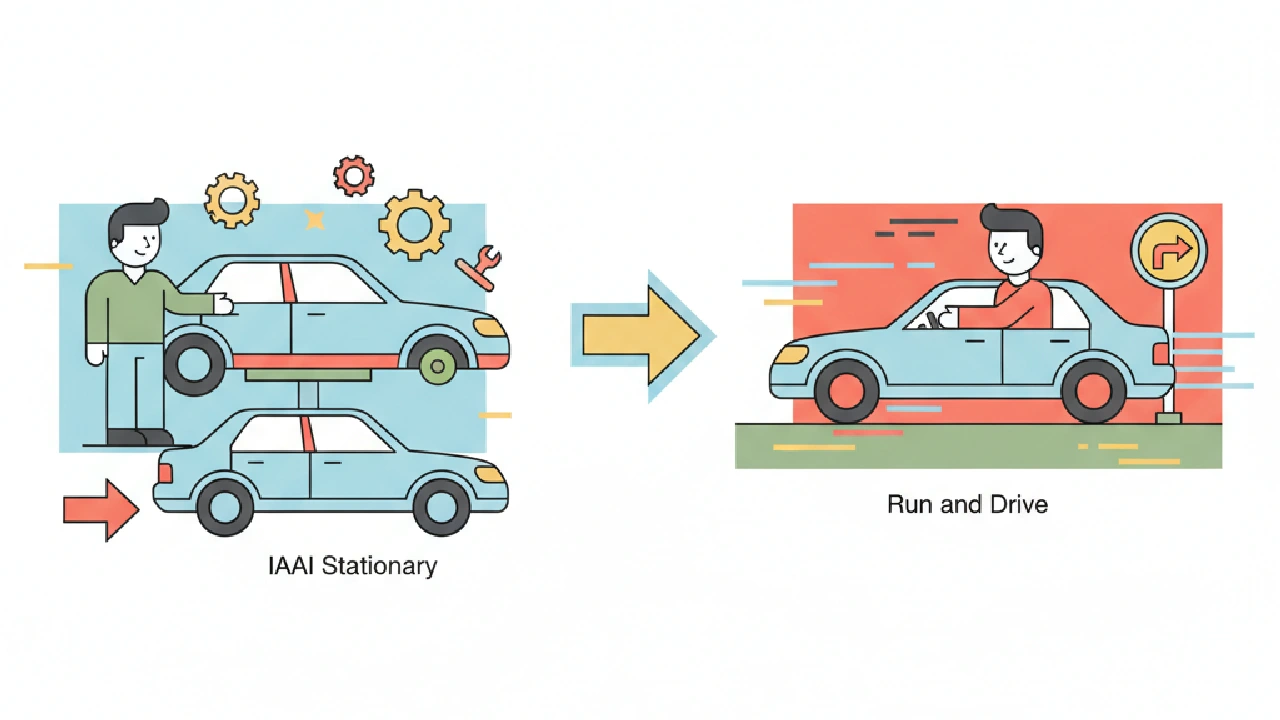
IAAI Stationary vs Run and Drive comes down to what happened in one check at the branch gate. Run & Drive means the motor started (a jump counts) and idled, forward and reverse both engaged, and the wheel turned one full rotation each way. Stationary means it wouldn't start, has engine damage, or wasn't tested on arrival.
Neither code is a promise. IAA says the status is set when the car arrives, and it isn't a warranty that the car will do it again or that it's roadworthy. Every IAA vehicle sells "as is, where is."
What IAA's three start codes actually say
IAA assigns a start code when a vehicle enters branch inventory. Here's each one in IAA's terms.
- Run & Drive. On arrival, the motor started (with or without a jump) and idled. Both forward and reverse gears engaged. The steering wheel made one full rotation in each direction. IAA says these functions aren't guaranteed at pickup.
- Starts. On arrival, the motor started (with or without a jump) and idled. That's all. IAA says it may not start, drive, or move forward at pickup.
- Stationary. On arrival, it won't start, has engine damage, or wasn't tested. IAA says it may not start, drive, or move forward at pickup.
Read that last one twice. "Not tested" sits under the same label as "engine damage." A Stationary tag tells you the yard didn't see it run. It doesn't tell you why.
IAA's Auction Rules go one step further. The optional IAA Vehicle Score doesn't guarantee the engine starts or that the car qualifies as Run & Drive. The rules control over anything on a listing page.
So treat the code as a snapshot from check-in day, not a diagnosis.
How each code moves your max bid
The formula doesn't change by code. What changes is how much you can trust two of its lines.
Max bid = ARV - repairs - auction fees - transport - profit target
Run & Drive takes some drivetrain doubt out of the repair line. You know the engine turned over, the transmission found both directions, and the steering column wasn't locked.
You still don't know how it shifts under load, how hot it runs, or whether it'll start at pickup. Keep a margin for pickup-day surprises.
Starts clears the engine-turns-over question and nothing else. Driving wasn't checked. If you won't eat a transmission or driveline job, bid Starts closer to Stationary than to Run & Drive.
Stationary puts the engine and transmission back in the unknown column. Price the repair line as if the bigger failure is real, unless photos or notes clearly point to something small.
Raise the transport line too. A car that may not roll can need a winch, a rollback, or extra yard handling.
There's no published IAA number for how much to add. Get a real quote from your transporter for a non-runner before you bid. Use your own parts and labor pricing for the worst likely repair, not a rule-of-thumb figure.
A hypothetical bid, two ways
Same car, two codes. These numbers are for illustration only.
- ARV $14,000, fees $1,200, profit target $2,500 in both cases.
- Run & Drive: repairs $3,500 (body plus a margin), transport $400. Max bid = $14,000 - $3,500 - $1,200 - $400 - $2,500 = $6,400.
- Stationary: repairs $6,000 (you priced in a used engine), transport $650 (your carrier quoted a non-runner). Max bid = $14,000 - $6,000 - $1,200 - $650 - $2,500 = $3,650.
The code didn't change the car's value. It changed what you have to assume about the car, and that cost you $2,750 of room.
Reading a Stationary lot before you write it off
Stationary lots scare off bidders. Sometimes that's right, and sometimes it's your spread. The listing usually tells you which, if you read it in this order.
- Damage line. Engine, front-end, or fire notes mean you treat the no-start as mechanical until proven otherwise.
- Engine-bay and underside photos. If the damage line says engine and the photos only show body panels, wait for more shots or pass.
- Keys. No key on a Stationary unit means extra labor just to diagnose it.
- Title notes. The start code doesn't change the brand. Heavy engine, structural, or fire damage makes both the repair and the titling harder. Put that in ARV, not in a made-up fee.
- Seller and history. Note the seller type and check the sales history. A car that sold and came straight back to auction is a red flag.
Here's a hypothetical way this goes wrong. A flipper sees "Stationary" plus a front hit and assumes a dead battery.
At the shop, it turns out the hit pushed the radiator into the fan and the engine overheated on the tow. That repair line was never in the bid.
For the shop-side math, see how to build a salvage repair estimate before you bid. For the hauling side, see the transport mistakes that shrink your max bid.
Before you bid on a start code, check this
- Read the code against IAA's wording, not the buyer forums.
- On Stationary, find out whether it's "no start," "engine damage," or "not tested" from the photos and notes.
- On Starts, decide up front whether you'll take transmission risk.
- On Run & Drive, still budget for a no-start at pickup.
- Get a non-runner transport quote for anything not coded Run & Drive.
- Price the worst likely repair with your own parts and labor numbers.
- Confirm the title brand separately. The start code says nothing about it.
If you also buy at Copart, its run-and-drive label has its own rules. See what run and drive means on Copart. For the full lot routine, use the IAAI pre-auction lot checklist.
IAA sets the start code. AutoFlip Pro doesn't set it, verify it, or inspect the car.
As an auto auction analysis tool for Copart and IAAI buyers, what it does is run the max-bid math from your repair and transport inputs, with a risk check on sales history, title type, runs-and-drives status, engine-start info, and seller type. Enter the Stationary-sized repair and transport numbers, then analyze an IAAI lot free before you bid.
Key takeaways
- Treat every IAA start code as a check-in snapshot, not a condition promise.
- Read Stationary as "unknown." It covers engine damage and "not tested" alike.
- Bid Starts closer to Stationary unless you'll take transmission risk.
- Get a real non-runner transport quote instead of guessing a cushion.
- Keep the formula the same and change the repair and transport inputs.
FAQ
Does IAAI Run & Drive mean the car is roadworthy?
No. IAA says Run & Drive means the car started, idled, engaged forward and reverse, and the wheel turned a full rotation each way on arrival. IAA states it's not a warranty the car will do that later or that it's roadworthy.
What's the difference between Starts and Run & Drive at IAAI?
Starts means the motor started and idled on arrival, nothing more. Run & Drive adds both gears engaging and the steering check. With Starts, the transmission and driveline were never tested.
Does Stationary always mean engine damage?
No. IAA's Stationary label covers a car that won't start, has engine damage, or wasn't tested on arrival. The photos, damage line, and keys are how you tell which one you're looking at.
How much extra should I budget to transport a Stationary car?
IAA doesn't publish a number, and you shouldn't guess one. Ask your carrier for a non-runner quote on that pickup location before you bid. Put that exact figure in your transport line.
Can a Run & Drive car fail to start at pickup?
Yes. IAA says these functions aren't guaranteed at pickup. Plan a jump pack and a backup tow option even for Run & Drive lots.