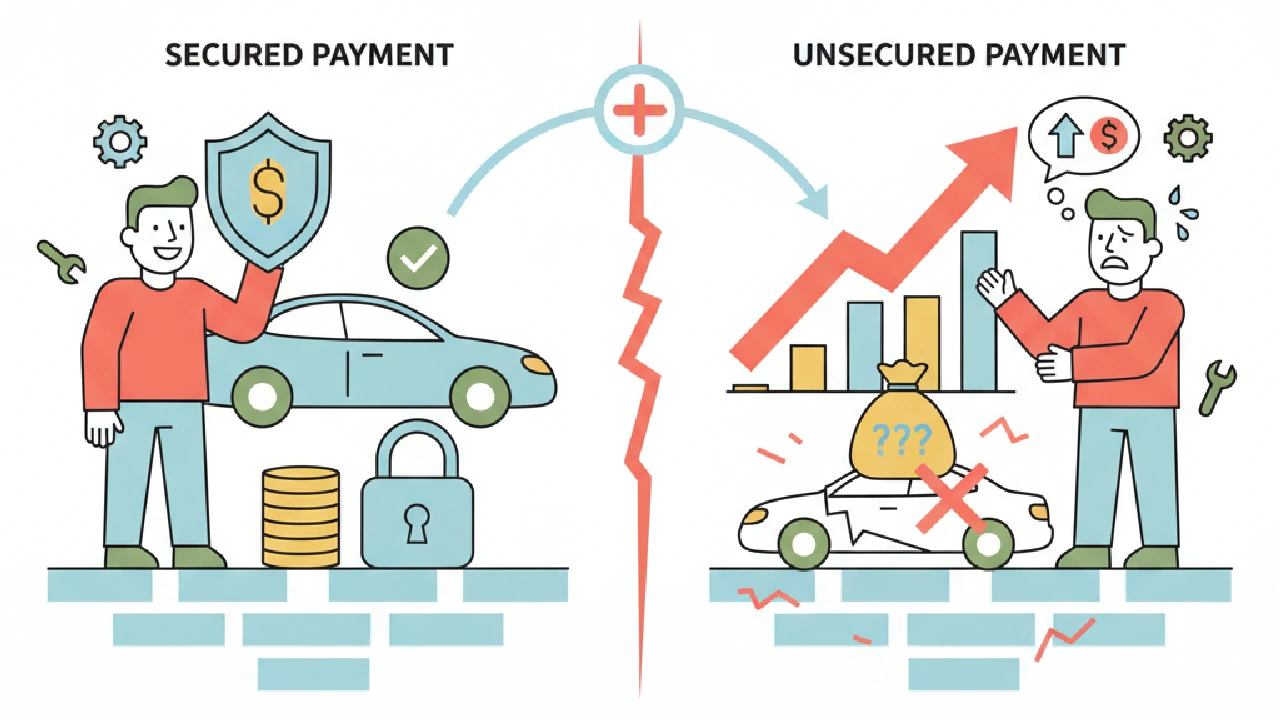
Win a $4,500 salvage lot as a non-licensed buyer and Copart's buyer fee is $750 if you pay by debit card or wire. Pay the same lot by credit card and that fee is $1,000. Same car, same hammer price, $250 gone before the truck shows up.
That gap is the whole story of Copart secured payment vs unsecured payment. Copart prints two buyer fee tables side by side, and the way you pay picks the table. Here is what counts as secured, how big the gap really is at different bids, and the split payment mistake that puts a whole lot on the expensive table.
What Counts as a Copart Secured Payment?
Copart sorts payment by how sure it is the money will land. Its help page says methods are "secure or non-secure based on the risk of the funds not reaching Copart," and that it "offers a discount on secure payment methods" (Copart Help: Pay For Your Vehicles).
The Copart Member Fees page lists the two groups on the fee table headers, as of October 21, 2026:
- Secured: debit card, wire transfer, MoneyGram, and Canada Corporate Creditor Account.
- Secured, subject to approval: cash, company check, ePay, third party financing, Available Funds, and Western Union Business Solutions GlobalPay X.
- Unsecured: credit card, Apple Pay, Google Pay, and PayPal.
A few of those come with strings. Copart's Payment Options page says ePay is only for select Power Buyers, company checks are only for approved business buyers, and personal checks are not accepted. It also says Copart does not take cash for the vehicle itself, only for fees.
Cashier's checks are not on either list on the current fee page. If that is how you like to pay, ask Copart how it will be treated before you count on the lower table.
Card payments have a ceiling too. Copart says debit and credit card purchases "are limited to around $20,000 USD per day," and the card must be in the account holder's name. Decision rule: if the lot plus fees is near that number, plan a wire.
How Big the Buyer Fee Jump Really Is
Here is the part most guides get wrong. Below $15,000, the unsecured buyer fee is not a percentage markup. It is a separate dollar amount in each bid bracket, so the gap moves around as the price climbs.
These rows come from the US Non-Licensed, standard vehicle tables on the Copart Member Fees page, checked October 21, 2026. The gap is simple subtraction.
| Final bid | Clean: secured | Clean: unsecured | Clean gap | Non-clean: secured | Non-clean: unsecured | Non-clean gap |
|---|---|---|---|---|---|---|
| $1,000 | $325 | $385 | $60 | $375 | $440 | $65 |
| $2,500 | $500 | $650 | $150 | $610 | $775 | $165 |
| $4,500 | $750 | $1,000 | $250 | $750 | $1,000 | $250 |
| $7,500 | $815 | $1,065 | $250 | $900 | $1,175 | $275 |
| $10,000 | $850 | $1,200 | $350 | $1,000 | $1,390 | $390 |
| $15,000 and up | 7.25% | 12.25% | 5 points | 7.50% | 12.50% | 5 points |
So the "5% more" line you see online only applies at $15,000 and up. On a $2,500 clean car, the card costs you $150 more. On a $10,000 clean car it is $350.
Licensed buyers have separate tables, and some of those run lower. Check the Member Fees page inside your own Copart account to see your schedule. For why the base fees run this high in the first place, see why Copart fees are so high, and for every line on the invoice, read Copart fees explained for 2026.
Decision rule: find your bracket and your gap before you bid, not at checkout.
The Split Payment Trap
A lot of buyers figure they can wire most of the balance and put the last few hundred on a card. Copart's fee page shuts that down: "If any portion of the payment is applied with non-secure funds, non-secure funds fees apply for that unit."
In plain terms, one card dollar moves the whole lot to the unsecured table. Take a hypothetical $4,500 salvage lot that comes to $5,485 paid secured. Wire $5,000 and put the last $485 on a credit card, and the buyer fee goes from $750 to $1,000 on the whole car.
Available Funds have their own rule. Copart says they "cannot be used for partial payment with an unsecure form of payment."
Decision rule: pick one secured method per car and cover the full balance with it. If you are short, move money before the sale, not after. The bracket math behind this is in Copart buyer fee calculator math.
Hypothetical: One Salvage Lot, Two Ways to Pay
This example is hypothetical. It assumes a US buyer with no business license, a standard car with a non-clean (salvage) title, a $4,500 final bid won with a live online bid, and the title mailed later. Every fee comes from the Copart Member Fees page as of October 21, 2026.
| Line | Paid secured (debit or wire) | Paid unsecured (credit card, PayPal, Apple Pay, Google Pay) |
|---|---|---|
| Final bid | $4,500 | $4,500 |
| Buyer fee ($4,500 to $4,999.99 bracket) | $750 | $1,000 |
| Gate fee (non-clean) | $95 | $95 |
| Environmental fee (non-clean) | $15 | $15 |
| Virtual bid fee, live ($4,000 to $5,999.99) | $125 | $125 |
| Total at Copart, before title, storage, and transport | $5,485 | $5,735 |
Only the buyer fee changes. Gate, environmental, and bid fees are the same either way.
Now flip it around. Say your all in ceiling at Copart is $5,485 and you know you will pay by card.
In the $4,000 to $4,499.99 bracket the unsecured non-clean buyer fee is $935, so a $4,250 bid lands at $4,250 + $935 + $95 + $15 + $125 = $5,420. Paying by card means your max bid has to drop by about $250 on this car.
Two more hypothetical clean title checks, live bid, no license:
- $10,000 bid: $11,078 secured vs $11,428 unsecured, a $350 gap.
- $16,000 bid: buyer fee of $1,160 at 7.25% secured vs $1,960 at 12.25% unsecured, an $800 gap on that fee alone.
Decision rule: price the lot on the table you will actually pay on. The full method for setting a ceiling is in our Copart max bid strategy.
Payment Deadlines, Late Fees, and Wire Problems
Wires are secured, but they are slow, and Copart's clock does not wait for your bank. Copart says funds must be received within 3 business days, counting the day of sale, or a $50 late fee hits each vehicle (Copart: Pay and Pick Up).
Copart's wire transfer help page says domestic wires typically take 24 to 48 hours. A wire sent late on day 3 can land after the deadline. So send it the day you win if you can.
The wire also has to come from an account in the exact name on your Copart profile. Copart warns a name mismatch can delay or reject the payment, and that rejections can take up to a week to process. Your bank charges its own wire fee on top, so check that with your bank.
Miss payment for longer and it gets expensive. If a lot is not paid in full within 8 calendar days, counting sale day, Copart relists it and charges 10% of the final sale price with a $600 minimum. The details are in how much the Copart relist fee is.
Storage runs on its own clock. Copart holds a car free for up to three days, counting the day you bought it, and rates after that vary by yard.
Our Copart storage fee timeline walks through when charges start. Once you are paid, get your Copart gate pass PIN to your hauler fast.
Secured Payment Lowers Fees, Not Title Risk
Paying by wire changes one thing: which buyer fee table applies. It does nothing for the car's title brand, damage, or whether your state will let you put it back on the road.
Check the title group in the Title Code tooltip on the lot page before you bid. Clean and non-clean lots sit on separate fee tables, and non-clean lots also pay a $95 gate fee and a $15 environmental fee instead of $79 and $0.
Decision rule: settle the title question first, then the payment method, then the bid.
Where AutoFlip Pro Fits Before the Bid
AutoFlip Pro is an auto auction analysis tool for Copart, IAAI, and bid.cars lots. Its free Copart Fee Calculator has a Payment method field, so you can switch between secured and unsecured and see the buyer fee change on your exact bid. The max bid calculator then adds transport, repairs, and your profit target on top of the fees.
Before your next bid, run a free Copart lot analysis and check the max bid against your own numbers.
Before You Pay for a Copart Lot, Check This
- You know which fee schedule your account is on (licensed or non-licensed).
- You checked the title group in the Title Code tooltip.
- You found the buyer fee for your bracket on the table you will actually pay on.
- The full balance goes on one secured method, with no card top up.
- Your bank account name matches your Copart profile exactly.
- The wire goes out the day you win, well inside 3 business days.
- If you are paying by card, the total fits under the roughly $20,000 per day card limit.
Key takeaways
- Pay with debit card, wire, or MoneyGram to stay on Copart's lower buyer fee table.
- Budget the real gap for your bracket. It is a flat dollar amount below $15,000 and 5 percentage points at $15,000 and up.
- Never split one car between a wire and a card. Any unsecured dollar puts the whole lot on the unsecured table.
- Send wires early from an account in your exact Copart name so a delay does not turn into a $50 late fee.
FAQ
Does a credit card always cost 5% more at Copart?
No. On the US Non-Licensed standard tables, the 5 point gap only applies at $15,000 and up. Below that, the unsecured fee is a separate dollar amount per bracket, such as $1,000 vs $750 on a $4,500 bid.
Can I wire the bid and put the fees on a credit card?
Not without paying more. Copart says that if any portion of a lot's payment uses non-secure funds, non-secure fees apply to that unit. Put the whole balance on one secured method.
Is a debit card secured at Copart?
Yes. Copart lists debit card as a secured method, along with wire transfer and MoneyGram. Credit card, Apple Pay, Google Pay, and PayPal are unsecured, and any card purchase is limited to around $20,000 per day.
What happens if my wire arrives late?
Copart charges $50 per vehicle if funds are not received within 3 business days, counting sale day. If the lot is still unpaid after 8 calendar days, Copart relists it and charges 10% of the sale price, with a $600 minimum.