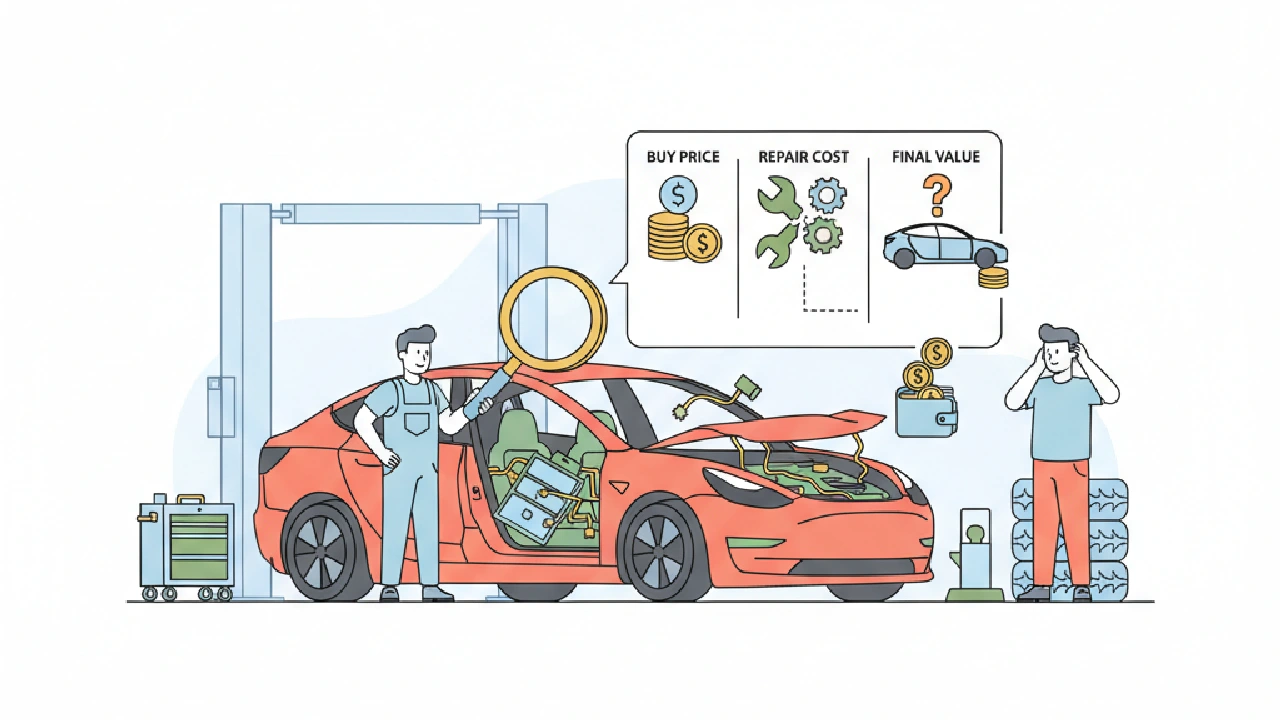
Is buying a salvage Tesla worth it? Short answer: not for most buyers. I buy on Copart and IAAI — this is the pre-auction briefing. No fluff. Numbers come from industry guidance, clear rules, and hard lessons. If you plan to bid on a salvage Tesla, read this first.
Core idea — what you must accept before you bid
Buying a salvage Tesla changes the rules. You lose normal resale paths, face higher repair bills, and can lose access to official services and Supercharger privileges. If you’re not set up to absorb that risk, walk. For a practical checklist I use on auction day, see how to analyze a Copart or IAAI lot before you bid.
1) Max-bid math — how I set my ceiling at Copart/IAAI
Set one number: your absolute walk-away maximum. Treat everything else as noise. My formula is simple and strict. Start with an ARV baseline for a clean-title equivalent (see salvage car comps: how to set comparable values), then apply realistic discounts and extra costs.
Do this in percent so you don’t invent false dollar confidence. If a clean-title comparable is 100 (that’s your ARV), expect the market reality to be lower on salvage Teslas. Industry guidance says salvage units often carry a real value loss in the 20–40% range versus clean titles. But auction listings sometimes only drop prices 5–10% off market. That gap is the trap. For tactical bidding mechanics on Copart, review setting your Copart max bid without overpaying.
A practical way to avoid that trap is to let a disciplined calculator do the heavy lifting. AutoFlip Pro’s Intelligent max bid calculator combines market-value estimates, repair cost inputs, transport, auction fees, and your target profit margin to produce a disciplined ceiling — use that when your gut conflicts with the listing price. It maps directly to the problem above: you’ll see when a 5–10% listing discount still leaves a negative spread after real repairs and fees.
So my max-bid math goes like this (percent version you can scale to any ARV):
- ARV = 100 (clean-title market price).
- Real salvage true resale value = ARV minus 20–40% (so 60–80 on the same scale).
- Estimate repairs — plan for repairs often exceeding $12,000 even on what look like minor damage.
- Subtract those repairs and your buyer fees/transport from the salvage purchase price to calculate the spread.
Example logic without inventing extra numbers: if the listing price only discounts 5–10% but the true resale value is down 20–40%, you’re buying a vehicle priced too close to market. That kills the spread unless the repair number is zero — which it almost never is for Teslas.
2) Title risk — why Tesla-specific title rules break common exit strategies
Tesla treats branded titles differently than many other makes. Expect three complications you won’t see on a Honda or Ford.
- Tesla will not accept salvage, rebuilt, or certain branded title trade-ins. That closes a clean dealership exit.
- Insurance and financing are harder. Insurers can levy surcharges up to 20% or refuse full coverage. Lenders often avoid salvage vehicles entirely.
- Software and account-level restrictions happen. If the repair path didn’t follow Tesla standards, you may face disabled features or Supercharger restrictions.
Practical result: you must plan to own and hold, or sell to a private buyer who accepts salvage. Don’t rely on trading the car back to Tesla or a dealer. For a deeper look at how title brands affect flip economics, see salvage title brands that kill your flip spread.
3) Repairs, software, and the hidden costs you’ll get surprised by
Cosmetic damage is cheap. Structural, battery, and electrical work are not. Teslas hide complexity behind body panels and software. Two specific pain points:
- Battery and alignment issues. Damage to packs or chassis rails looks fixable on photos. In reality it can require deep teardown and recalibration. Industry guidance flags repair bills commonly exceeding $12,000.
- Software reconciliation. If a vehicle has been repaired outside Tesla’s protocols, vehicle software may show faults or features may be restricted. Restoring full functionality can be a technical fight.
If you’re not a trained EV tech with access to proper parts and tooling, plan to pay shop rates. If you are an EV rebuild shop, verify part availability and whether Tesla will accept replaced modules for any remaining warranty/servicing interactions. When you inspect photos and records at auction, use a salvage-auction lot analysis to check for structural and battery red flags — see how to analyze a salvage auction lot like a pro before you bid.
4) Mini-case: how the spread vanishes — percentage math you can run on any listing
Run this at the listing screen. I do it in the lot before clicking bid.
- Step 1 — Pick your clean-title comparable and call that 100 (this is ARV in percent terms).
- Step 2 — Ask: is the salvage listing priced at a small discount (5–10%) or a large one? If it’s only 5–10% below the clean market, you’re in danger.
- Step 3 — Reduce ARV by expected salvage value loss: apply 20–40% to estimate realistic resale value post-repair.
- Step 4 — Subtract the known repair estimate. Industry guidance shows repair bills often exceed $12,000 on Teslas. Put that number into your equation before fees.
- Step 5 — Add buyer fees, transport, and any state rebuild/title costs. If those push you past the post-repair resale estimate, do not bid.
Concrete read: if the listing only dropped 5–10% but the vehicle will realistically sell at 20–40% below a clean title, you must assume the spread is negative unless repairs are virtually nil. That’s not speculative — it’s the auction operator’s math. Walk or very low-ball.
5) Exit strategy — selling, insuring, and the buyer pool
Plan the exit before you buy. With a salvage Tesla your buyer pool shrinks. Many private buyers won’t touch a branded title. Dealers and Tesla won’t accept it. Insured buyers may demand reduced coverage or charge higher premiums — industry guidance notes insurers can add surcharges up to 20% or decline coverage.
Good exit options if you still buy:
- Sell to an EV rebuilder or body shop that will repair to a known standard.
- Hold and use as a daily driver if you accept the risks and lost resale value.
- Export to a market where rebuilt titles are acceptable (local rules vary).
Bad exits: assuming you’ll trade it to Tesla later. Tesla rejects salvage/rebuilt trade-ins. Don’t budget for that escape hatch.
Where a salvage flip tool helps
If you want a quick, objective check before you pull the trigger, two AutoFlip Pro capabilities map directly to the biggest auction-day failure modes:
- Risk Level Calculation — flags sales-history red flags, title-brand impact, runs-and-drives and engine-start signals so you don’t overpay for repeatedly sold or high-risk lots.
- Market-value estimation + Max Bid Calculator — combines comparable listings, repair inputs, transport, fees, and your profit margin into a disciplined maximum bid instead of relying on gut math.
Use those checks to rule-out listings quickly. If you want to test them on a live lot, analyze a salvage Tesla lot free before you bid.
Key takeaways
- Set one absolute max-bid number using ARV minus 20–40% and repairs — don’t chase listed discounts of only 5–10%.
- Tesla title rules close major resale and service paths. Factor that in before you bid.
- Repairs often exceed $12,000 on Teslas. Treat that as a realistic line item in your math.
- Insurance and financing can be harder or costlier — assume surcharges up to 20% or worse.
- Only buy if you control repairs, parts, or you plan to keep the car long-term.
FAQ
Can I trade a salvage Tesla back to Tesla later?
No. Tesla will not accept trade-ins for vehicles with salvage, rebuilt, or other branded titles. Do not count on trading it back to Tesla.
Are repairs for Teslas always more expensive than ICE cars?
Often yes. EV-specific parts, battery work, and software reconciliation add cost. Industry guidance shows repair bills commonly exceeding $12,000 on salvage Teslas. Plan for that.
Will insurance cover a salvage Tesla?
Maybe. Some insurers will provide coverage but can add surcharges or exclude full protections. Industry guidance notes insurers can add surcharges up to 20% or decline full coverage. Get written insurance terms before you bid.
When is a salvage Tesla worth buying?
Rarely. It may be worth it if you’re an experienced EV rebuilder, have parts access, or the vehicle is priced far below market and repairable without Tesla-only parts. If you plan to sell later, it’s usually not worth the risk.
Final checklist — what I do before I bid
- Confirm ARV with recent clean-title comps.
- Run the percent math: ARV minus 20–40% salvage hit, minus expected repairs (plan for $12,000+), minus fees/transport.
- Verify title branding with DMV records and insurer willingness to cover.
- Check the Tesla app/account if possible — confirm Supercharger/feature access before you buy.
- If anything in the math goes red, don’t chase. Walk.
If you want, send me one listing link and the clean-title comps you’re using. I’ll run the percent math and tell you whether it’s a paste-on-the-deck buy or a hard pass.