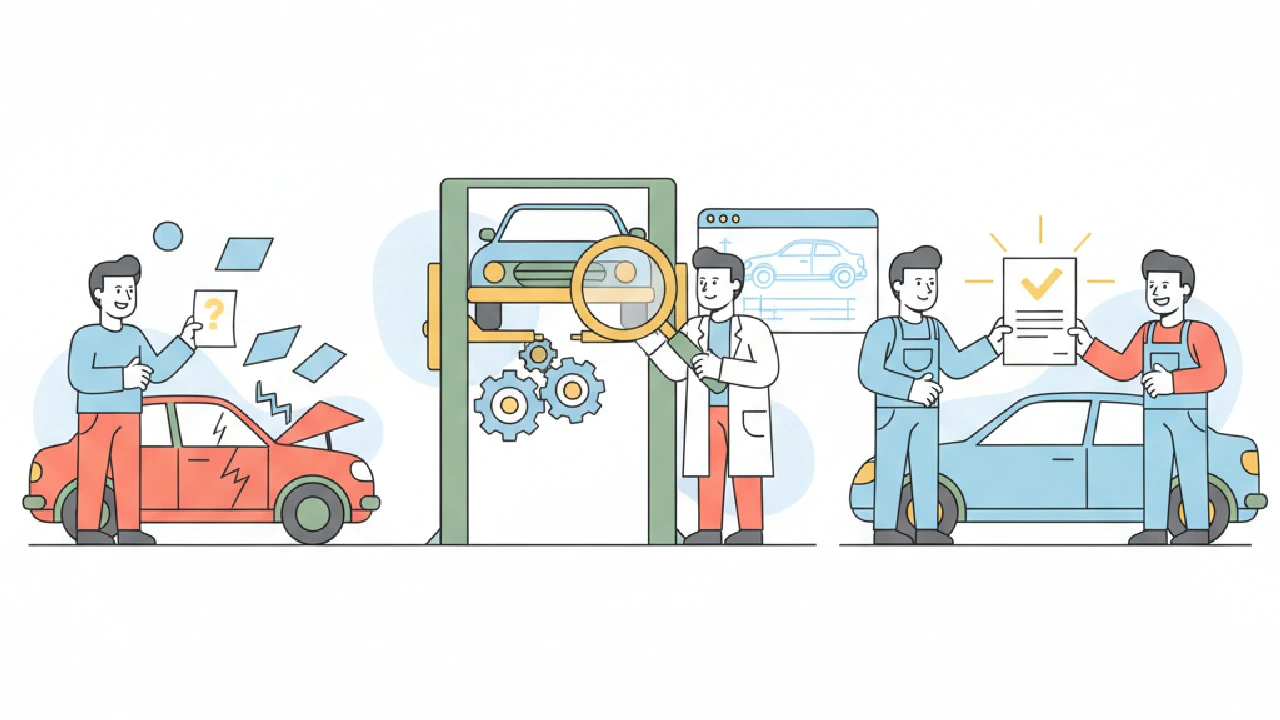
Short version: a rebuilt title inspection confirms a previously totaled car was repaired without stolen or unsafe parts (see what a salvage title means: what a salvage title means for buyers). If you flip salvage from Copart or IAAI, know what the inspector will look for, what paperwork they demand, and how the inspection changes the math on your max bid.
1) Core idea — what inspectors actually check
Keep this in mind: inspectors focus on three pillars. They want the frame and control points straight, safety systems reset and working, and the VIN and parts to be traceable. That means structural integrity; safety systems (airbags, seatbelts, brakes, suspension, lights); and anti-theft/VIN verification. For a step-by-step pre-bid checklist on lot-level checks, see how to analyze a salvage auction lot before you bid: how to analyze a salvage auction lot before you bid.
Don’t expect a paint-perfect cosmetic review. Inspectors look for stolen parts and whether the vehicle meets the state's baseline roadworthiness rules. In some states the exam is mainly about stolen parts; in others it’s a full safety check. Know your state.
2) State traps that wreck flips
Every state runs the inspection differently. This is where people get hammered.
- New York: The DMV salvage examination is run to detect stolen parts, not to certify safety or emissions. It’s a separate process from the standard safety inspection. The fee is roughly $200–$205. If you win a car thinking the rebuilt stamp means it’s road-ready, you can still fail the safety inspection later.
- North Carolina: They separate a quick VIN check (15–30 minutes, fee about $20) from a full salvage-to-rebuilt conversion (45–90 minutes). A VIN check won’t be enough if airbags need resetting or structural work was done.
- New Hampshire & Maryland: These states have appointment fees noted in their public guidance — New Hampshire listed $60 and Maryland $75 for salvage exams. A lower fee doesn’t mean a laxer inspection; it just changes your pre-bid cost planning.
- Across provinces and states: Standards vary. A rebuilt title in one state may mean something different in another. Don’t assume equivalence.
3) Max-bid math — how inspections affect your ceiling
You must fold inspection odds and fees into your max bid before hammer time. The inspection is a real cost and a gating event. Build it into the spread, not as an afterthought.
Calculate your max bid like this (use variables if you flip across states):
- ARV — the market value after repair (estimate as X).
- Target profit — what you need to make (Y).
- Known fees — inspection fee (state number), auction buyer fee, title transfer, transport (Z).
- Repair contingency — realistic repair budget (C) and additional contingency for hidden structural or electrical issues (see the salvage auction repair estimate for pre-bid repair math: salvage auction repair estimate).
Max bid = ARV - Target profit - Known fees - Repair contingency - Contingency buffer.
If you’re buying in New York, add roughly $200–$205 to Known fees because you’ll pay that salvage examination fee. If you might be redirected to a North Carolina VIN check instead, include about $20 plus the time-risk of needing the longer salvage-to-rebuilt conversion (45–90 minutes) which may flag more problems.
Do not forget paperwork time and potential rework if the inspector rejects a component for lack of documented origin. That’s a cost in both cash and days on the lot.
4) Paperwork and proof that actually wins inspections
Inspections fail more often from missing paperwork than from a scuffed bumper. Bring receipts and part IDs that tie replacement parts to the vehicle VIN. In many jurisdictions inspectors will ask for original invoices showing stock numbers and VINs for replacement components. Use a first salvage flip checklist to make sure you have every required document before exam day.
If you used aftermarket parts, be ready to prove they weren’t stolen. If you swapped modules, have the reset or reprogram logs. If an inspector asks for proof of ownership on rebuilt components, you don’t want to be asking the yard to pull invoices at 8:55 AM on exam day.
5) Title risk — what the rebuilt brand actually means
Passing an inspection results in a permanent rebuilt/reconstructed brand on the title. That brand stays on the record. Buyers downstream will price that in. Treat a rebuilt title as a permanent discount to ARV — here's why rebuilt vs salvage title matters for resale: what a rebuilt brand means for resale.
Also, a rebuilt title does not equal thorough repairs. Passing is a bare-minimum threshold in many states. Use a mechanic or frame shop inspection before you buy if you value higher resale or a clean sale to dealers.
Mini-case: inspection fees change the bid
Scenario: you’re flipping regionally and want to compare state inspection costs before you bid. Use this exact fee data that states publish.
- New York salvage examination fee: roughly $200–$205.
- North Carolina VIN-only check: fee about $20 and it takes roughly 15–30 minutes. The full salvage-to-rebuilt conversion can take 45–90 minutes and includes airbag reset and structural checks.
- New Hampshire appointment fee: $60.
- Maryland salvage inspection fee: $75.
How this plays in real math: if you expect a quick VIN check only and that’s $20, you might accept a slightly tighter spread than for a vehicle likely routed through a New York salvage exam at ~$200. Don’t assume the cheaper fee equals easier passing — it just changes your pre-bid outlay and your decision threshold on marginal deals.
Actionable moves on auction day
- Before you bid, identify the book state for title branding and the destination state for registration. If you need lot-level prep specific to Copart or IAAI, follow guidance on how to analyze a Copart or IAAI lot before you bid: how to analyze a Copart or IAAI lot before you bid.
- Confirm the state’s inspection fee and whether the exam focuses on stolen parts, safety, or both.
- Have original invoices or bill of sale for replacement parts ready to upload or hand to the inspector.
- Factor the inspection fee (use the state number) into your max bid math before you click confirm.
- If a vehicle needs airbag reset or frame work, assume the longer inspection pathway (like NC’s salvage-to-rebuilt process).
Where a salvage flip tool helps
Inspections often reveal red flags you missed at the lot — sales history or repeated prior "sold" entries are a major example. AutoFlip Pro's Risk Level Calculation (sales history, title type, runs & drives, engine start, insurance-seller signal) highlights lots with higher inspection risk, and its Max Bid Calculator helps fold inspection fees and expected rework into a safe bid ceiling.
- Use the risk score to spot lots with multiple prior sales or insurance-seller signals before you bid.
- Use the max-bid output to include state-specific inspection fees so you don't bid past your spread.
Try a free lot analysis to see inspection-risk signals on a Copart or IAAI listing: analyze a lot free before you bid.
Key takeaways
- Know which state inspection you’ll face. Fees range in public guidance — NY about $200–$205, NH $60, MD $75, NC VIN check about $20.
- Inspection is a gating cost. Fold it into max bid math before you attempt a spread.
- Bring paperwork for parts and module resets. Missing proof fails inspections more than cosmetics do.
- Passing gives you a permanent rebuilt brand. That’s a market reality you price into ARV.
FAQ
What does a rebuilt title inspection look for?
Inspectors check structural integrity, safety systems, and VIN/part tracing. Expect frame or control point checks, airbag and seatbelt function, and VIN verification to detect stolen parts.
Are inspection fees the same everywhere?
No. Fees and focus vary by state. For example, New York's salvage examination fee is roughly $200–$205, New Hampshire's guidance shows $60, Maryland lists $75, and North Carolina charges about $20 for a quick VIN check.
Can I register a salvage car before it passes inspection?
Generally no. Most states require the salvage-to-rebuilt process or a salvage examination before issuing a registration or a rebuilt title. Operating a salvage vehicle on public roads is often restricted except when traveling directly to an inspection.
What paperwork do inspectors demand?
Original invoices and receipts tying replacement parts to the vehicle VIN, proof of ownership for donor parts, and reset/reprogram logs for airbags or modules. Without documentation many inspections fail or delay you significantly.
If it passes the inspection, is the car fully safe?
Passing is a minimum standard. It shows the vehicle met the state's rebuild criteria. It is not a full guarantee of long-term reliability. Get a mechanic check if you intend to retail the car at a premium.
Final checklist — what to bring and do
- Confirm which state's inspection applies and its exact fee.
- Print original invoices and part stock numbers tied to the VIN.
- Have module reset logs and airbag repair receipts ready.
- Include the inspection fee in your max bid math before you bid.
- Plan logistics: transport to the exam site and contingency days for rework after a failed exam.
That’s the short, practical brief. Treat the rebuilt title inspection as a predictable gate in your flip workflow — plan the fee, pack the paperwork, and never bid past the line the inspection will push you to cross.