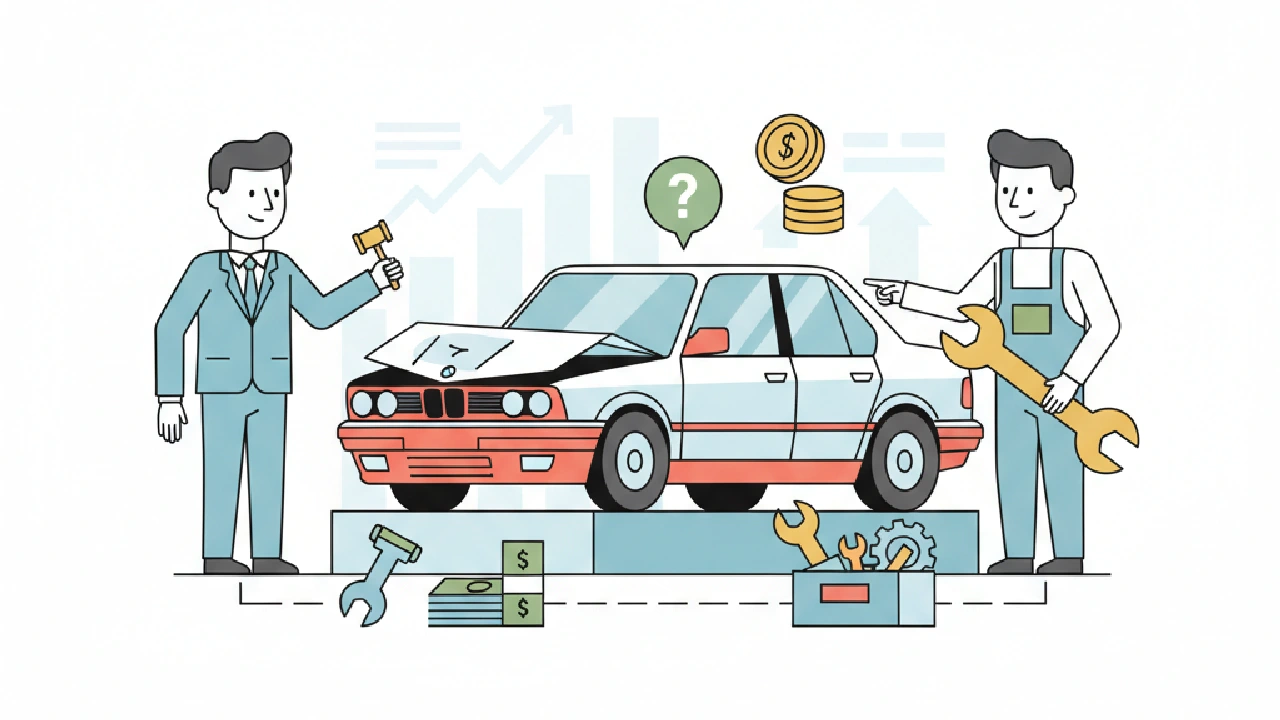
Quick: if you buy salvage BMWs without a hard checklist, hidden costs will eat your spread. This guide is about the specific traps that kill flips — not theory. Read it before you log into Copart/IAAI. The primary focus: salvage bmw flip hidden costs and what to do on auction day.
Core idea — buy the problem you can fix, not the price
The auction price is the bait. The sale invoice, repair reality, and title rules are the hooks. Treat every BMW like an electronics and structure package. If you need a quick lot-analysis checklist, analyze a salvage auction lot like a pro before you bid. If you can't confirm the hidden items below, sit out. The goal on auction day is to make a firm ‘no’ faster than a reckless ‘yes.’
1) Hidden damage categories to flag immediately
When you see a salvage BMW, these are the hidden-cost flags that matter more than a dented bumper:
- Structural damage. Frame bends or unseen chassis damage are the worst. Structural repairs commonly run $2,000–$10,000+. If the car shows any signs of impact near crumple zones, walk unless you can confirm frame repair history or a professional inspection.
- Airbag deployments. Airbag jobs can be a wallet killer. Look for “deployed” or airbag module fault notes — budget $1,500–$4,000 for parts, sensors, and reset work.
- Electrical faults. BMWs hide electrical gremlins. Modules, CAN-bus issues, coolant-pump failures and sensor errors may appear only after a test drive or diagnostic scan. Plan $1,000–$5,000 depending on the module and coding needed.
- Cooling and drivetrain issues. Failures here often surface after towing. They add diagnostic hours, parts, and labor time.
- Buyer premiums and paperwork. Public and brokered buyers still pay auction buyer fees plus gate/service and related charges. For planning, expect an effective buyer-fee burden often in the high-single to low-double-digit percent range of hammer on mid-range lots — and verify the lot fee calculator. Those fees can erase a large share of the paper spread.
Short rule: if you see the words “frame,” “structural,” “airbag,” or “electrical” in the auction notes, treat the lot as a specialist job and either price it like one or pass. Don’t bid on hope. For more on phrasing to watch, see 5 Copart red flags hidden in sales history.
2) Max-bid math — the 70% rule and where it fails
Before you click bid, run one rule: the 70% all-in rule. Total investment (purchase + repairs + auction fees + transport) must not exceed 70% of expected resale value. That rule is blunt, but it prevents emotional overbids.
Why it works: modern BMWs can look cheap at auction, but labor and parts for repairs often run higher than sedan-basics. Specialist labor often runs 20%–40% above generic shop rates. Use that to pressure-test any shop estimate you get off the lot sheet. Also refer to salvage car comps to bid like a pro when assembling resale comps.
Use AutoFlip Pro’s Intelligent max bid calculator to apply the same math without juggling spreadsheets: it pulls local comparable listings for a clean market value, applies title discounts, adds transport cost and auction fees, and factors repair cost, target profit and risk adjustments so you see a suggested max bid. Make sure your profile settings (zipcode and default destination) are correct so the comps and transport distance match your market.
Practical auction-day steps:
- Check the auction fee calculator for buyer fee and related charges. Apply a conservative fee estimate (often high-single to low-double-digit percent effective on mid-range lots) before you add repairs — then verify live fees.
- Assume at least one item will land in the higher end of the provided repair ranges. For electrical and airbag issues, assume the higher-end scenarios are possible and price accordingly.
- If your total is creeping above the 70% line, stop. Walk away. That’s where most flips go from profit to break-even or loss.
Note: people under-estimate the fee side every auction. Buyer fees and related auction charges are not optional. Put them on the front line of your max-bid calc.
3) Title and resale risk — the long tail that eats profit
Salvage titles reduce market demand. Some buyers won’t touch salvage BMWs at any price. Even after repairs, resale value can take a permanent hit. Your exit strategy must be ironclad before the paddle goes up.
What to check on auction day:
- Is the car flagged with a salvage title, salvage record, or unspecified history? If yes, do comps only among salvage-titled resales, not clean-title ads. Be realistic about buyer pool.
- Will the car require special inspections or VIN checks to register? Those steps add hold time and friction. More hold time equals more exposure to changing market prices.
- Can you legally repair and re-register this vehicle where you plan to sell it? Rules vary and they change demand; if re-registration is uncertain, don’t bid.
If your buyer channel is retail to private buyers, avoid anything with complex title risk. Wholesale buyers or parts-only channels are better fits for messy-title lots. Also read salvage title brands that kill your flip spread to understand title-brand impacts on resale.
4) Repair realities — ranges, surprises, and labor
Repair estimates on auction listings are optimistic. The research guidance lists repair ranges and a recommended contingency. Key points to run through before you bid:
- Repair ranges the research highlights: common fixes often fall in the $1,500–$5,000 band. Structural repairs carry a wider band ($2,000–$10,000+).
- Add a contingency. The guidance recommends adding 20%–30% for hidden damage. If a shop gives you a number without that buffer, add it yourself.
- Expect shops that specialize in BMWs to charge 20%–40% higher labor. Build that into your expense model rather than hoping to negotiate it away.
Practical tip: ask shops specifically about calibrations, coding, and module pairings — those are where BMW bills stack up and where auction estimates frequently fall short.
Mini-case: the X5 that looked like an instant flip
Real-world example from the ground: a BMW X5 bought for $8,500 at auction was resold for $35,000 after fixing hidden frame damage and airbag issues — but the flipper likely underestimated repair costs by 30%+. On paper the spread looked huge. In practice the hidden structural and safety work created delays and cost overrun risk.
Lesson: paper spread without a verified repair plan is a mirage. That X5 proves the point: big upside exists, but only for buyers who budget the full hidden-cost stack and the additional repair margin called out in the notes.
5) Auction-day playbook — how to behave live
On auction day do these things, in this order:
- Scan lot notes for the high-risk words: frame, structural, deploy, airbag, flood, wiring, electrical.
- Pull the title status and registration flags. If the title status isn't clear, treat it as a title risk.
- Call your BMW tech or shop. Ask one direct question: would you take this car as a shop job with my price cap? If they hesitate, don’t bid.
- Apply the 70% rule using salvage-market comps. Use only comps with similar title/condition. If comps aren’t available in your radius, widen the search but discount aggressively for transport and buyer pool shrinkage.
- Factor buyer fees and related auction charges. Use a conservative planning estimate and verify on the lot calculator.
- Decide max bid and stick to it. If you get emotional, walk. For Copart-specific bidding technique, see setting your Copart max bid without overpaying.
Auctions are not fishing expeditions. Treat them like RFPs: define constraints, evaluate price, and award the contract only when constraints are met.
Where a salvage flip tool helps
Buying high-risk lots without seeing red flags until after payment is one of the most common killers of salvage flips. A tool that scores risk from sales history and title notes can save you from those blind buys.
- Risk-level checks: sales history, title type, runs & drives, engine starts, and insurance-seller flags help identify lots that need a specialist approach.
- Max-bid support: automating market-value comps, title discounts, transport, auction fees, repair cost, and target-profit math reduces spreadsheet errors and speeds decisions.
If you want to see these checks applied to a real lot before you bid, analyze a lot free before you bid and compare the flagged risks to your checklist.
Key takeaways
- Run the 70% all-in rule: purchase + repairs + fees + transport must not exceed 70% of expected resale value.
- Flag structural, airbag, and electrical notes first — these drive the largest hidden costs ($2,000–$10,000+; $1,500–$4,000; $1,000–$5,000 respectively).
- Account for auction buyer fees and related charges up front (verify on the lot calculator).
- Add 20%–30% contingency to shop estimates and assume labor rates 20%–40% higher for BMW specialists.
- If title or registration risk exists, switch to wholesale/parts strategy or walk.
FAQ
How do I calculate my max bid on auction day?
Use the 70% all-in rule: total investment (purchase + repairs + auction fees + transport) must not exceed 70% of expected resale value. If you can’t verify repair costs or title risk quickly, skip the lot.
What repair budget should I assume for a salvage BMW?
Work within the provided ranges: common repairs often sit in the $1,500–$5,000 band. Structural work can be $2,000–$10,000+ and airbag jobs are often $1,500–$4,000. Add the recommended contingency of 20%–30% for hidden damage.
Are salvage BMWs worth flipping at auction?
Yes, but only when the damage is simple and the title risk is low. Target minor collision or cosmetic damage with clean title paths. Avoid frame, flood, and complex electrical cases unless you have a specialist buyer channel.
How do buyer fees affect my bid?
Buyer fees are real and often larger than beginners expect. Put verified (or conservatively estimated) auction fees into your max-bid math before you add repairs.
Actionable checklist — what to do before you bid
- Read the lot notes for structural/airbag/electrical flags.
- Confirm title status and registration requirements.
- Call a BMW shop and get a quick sanity check on labor and calibrations.
- Apply the 70% all-in rule with auction fees and transport included.
- Add 20%–30% contingency to the shop estimate and assume higher specialist labor (20%–40% upcharge).
- If any step fails, pass — don’t overbid on hope.
That’s the brief. Be disciplined. The best flips come from consistent filters, not one-off luck.