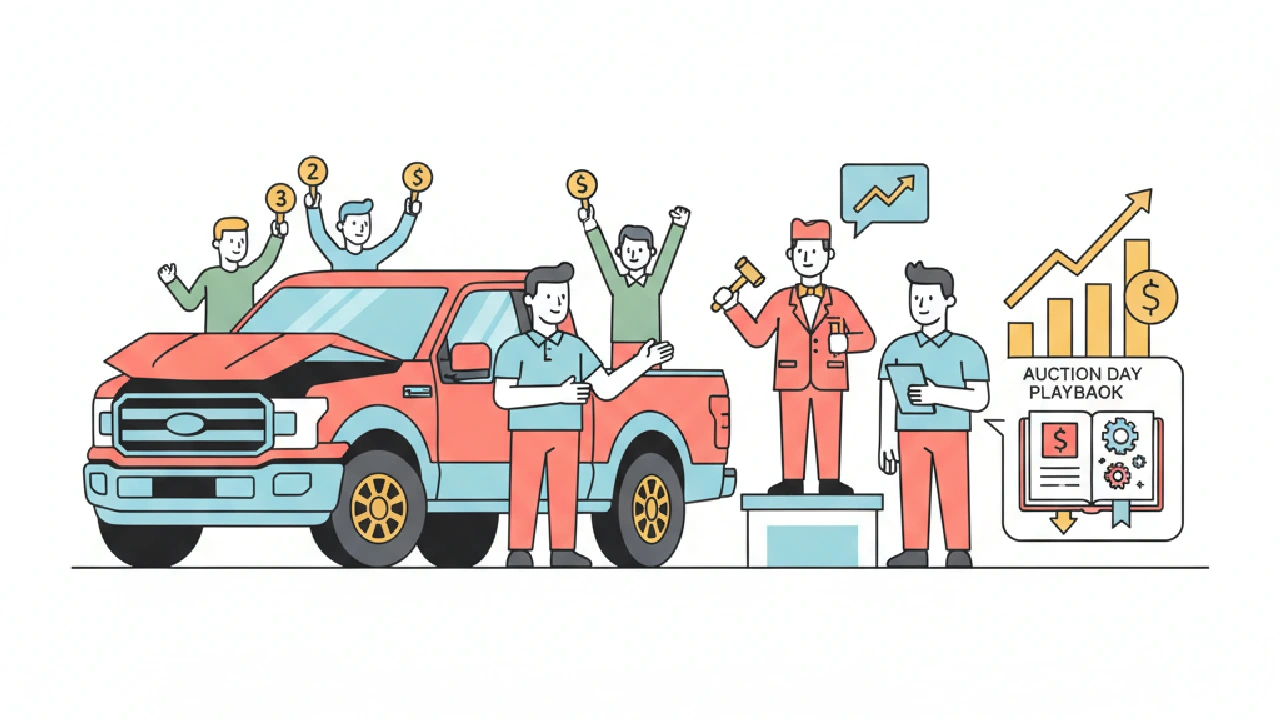
If you want salvage f150 flip profit, you need simple math, fast inspection habits, and a short repair plan before you ever click "bid." This is a briefing, not theory — read it like you're standing beside me before auction day.
The core idea — buy cheap, limit unknowns, sell clean
Flip the gap between what the truck will sell for once repaired (ARV) and what you pay + fix costs. That gap is your profit. Focus on F-150s with minor collision damage or cosmetic problems — analyze a salvage auction lot like a pro before you bid. Walk away from anything with clear frame, structural, or transmission flags unless you can accept zero margin.
1) Max-bid math — use the 70% rule and be literal
Do the numbers before the auction. A simple guardrail is the 70% rule: total investment (purchase + repairs + fees + transport + registration) should be under 70% of your expected resale value. That gives room for unexpected costs and a realistic net profit.
Concrete example: If a repaired F-150 ARV is $15,000, your total investment must stay under $10,500. Work backwards from $10,500 to your max bid after estimating repairs and fees. If your repairs and fees equal $4,000, max bid = $10,500 - $4,000 = $6,500. If you can’t estimate repairs confidently, pass on the truck.
Why 70%? It forces discipline. Auctions and salvage trucks hide small eats — consumables, odds-and-ends, detailing, and a part that wasn’t in the photos. If your math leaves zero cushion, someone else’s shop bill will eat your profit.
2) Title and structural risk — the traps that kill deals
Titles matter. Salvage title flipping: your briefing for auction day affects buyer pool and acceptable price. Know your state rules, but more important: know the physical risks tied to certain title brands.
Frame or unibody damage and transmission failure are common killers. Minor collision damage keeps profit potential, while catastrophic frame or transmission failure often erases margins. If auction notes or photos suggest a bent frame, popped subframe bolts, or major transmission issues, treat it as a loss unless you have a confirmed low-cost fix. Also be mindful of salvage title brands that kill your flip spread when evaluating resale pools.
Don’t assume "runs and drives" equals no structural work. A truck can start and still have hidden alignment and chassis issues that make it unsellable to retail buyers who expect a straight frame.
3) Repair plan and comps — be surgical with parts and radius
Before you bid, make a one-sheet repair plan. List parts, labor hours, and non-negotiables: safety items (brakes, tires), emissions/registration items, and the cosmetic fixes that move price. Price parts on the phone if you must. If the winplate shows a specific damaged corner, price that bumper, sensor, and light now.
Set your comp radius. For an F-150, buyers come from a wider area than cars. Use a broader comp radius for trucks — rural buyers will pay more for a truck they can drive home. That said, don't inflate ARV by pulling comps from a different market. Be honest about where you’ll sell: local private sale, wholesale, or dealer trade. If you need a step-by-step on comps, use salvage car comps to bid like a pro.
Spread matters: if auction trucks sell 20% to 40% below clean-title equivalents, that gap is where your profit can live. But that gap also compresses quickly in high-demand models; popular F-150s get competitive bids. Lock your ARV conservatively.
4) Auction tactics — bid smart, use proxies, watch fees
Proxy bidding prevents emotional overspend. Enter your max bid and step away. If you're on the phone, use a partner to call your max so you don't chase the lot in real time. For auctions like Copart, make sure you know how to set your Copart max bid without overpaying.
Estimate buyer fees, transport, and registration before max-bid math. Fees vary by auction and lot. If you don’t know fees, assume they’ll be material enough to shift your max bid downward. Same for transport — trucks often need flatbed or wheel-lift carriers; factor the cost and pickup timing into your cash flow.
Geography helps. Filter for lots in lower-competition zones when you can. If a vehicle lists in a major metro, expect more bidders; if it’s in a rural yard, you might have room. But don't buy a truck that creates a title problem for your state just to save on bids.
Mini-case: Run-through with numbers (practical)
Walk through a real bid. ARV estimated at $15,000. Known repairs: rear quarter panel and bumper, parts + labor estimated at $3,000. Auction buyer fees, transport, re-registration and small consumables you budget at $1,000. The 70% rule says total costs must stay under 70% of ARV.
- ARV: $15,000
- 70% threshold: $10,500
- Estimated repairs: $3,000
- Other fees/transport: $1,000
- Max bid = $10,500 - $3,000 - $1,000 = $6,500
- If you pay $6,500 and hit your repair estimate, expect to clear a profit margin after resale. If any number blows past estimate, you’re in trouble.
This is not glamorous math. It’s survival math. Don’t overcomplicate it.
5) Selling plan — clean truck wins buyers
Your resale strategy sets ARV. A truck sold locally, cleaned, detailed, photographed well, and listed with full repair receipts will net more than a sloppy, half-fixed unit. Spend time on photos of the engine bay, frame rails, and repair receipts. Buyers pay for certainty.
Be honest about the rebuilt/salvage history but sell the repair quality. If you can show a certified alignment, a receipt for a replaced subframe member, or a parts invoice for a quality OEM bumper, include those proofs. That narrows the discount buyers will demand.
Where a salvage flip tool helps
One quick way to avoid buying high-risk lots is to surface the red flags before you wire money. A risk-scoring feature (Risk Level Calculation) that uses sales history, title type, runs & drives, engine start, and insurance-seller signals helps highlight lots with prior "sold" history or problematic title brands so you can skip them.
- Use risk flags to filter out lots with repeated "sold" entries or junk/parts-only titles.
- Combine that with basic VIN/lot lookup so you don’t waste time on obviously bad units.
Analyze a lot free before you bid
Key takeaways
- Use the 70% rule: total cost must stay under 70% of expected resale value.
- Walk away from frame or transmission flags unless you have a verified low-cost fix.
- Create a one-sheet repair plan and price parts before you bid.
- Set your comp radius honestly; F-150 demand is broad, but market matters.
- Use proxy bids and factor in buyer fees, transport, and registration before calculating max bid.
FAQ
How much profit can I expect flipping a salvage F-150?
Profit varies by damage and market. Industry guidance suggests a typical net profit range if repairs are controlled and damage is minor. Use your ARV minus the 70% threshold math to estimate a conservative outcome.
When is a salvage F-150 not worth buying?
When photos or notes show frame damage, major structural repair, or transmission failure without a confirmed cheap repair. Also skip trucks where you can’t reasonably estimate repair costs before bidding.
How do I handle unknown hidden damage?
Build a cushion into your estimates. The 70% rule buys you that cushion. If you can’t get comfortable numbers on parts or labor, pass. Hidden damage is the trap that turns a good-looking bid into a loss.
Should I sell private or wholesale?
Private sales generally get higher dollars but require time, cleaning, and proof of repairs. Wholesale moves faster but at a lower price. Choose based on how quickly you want turnover and how confident you are in the repair quality and paperwork.
What's one last tip before auction day?
Write your max-bid on paper and stick to it. If a deal requires mental gymnastics at the auction, that’s a red flag. Big profits are built on disciplined math, not last-minute hunches.
Bring this to the lot. Use the one-sheet, run the 70% math, and don’t flirt with major structural issues. Profit is boring when done right; it’s loud and painful when it isn’t.