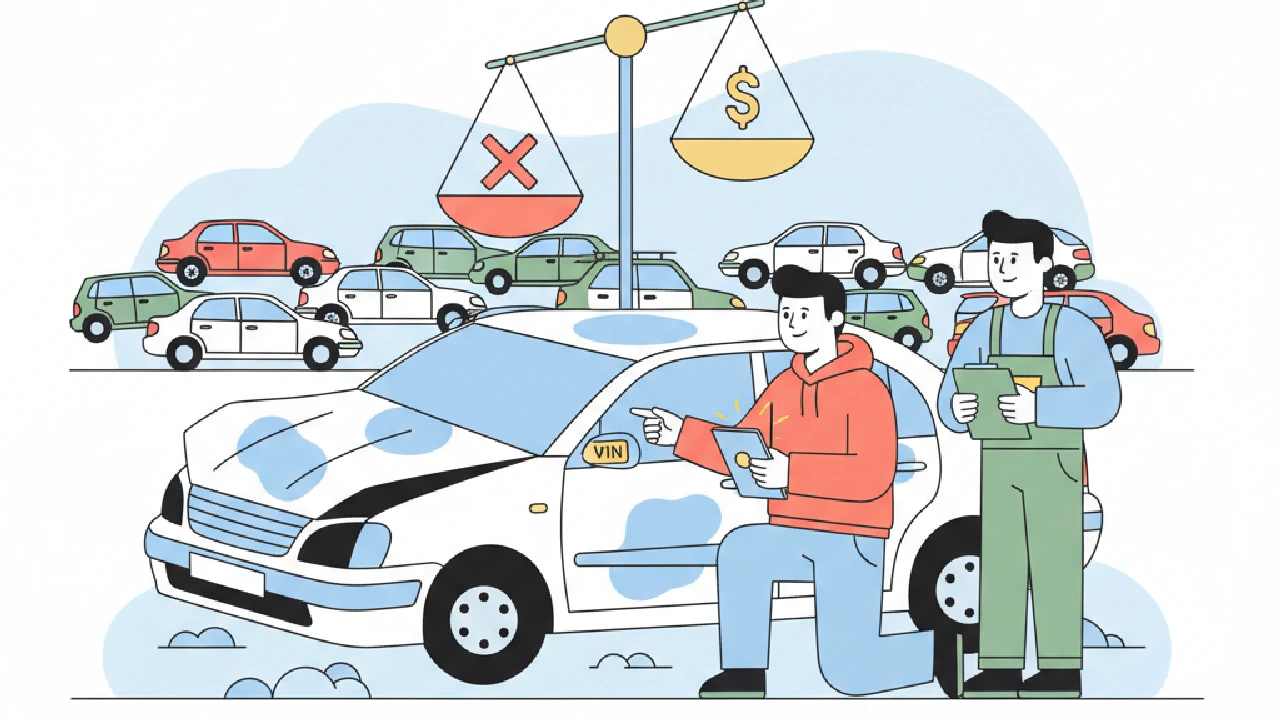
When to walk away salvage auction is the single question that keeps good flippers from losing money. I run Copart/IAAI lanes several times a week. Here’s how I decide before the hammer drops.
Core idea — the all-in ceiling
Don't buy on hope: use the "all-in cost" and a firm ceiling. All-in cost = bid + repairs + buyer fees + transport. The rule I live by: keep total investment at or below 70% of the vehicle’s expected clean-title resale value. If the numbers push past that, walk.
This is the decision engine. Everything else is detail work that either tightens your spread or blows it up.
Max-bid math — work backward before you bid
Set your ARV (expected clean-title resale value) using salvage car comps to set ARV. Then calculate your ceiling: Ceiling = 70% × ARV. You cannot let your all-in cross that line.
Do the simple subtraction in the aisle. Max bid = Ceiling − (repairs + buyer fees + transport). Make those line items realistic and conservative. Use firm numbers for fees and transport you actually pay, not optimistic guesses. For Copart-specific lots, follow a focused approach on how to set your Copart max bid without overpaying so platform quirks don’t erode your spread.
Why this works: the 70% ceiling gives you room for the unknowns. If repairs blow out, you still have a margin. If you ignore it, you end up emotionally topping out and losing the spread.
Mini-case: algebraic example — no made-up prices
Say your ARV is X. Ceiling = 0.7 × X. Your repair estimate is R, buyer fees and transport are F. Max bid = 0.7×X − (R + F). If that max bid is negative or zero, walk. If bidding would exceed that computed max, walk.
Keep your math visible on your phone or a notepad. Don’t let a bidding war erase the math.
Title and VIN traps — immediate walk triggers
Titles and VINs are binary risks. If something smells off, stop. Examples of immediate walk triggers:
- Seller won’t confirm salvage brand and VIN match the lot photos and paperwork.
- VIN appears altered or doesn't return a clear history when you run it.
- State rebuilt-title rules create uncertainty about whether you can legally retail the car. If you can’t verify rebuild eligibility quickly, walk.
If the dealer or seller refuses questions or stalls on paperwork, that’s not negotiation — it’s a title trap. Walk and move to the next car. For an auction-day primer on handling salvage titles during flipping, see a concise salvage title flipping auction briefing. Also learn to recognize title brands that destroy flip margins so you don’t buy a headwind.
If you’re unsure what a salvage title or rebuilt title actually means for resale, review a detailed explanation of salvage titles and how they affect resale.
Damage you can’t price reliably — walk immediately
Some damage categories wreck your ability to estimate repairs. These are automatic walk triggers unless you have a trusted shop and hard invoices.
- Flood damage — corrosion and electrical gremlins hide for months. Estimates are unreliable.
- Severe frame/structural damage — frame straightening or structural fixes can exceed the ranges operators quote; unexpected frame issues often destroy your margin. Frame work may exceed $5,000–$10,000 and still not restore factory tolerances.
- Complex electrical or airbag cascades where you can’t verify module and harness condition.
If any of those appear and you can’t inspect thoroughly or get a written, line-item estimate, walk. Do not buy to "see what it needs." That’s gambling, not flipping.
Repairs vs parts-out — know your exit before you bid
Decide up front whether you will repair and retail or parts-out. The two strategies have different walk rules.
If repairing to sell:
- Only chase cars with repair costs you can verify through shops you trust.
- Use the ceiling math. The ARV you modeled must be realistic for your market.
If parting out:
- Model salvage parts value conservatively. Buyer fees and transport eat into parts margins fast.
- Walk when projected parts revenue minus costs won’t beat your all-in floor. If the math is tight or speculative, skip it.
Don’t fall for “parts-only” sellers who misrepresent a running car as a parts candidate. If you can’t prove parts value in writing or with firm comps, walk. Before you bid, run through how to analyze a salvage auction lot before you bid so your exit is clear.
Auction behavior and soft signals — when emotion costs you
Bidding psychology kills good deals. Watch for these traps and be ready to walk:
- Bidding wars that push above your max. If you find yourself rationalizing bids with "I can do more work" or "I’ll get lucky," stop.
- Last-minute bidding by unknown accounts. If the lot becomes heated and the price moves past your calculated ceiling, walk.
- Selling notes like "starts" but the seller refuses inspection. A car that "starts" in a photo can hide transmission or driveline failure. If you can’t verify mechanical condition, walk.
There’s always another unit. Don’t let a single car wreck your weekly run sheet.
Concrete inspector checklist for auction day
Before you raise your paddle, confirm these items. If any fail, walk.
- VIN in photos matches title and auction listing.
- Title brand clearly described and consistent with state rules.
- Visible damage limited to areas you budgeted for (cosmetic, bumper, a door). If it looks structural or waterlogged, walk.
- Electrical systems and airbag status visibly consistent — no hanging modules, exposed harnesses, or soaked connectors.
- You have a reliable repair estimate or a concrete parts-value model on hand.
Mini-case: how to read spread without new numbers
Don’t need a price to see the pattern. Take a candidate and build the spread on paper: ARV = X, Ceiling = 0.7×X, Repairs = R, Fees+Transport = F. If Ceiling − (R + F) ≤ 0, walk. If you can’t narrow R and F to real invoices or recent bills from your vendor list, walk.
That algebra avoids invented numbers and keeps you disciplined.
Where a salvage flip tool helps
Buying high-risk lots because you missed title or sales-history red flags is a quick way to lose money. AutoFlip Pro’s Risk Level Calculation analyzes the sales history, title brand, runs & drives and engine-start entries, and insurance-seller signals so you can spot lots that should be walked before you wire funds. Use this to prioritize which auctions to chase and which to skip.
- Flags multiple prior “Sold” entries or a “Sold” + later “Active” history — common, serious red flags.
- Scores runs/drives, engine starts, and title brand to produce a Low / Medium / High risk level you can act on.
Analyze a lot free before you bid.
Key takeaways
- Use the all-in ceiling: never let bid + repairs + fees + transport exceed 70% of your ARV.
- Walk on flood, unverified frame damage, or complex electrical issues without written estimates.
- Set a hard max bid before the auction and stick to it. Emotional bidding kills margins.
- If title or VIN paperwork is unclear or the seller stonewalls, walk immediately.
- Decide repair vs parts-out ahead of time and model both conservatively.
FAQ
How strict should I be with the 70% rule?
Be strict. Treat 70% of ARV as a working ceiling, not a target. It’s protection against unseen costs. If a deal only works by squeezing below that number with optimistic repair figures, walk.
Are there ever exceptions to walking on frame damage?
Only with verified shop invoices and a trusted structural repair vendor. If the shop proves it can restore the unit for a fixed price and the all-in stays under your ceiling, consider it. Without that proof, walk.
What if the car "starts" but I can’t drive it before purchase?
"Starts" is not a warranty. If you can’t verify drivability or get a clear mechanical inspection, walk. Many sellers label cars as "starts" to hide deeper transmission or electrical faults.
When should I walk on a parts-out play?
Walk if parts pricing depends on optimistic assumptions or if you can’t inventory key high-dollar parts before bidding. If your parts model isn’t rock-solid, skip the lot.
What's the quickest single check that tells me to walk?
If your math shows Ceiling − (R + F) ≤ 0, walk. It’s clean, fast, and prevents emotional overbidding.
Actionable checklist — what to do right now
- Before auction day: list trusted repair vendors and get talk-time estimates for common jobs.
- Build an ARV sheet with local comps for each model you chase. Keep it on your phone.
- On auction day: compute Ceiling = 0.7×ARV before you bid. Calculate max bid = Ceiling − (R + F).
- If title, VIN, damage, or inspection access fails any check, walk immediately.
- Stick to your max bid. Log the lot and reasons for walking. You'll thank yourself next week.
Keep it simple. The job is to buy with a buffer, not to prove you can fix anything. Walk when the math or the title tells you to. Bring the next one.