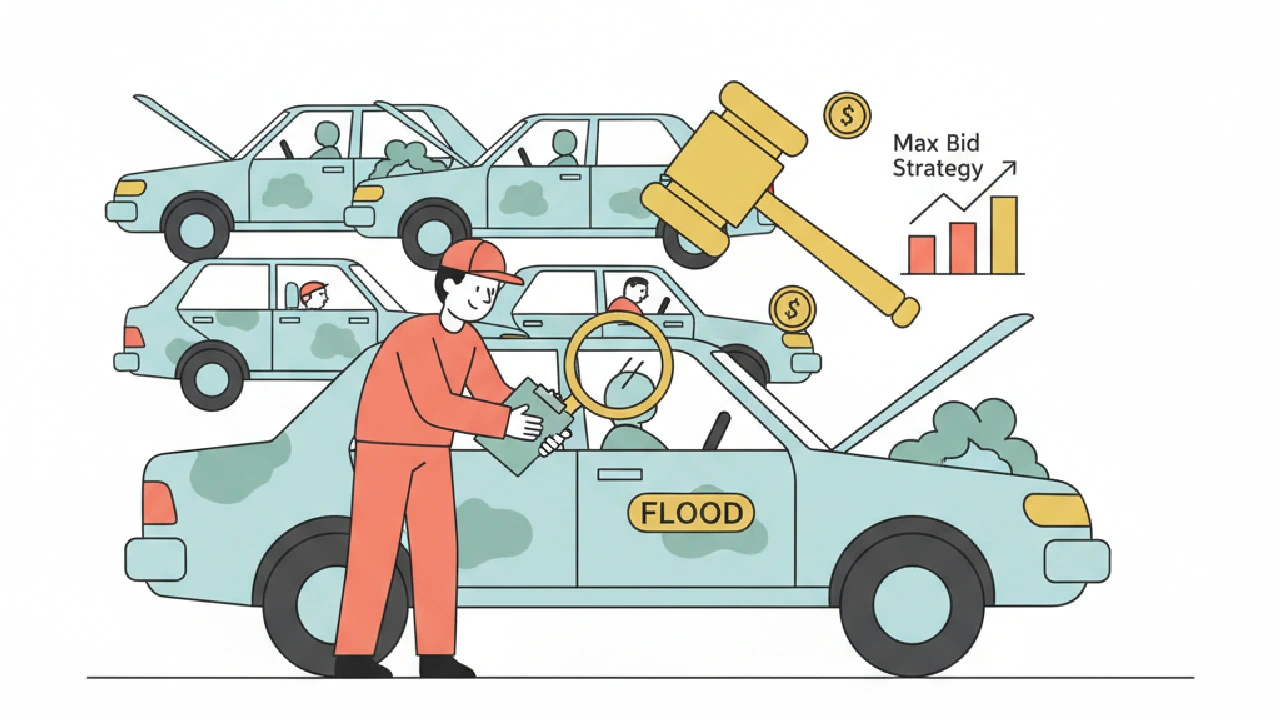
Start here: the flood title resale discount kills margins. If you don’t build that permanent hit into your max bid, you’ll lose money after repair fees and buyer costs. This post shows how to fold the flood title resale discount and auction-sale ratios into one quick max-bid formula. Read this before auction day.
Core idea — price the brand, not the damage
Flood branding is permanent. The market treats that label as a fixed discount to clean-title retail — typically 20–40% off what the same car would fetch with a clean title. You can’t engineer your way around that with cosmetics or a spotless engine bay. Factor that permanent haircut into your after-repair resale (ARV) before you ever set a max bid. Use an auction checklist to confirm flood damage repairability before you commit.
1) Read the market: auction sale ratios and what they imply
Know how salvage auctions clear. The market sells flood/salvage cars aggressively low. Industry data shows auctions often sell around 25.6% of ACV, with a buyer bid range roughly 19.7%–28.7% of ACV. That’s how dealers and volume buyers are pricing risk at wholesale. If you plan to flip, set your expectations to that reality first.
What this means in practice: you’re unlikely to buy an off-radar flood car at 50% of retail on auction. The room’s pricing will push you toward the low-20s of ACV. If your ARV (after flood discount and repairs) can’t clear a resale at least above that auction cost plus fees, don’t bid. For a recent view of those shifts, see the salvage auction market 2026 analysis.
2) The quick max-bid math (use these steps every time)
Keep it simple. Use four inputs:
- ACV (clean retail baseline — use comps)
- Flood title resale discount (20–40% off clean retail)
- Estimated repair and electrical risk (documented items + hidden risk)
- Auction-sale reality (buying into a 19.7%–28.7% of ACV range; auctions clear ~25.6% of ACV)
Step-by-step formula I use in the lane (plain language):
- Find clean retail via salvage car comps to find clean retail.
- Apply the flood title resale discount to get an ARV range (subtract 20–40%).
- Subtract known repair costs and leave a buffer for electrical/mold/corrosion issues.
- Subtract buyer fees, transport, and staging (estimate conservatively).
- Result = max cash you can pay at auction.
Then compare that max cash to auction reality: auctions clear in the 19.7%–28.7% of ACV range and often around 25.6% of ACV. If your max cash is below that market buy-in, walk away.
Mini-case: use the published ratios to test the spread
Work in percentages so you don’t invent dollar numbers at the lot. Start with a clean retail baseline of 100 (this is a unit placeholder).
- Auction sale average: ~25.6 of 100 (published auction clear rate).
- Flood-title resale after repair: 60–80 of 100 (because of the 20–40% permanent discount).
The gross theoretical spread before repairs and fees is 60–80 minus 25.6 = 34.4 to 54.4 points of margin. That looks OK on paper. But now subtract the real repair risk. Flooded engines alone can cost between $3,000–$8,000 to fix. You must convert that dollars-to-percent back against your clean retail baseline to see if that 34.4–54.4 point spread survives once repairs, buyer fees, transport, and warranty risk are in.
If after you carve out repairs and fees the spread goes under your minimum profit target, don’t bid. If the leftover spread is healthy, put a firm max bid into the lane and do not chase.
3) Title risk, disclosure, and resale friction
Title brands follow the car forever. Some states brand a car 'flood damaged' or 'salvage' based on repair cost rules. For example, a state rule flags a vehicle as flood damaged if repair costs exceed 70% of fair market value in certain conditions. Dealers and consumers will see the brand on every future title check.
Expect resale friction. Some buyers won’t buy flood-branded vehicles. Some insurers won’t write comprehensive coverage on branded cars. That shrinks your pool of buyers and lowers the ARV you can realistically get even after a clean rebuild. Account for that when you choose which cars to chase.
Verification steps I run before max-bid:
- Pull a salvage title history/NMVTIS report red flags guide to confirm brand and claim history.
- Ask for a detailed damage description and photos of interior moisture, under-dash, and trunk wells.
- Prefer lots with mechanic inspections that call out water contamination. If I can’t confirm electrical modules and airbag status, I cap my bid lower.
4) Repair surprises that blow your spread
Flood damage hides in the electrical systems and the cabin. Mold and corrosion show up later. Engine and transmission work can spike costs fast. You already know flooded engines alone can run $3,000–$8,000. Those are direct costs. The indirect costs — replacing wiring harnesses, control modules, and the HVAC evaporator — are the real killers because they’re often scattered across several repair invoices. See common salvage repair cost surprises to know what vendors bill separately.
Actionable approach at inspection:
- Look for muddy seals under carpets and silt in the spare well. Those tell you how deep water got.
- Inspect ADAS sensors, BCMs, and visible connectors for corrosion. If pictures are fuzzy, assume the worst.
- If the seller lists the engine as seized or hydrolocked, treat that as a heavy risk and double your repair buffer.
5) How I size my buffer and when I walk
I always build a larger buffer on flood cars than clean salvage. Why? Because the market penalty is permanent and insurance/consumer demand is lower. Use a repair buffer that reflects both documented damage and unknowns in the electrical system. If you can’t document electrical work costs, assume a material buffer is needed.
Rules I follow strictly:
- If the ARV after the 20–40% brand and known repairs can’t safely clear a buy at the 19.7%–28.7% auction range, do not bid.
- Never chase a car past your max bid. Flood cars attract emotional bids because they look cheap. Stick to math.
- Prefer cars where the flood report shows only lower-level intrusions (door sills, trunk) and no module or engine immersion.
Where a salvage flip tool helps
A max-bid tool that folds title discounts, transport, fees, repair estimates, and profit margin into one calculation saves you from emotional chasing. AutoFlip Pro’s Max Bid Calculator uses inputs like clean market value, title discount, transport cost, auction fees, repair cost, and risk adjustment — which maps directly to the flood-title resale discount problem and helps you see whether a lot still clears after all expenses.
- Use it to test whether your ARV (with a 20–40% flood haircut) still beats the auction buy band.
- Run a free lot test to see the numbers before you bid: analyze a Copart lot free before you bid.
Key takeaways
- Always price the flood title resale discount (20–40%) into ARV before bid.
- Use published auction-sale ratios (19.7%–28.7% of ACV; ~25.6% typical) as your market-buying band.
- Account for big repair risks — flooded engines ($3,000–$8,000) and electrical corrosion — before setting a max bid.
- Pull NMVTIS/title history and require clear interior photos; if you can’t verify, lower your max bid or walk.
FAQ
How permanent is the flood title resale discount?
The brand is permanent. The market applies a 20–40% discount to the car’s clean-title retail for every later sale. That’s the baseline hit you must accept when planning resale.
Can repairs get a flood car back to clean-title value?
No. Even thorough repairs don’t erase the brand. The resale penalty remains. Fixing the car can make it salable, but it won’t remove the 20–40% market haircut.
What auction price band should I expect when bidding?
Expect the market to price at roughly 19.7%–28.7% of ACV, with many sales clustering around 25.6% of ACV. Use that band to test your max bid math.
What inspection items matter most for flood cars?
Interior moisture evidence, silt in hidden wells, fogged lights, and visible corrosion on connectors and control modules. Documented engine or module immersion is a major red flag.
When should I walk away?
If your ARV after the 20–40% flood discount minus known repairs and a conservative repair buffer is less than the auction-market buy-in you’d need (the 19.7%–28.7% ACV band), walk. Don’t chase bargains that math can’t support.