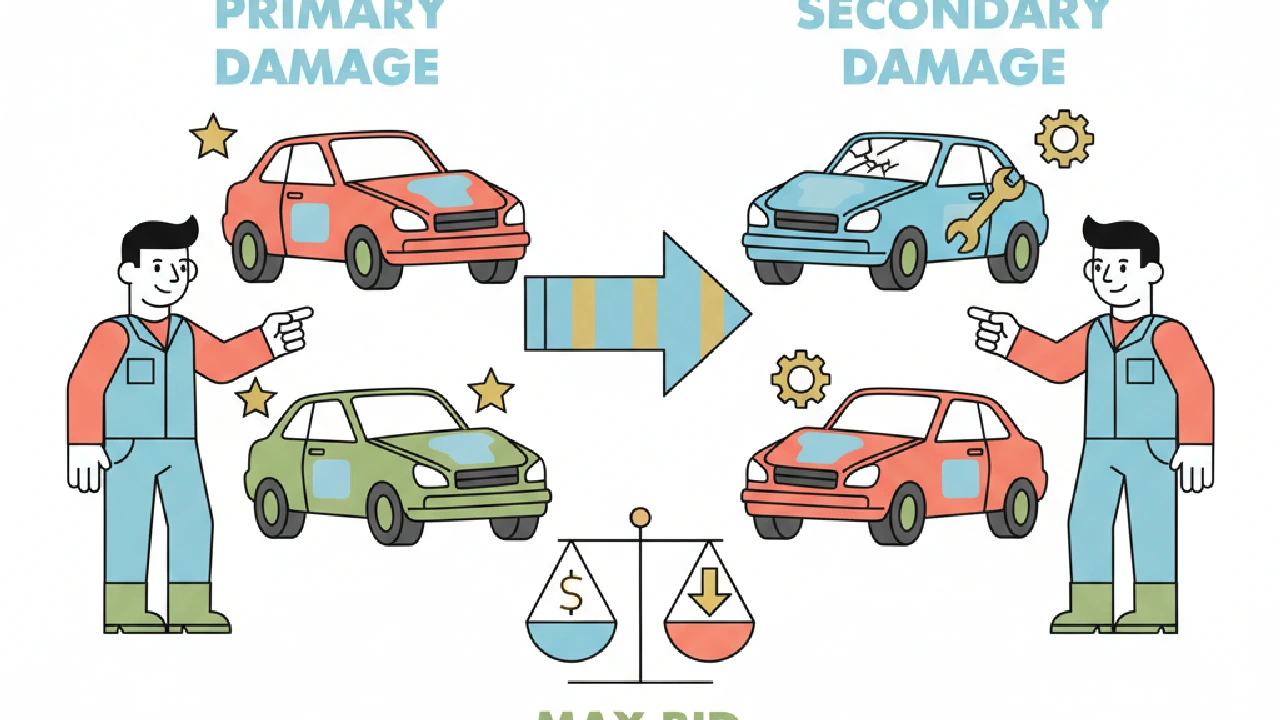
Copart's US glossary lists 26 damage codes, and every lot page shows two of them: Primary Damage and Secondary Damage. Copart says neither one carries more weight than the other. If you only price the first code, you are bidding on half the car.
Copart damage codes are a sorting tool, not a repair estimate. They tell you where to look in the photos and what to ask an inspector. They do not tell you what the fix costs, and Copart says so in writing.
Below: what each code means in Copart's own words, how to read primary vs secondary, and how to turn both into a max bid.
What Copart damage codes tell you, and what they don't
Copart describes damage codes as a way to "indicate known damage to the lot." On its US help pages, the codes sit under broad condition types. One of them is Minor to Heavy Damage, which Copart describes as a car that "has sustained noticeable damage like a collision and is either salvage titled or will require a lot of work to fix."
Copart lists Front End, Rear End, Side and All Over as subcategories of that type. So FR, RR, SD and AO only tell you where the hit was. They say nothing about how deep it went.
Here is Copart's disclaimer, word for word, from its glossary of common terms:
"These codes indicate known or reported damage only and are limited by nature. Copart expressly disclaims the accuracy of damage codes, as information may not accurately reflect the type or extent of damage to any vehicle. Damage codes may not be used or relied upon for bidding purposes or for any other reason. Copart strongly recommends that Members thoroughly inspect lots before purchase."
Copart is telling you the code can be wrong about the type and the extent of the damage. Use it to pick which photos to study, then verify before you set a number.
Primary vs secondary damage: Copart says they weigh the same
A lot of buyers treat the primary code as the real damage and the secondary code as a footnote. Copart's own wording says the opposite. Its glossary and its types of conditions page both say this:
"Damage codes are listed as Primary Damage and Secondary Damage (2nd). Both damage codes indicate significant information about the lot and any one code should not be interpreted to carry more significance than the other."
Copart Canada's glossary says the same thing in different words: "one code should not carry more significance than the other." Some buyer guides online call the primary code "major" and the secondary code "minor." Copart's own pages don't support that, so don't build your bid on it.
In practice, that means a lot showing FR primary and UN secondary has two problems to price, not one big one and one small one. You don't know which costs more until you look. Price both codes as if either one could be the expensive one.
All 26 Copart damage codes and what Copart says about each
Copart's US help pages publish the code and its label, and only a few codes get a written definition. Where the US site is silent, Copart's Middle East glossary sometimes adds a description. Those are marked below as non-US wording, so treat them as a guide, not as US policy.
| Code | Copart label | What Copart publishes |
|---|---|---|
| AO | All Over | US: a subcategory of Minor to Heavy Damage. Non-US: damage to more than one area of the vehicle. |
| BC | Biohazardous/Chemical | Non-US: chemical contamination to any area of the vehicle. |
| BE | Burn (engine) | US burn damage: "damaged by some form of fire." |
| BI | Burn (interior) | Non-US: fire damage to the interior or luggage bay, including wiring damage. |
| BN | Burn | US: "damaged by some form of fire." Non-US: extensive fire damage to most or all of the vehicle. |
| CC | Cash for Clunkers | Label only. |
| DH | Damage History | Label only. |
| FD | Frame Damage Reported | Label only on the US site. |
| FR | Front End | US: a subcategory of Minor to Heavy Damage. Non-US: damage from the A post forward. |
| HL | Hail | Non-US: damage to body panels from hailstones. |
| MC | Mechanical | Non-US: engine and gearbox damage, such as knocking, smoke, gears not engaging, oil leaks, or cracks. |
| MN | Minor Dents/Scratches | US: "minor damage like scratches on the paint, or a few dents from a hailstorm or a parking lot collision." |
| NW | Normal Wear | US: "This vehicle only has very minor damage." |
| PR | Partial/Incomplete Repair | Non-US: visible evidence of poor or incomplete repairs. |
| RJ | Rejected Repair | Non-US: visible evidence of previous poor quality repairs. |
| RO | Rollover | Non-US: panels including the roof clearly show signs of being rolled or flipped. |
| RR | Rear End | US: a subcategory of Minor to Heavy Damage. Non-US: includes rear quarter panels and boot floor. |
| SD | Side | US: a subcategory of Minor to Heavy Damage. Non-US: either side, including front wings and rear quarters. |
| ST | Stripped | US: "Parts have been stripped off this vehicle," such as wheels, tires, doors, mirrors, hood and trunk. |
| TP | Top/Roof | Non-US: visible damage to the roof, door tops or tailgate top. |
| UK | Unknown | No definition published. |
| UN | Undercarriage | Non-US: damage to any part of the underside, including suspension, exhaust and fuel tank. |
| VI | Missing/Altered VIN | Non-US: VIN missing, altered or restamped. |
| VN | Vandalism | Non-US: overall, relatively light damage, including theft related damage to locks and ignition wiring. |
| VP | Replaced VIN | Label only on the US site. |
| WA | Water/Flood | US: "Some portion of this vehicle was submerged in water." |
Notice what is missing. There is no Copart code for theft recovery, electrical, or transmission, so don't assume a lot is clean of those just because no code says so.
Location codes: FR, RR, SD, AO, TP and UN
These tell you where the damage was reported, not how far it goes. Copart's lot page gives you 10 photos from multiple angles, so start there. Look at panel gaps, wheel position in the arch, and anything bent underneath.
For UN, check whether the lot has an undercarriage photo, which Copart describes as a detailed image of the underside. If you can't see it, you can't price it, so inspect or pass. For what to look for in the photo set, see our guide to reading frame damage in Copart photos.
FD is Frame Damage Reported, not flood
FD stands for Frame Damage Reported on Copart's US list. Flood is WA. Mixing them up is an easy mistake when you're scrolling a run list fast.
The word "reported" matters. Copart is passing along what it was told, and the disclaimer above still applies, so an FD lot needs a frame check before you bid.
Water and fire: WA, BN, BE and BI
Copart's US definition of WA covers a wide range, from water just reaching the floorboards to a fully submerged car. Copart also says it will often treat these cars "to extract water and attempt to prevent mold, fungus and bad odors."
That treatment is about smell and mold. It tells you nothing about wiring or modules. Before you bid on a WA lot, run through our flood damage repairable checklist.
Burn codes come in three flavors: BN for the vehicle, BE for the engine bay, and BI for the interior. Copart's US page describes burn damage only as damage "by some form of fire," so the photos have to tell you the rest.
Paper and identity codes: VI, VP, DH, PR, RJ, ST, CC and UK
These codes point at the car's history or identity more than at a dent. VI and VP flag VIN problems, so check what your state requires for that car before you bid.
PR and RJ suggest someone already worked on the car, and ST means parts are gone. UK means Copart doesn't know. Treat UK as a reason to inspect, not as good news.
Light codes: MN, NW and HL
Copart describes MN as minor scratches or a few dents, and NW as "very minor damage." A light primary code paired with a heavy secondary code is still a heavy car.
The lot fields that matter as much as the code
The damage code is one line on a page full of fields. Several of the others change your max bid just as much, and Copart puts disclaimers on most of them.
Run and Drive. Per Copart's vehicle icons page, the car started (on its own or with a jump box), went into gear, and moved forward at the time of inventory. Copart says that is "not a guarantee" for sale or pickup, as our guide to what Run and Drive means on Copart explains.
Engine Start Program. Copart verified only that the car started and ran at idle when it arrived, with no guarantee at sale or pickup.
Keys. Copart defines this as "whether Copart is in possession of the keys to the vehicle." A missing key is its own cost line, covered in our Copart no keys breakdown.
Estimated Retail Value. This is the seller's number, and for a damaged lot it is "the value prior to the occurrence of the damage." Copart "makes no representations as to the validity or accuracy of the listed value," so build your own resale comps.
Title type. Copart says a salvage title is "usually issued when an insurance company has declared a vehicle a total loss," and that "most states require a license to purchase vehicles of each type of title." Check your state before you bid, not after.
Read the damage code, then every field next to it. Each one can change what you can afford to pay.
How Copart damage codes feed your max bid
Copart and IAA publish no repair costs per damage code. Any article that tells you FR costs a set dollar amount is guessing. Your repair number has to come from the photos, an inspection, and your own shop's prices.
Start with the max bid formula: resale value, minus repairs, minus auction fees, minus transport, minus the profit you need. The damage codes only touch the repair line, but they decide how sure you can be about it.
Hypothetical example. Say a lot shows FR primary and UN secondary, and the photos show the front clearly but not the underside. You can price the front from the photos, but not the underside, so either pay for an inspection or leave room in your repair line for work you can't see yet.
What you should not do is price the front, call the UN "minor," and bid. Copart's wording says the second code matters just as much. For building the repair line itself, our pre-bid repair estimate guide walks through it.
A free scan on AutoFlip Pro pulls the lot details, photos and VIN decode, and shows a market value and an AI max bid inside an editable Max Bid Calculator. You type in your own repair number, so the bid reflects what you found in both damage codes, not a generic guess.
Inspect before you bid: what Copart and IAA offer
Copart's terminology page says it is "the Member's sole responsibility to ascertain, confirm, research, inspect and/or investigate the vehicle prior to bidding on it." Once the car leaves Copart's premises, you accept it "as is."
Copart lists your options on its learn more about a vehicle page. You can order a Copart Vehicle Inspection Report with "extra photos, at least two videos," use a third party report, hire your own inspector, or inspect the car yourself Monday through Friday during normal business hours at the yard where it's stored.
IAA is just as blunt. Its auction rules say a general statement like "front end damage" or "rear end damage" is "not intended to be inclusive or exhaustive of all of the damage the vehicle has suffered." Buyers agree not to rely on IAA's damage type, estimated repair cost, or whether the car starts or runs.
IAA also uses different start codes from Copart. Its Run & Drive check adds reverse gear and a full steering turn each way, which is covered in our IAAI start codes comparison. IAA's Vehicle Score rates damage on a 0 to 50 scale, but it is a subscription feature for paid, registered buyers only.
Before you bid on a coded Copart lot, check this
We've seen flips where the buyer read the primary code, liked the photos, and only found the secondary damage after pickup. The bid was fine for one problem and wrong for two. Run this list first.
You priced both the primary and the secondary code, not just the first one.
You checked FD against WA so you know whether it's frame or flood.
You went through all 10 photos for the areas both codes point to.
You have a plan for anything the photos can't show, like the underside on a UN lot.
You know what Run and Drive or Engine Start actually verified, and when.
Your resale number comes from your own comps, not the seller's Estimated Retail Value.
Your state lets you buy and retitle that title type with the license you hold.
When you have a lot number in hand, run a free Copart lot analysis before you bid, then plug in the repair number you built from both codes. For the full pre-bid workflow, see how to analyze a Copart or IAAI lot.
Key takeaways
Price the secondary damage code as seriously as the primary, because Copart says neither carries more weight.
Use damage codes to pick which photos to study, never as a repair estimate.
Read FD as Frame Damage Reported and WA as Water/Flood, and inspect both before bidding.
Check Run and Drive, Keys, title type and Estimated Retail Value next to the code before you set a number.
Inspect, or pay for an inspection report, whenever a code points at damage the photos can't show.
FAQ
Is primary damage worse than secondary damage on Copart?
Not by Copart's own definition. Copart says both codes indicate significant information and that neither should be read as more important than the other.
How many damage codes does Copart use?
Copart's US glossary lists 26 codes, from AO (All Over) to WA (Water/Flood). Most have only a label on the US site, with no written definition.
What does FD mean on a Copart listing?
FD means Frame Damage Reported. It is not a flood code; flood and water damage show up as WA.
Can I trust a Copart damage code when setting my bid?
Copart says you can't. Its glossary states that damage codes "may not be used or relied upon for bidding purposes" and recommends inspecting lots before you buy.